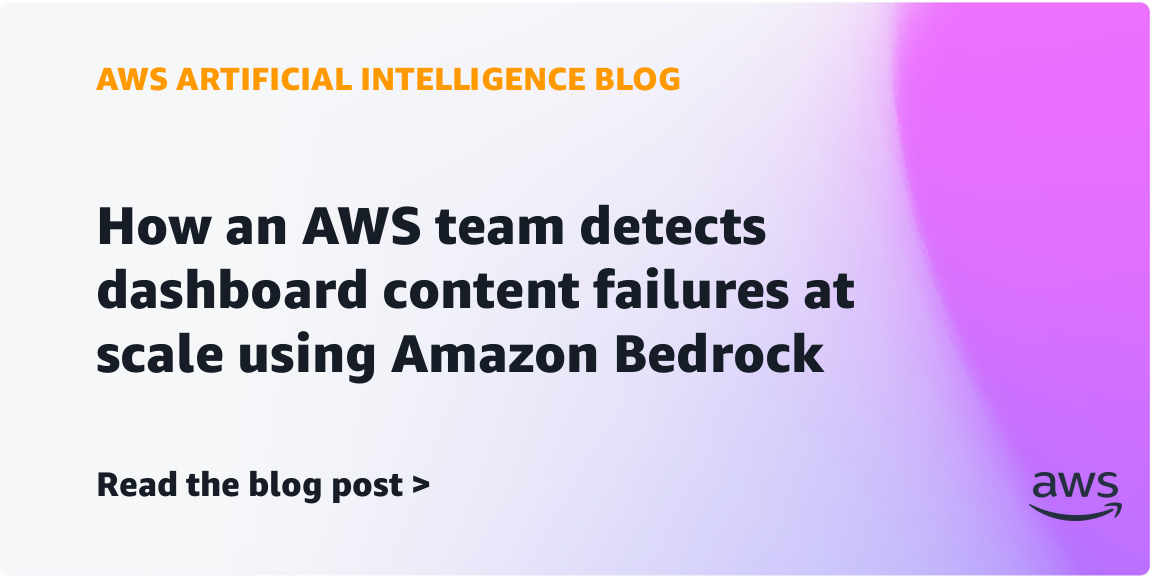
AWS built an AI system to catch dashboard content failures.
It scans hundreds of dashboards for blank or wrong data.
Detection time dropped from 72 hours to under 1 hour.
What happened
An AWS team built an AI-powered content validation system that scans hundreds of dashboards on the AWS Insights application (powered by Amazon Quick) to catch missing or incorrect elements. It uses Anthropic Claude models on Amazon Bedrock to visually analyze screenshots and alert owners via Slack when issues are found.
Why it matters
Traditional monitoring misses silent failures that only appear in what users see, such as blank charts or wrong numbers. Over 30 days, the system detected 802 content failure instances, and fewer than 1 percent had a user report. The solution reduced mean time to detection from up to 72 hours to less than 1 hour.
What to watch
The system uses two parallel validation methods: one for visual integrity and one for numeric consistency. When a visual failure is confirmed, owners get a Slack notification with the affected section name, a screenshot, an AI confidence score, and a link to the monitoring dashboard.
Ask the AI about this article →
The article highlights a common blind spot in business intelligence: infrastructure can be healthy while the content users see is broken. This gap arises from silent visual failures and numeric inconsistencies that escape both endpoint monitoring and data-layer checks. The proposed solution supplements, rather than replaces, existing monitoring by adding a semantic layer that judges what appears on screen.
The design deliberately splits responsibilities: AI models handle tasks requiring semantic understanding, like recognizing a dashboard section or interpreting a chart, while deterministic code makes numeric verdicts. This separation emerged from production lessons where LLM comparison logic proved inconsistent, prompting a shift to programmatic comparison for precision. The result improved recall from 0.88 to 0.95 by reducing false alarms.
For any organization relying on dashboards to drive decisions, the takeaway is that automated detection can transform response times from days to an hour. The solution’s success suggests a broader trend: using AI not just to generate insights but to verify the data feeding them, ensuring accuracy before information reaches executives.
For example, today's edition would include:
AI-summarized, only the topics you pick — one digest a day via Email, Slack, or Discord.
Free · takes 30 seconds · unsubscribe anytimeWhat is AIToday? →
Ask AI anything about this article. Q&As are published on this page for other readers too.
Interactive Brokers has begun connecting its platform with AI tools including ChatGPT, Claude, and Grok, and o…
A new report by Alipay+ and S&P Global, based on a survey of 6,000 consumers across nine markets in Asia, Euro…

CrowdStrike Holdings Inc

Palo Alto Networks beat fiscal fourth-quarter estimates on Tuesday and issued a strong outlook for its new fis…

Google has reportedly approached major studios such as Disney, Warner Bros

Paradium.AI, Inc. statistics have been updated on TradingView for the stock ticker AMEX:PAAI