What happened
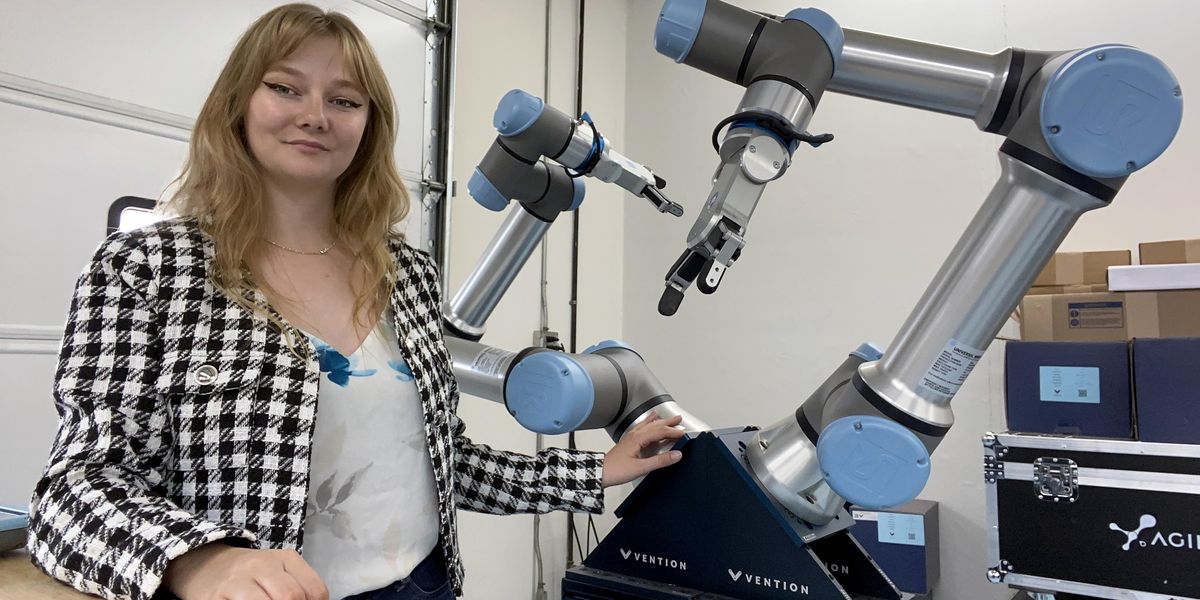
Sarah Downs, now a Ph.D. student in electrical engineering at Texas A&M University, developed an algorithm for a robotic arm that performs satellite assembly in space by sensing force and torque rather than using cameras. The robot solves the classic peg-in-hole problem—inserting an antenna into the correct opening on a satellite—without visual guidance, a capability she demonstrated as part of a master's degree project completed in collaboration with NASA and the U.S. Air Force.
Why it matters
In the harsh environment of outer space, camera systems can malfunction or experience communication delays. Downs's force-based insertion approach using torque sensors allows the robot to "feel" its way through assembly tasks, making it more reliable for satellite construction and maintenance in orbit. The work addresses a fundamental challenge in robotics: enabling machines to manipulate objects in extreme environments where traditional sensors fail.
What to watch
Downs is completing her doctoral thesis on the project at Texas A&M's Robotics and Automation Design Lab, which collaborates with NASA. Her thesis advisor is Robert Ambrose, a NASA veteran who launched the lab in 2022. After earning her Ph.D., Downs says she hopes to work for NASA, developing rovers that collect samples from Mars or robotic arms that perform tasks on space stations.
Summaries like this, in your inbox every morning.
Sarah Downs's career path reflects a deliberate blend of passion and pragmatism. Inspired in her teens by NASA's Mars rovers, she pursued robotics with the understanding that it could provide both intellectual fulfillment and financial security for her family—a priority that crystallized after her father's death in 2015. Her engineering education followed a structured trajectory: she participated in First Lego League and First Robotics as a teenager, completed a dual-enrollment program at Tulsa Tech while in high school, and then pursued electrical engineering at the University of Tulsa, drawn to small systems and electrical components.
Her graduate work demonstrates how robotics problems are often constrained by harsh physical realities. The peg-in-hole task—inserting an antenna into a satellite opening—is conceptually simple but becomes extraordinarily complex in the zero-gravity environment of space, where even small forces from a robotic arm can cause the satellite to drift. By eliminating dependence on cameras, which are vulnerable to malfunction and communication delays in orbit, Downs's force-sensing approach addresses a genuine operational gap. Her work at Texas A&M's Robotics and Automation Design Lab, which specializes in machines for extreme environments and collaborates with NASA, positions her within a research ecosystem directly aligned with her stated goal of eventually working on Mars rovers and space station robotic systems.
Pick your industry and the AI tools you use, and get news related to your work every day.
Free · 30 seconds with Google · unsubscribe anytimeWhat is AIToday? →
Ask AI anything about this article. The AI reads this article, earlier AIToday articles, and Wikipedia, and cites its sources. Q&As are published on this page for other readers too.
A non-engineer operator says one person ships four smartphone apps on Google Play, three on the App Store, wit…

A developer released agent-guardrails, a one-script Python standard-library plugin that guards Bash, Write, Ed…
The walkthrough points the CLI at a local mock via the ANTHROPIC_BASE_URL environment variable
A Zenn guide explains systems to install before letting AI agents, bots or scheduled jobs post, send, publish…
Skild AI used Nvidia Isaac Sim to give its S1 model one objective — score a goal — and let it compete against…
Yamazaki Mazak and ABEJA said on the 16th they will start joint development of physical AI, using ABEJA's ABEJ…