What happened
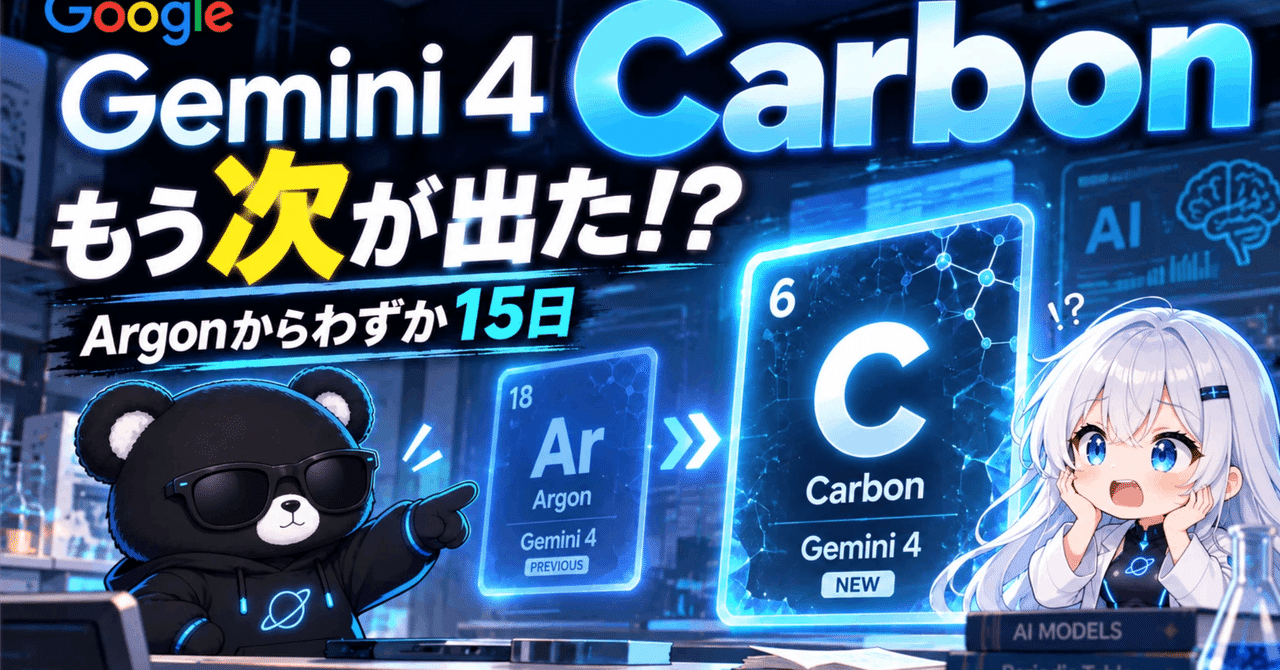
Google announced Gemini 4 Carbon on October 28, 2026, 15 days after Gemini 4 Argon reached the Gemini app on October 13. Carbon scored 59 points on the Artificial Analysis Intelligence Index v5.0 versus Argon's 50, and Google says it led at announcement.
Why it matters
A higher index score means Carbon is positioned as a step up in capability from Argon, which reached the Gemini app only 15 days earlier. That pace suggests Google is shipping new frontier models faster, though the score is Google's own reported result.
WHO IT HITSDevelopers and enterprise teams evaluating Google's Gemini models will see a faster release cadence and a higher-scoring option, but immediate access is limited to select cyber-defense personnel, so most will have to wait for staged rollout.
Summaries like this, every morning.
Gemini 4 Carbon arrives only 15 days after Gemini 4 Argon became available in the Gemini app, a cadence that stands out even by the fast-moving standards of frontier AI releases. Google is positioning Carbon less as a chatbot upgrade and more as a model built for extended autonomous work: coding, cyber defense, and tasks that run over days. That shift shows up in the evaluation Google chose to highlight, the Artificial Analysis Intelligence Index v5.0, where Carbon scored 59 points against Argon's 50. Alongside raw capability, Google says its internal testing found Carbon made about half as many unfounded claims as Argon and produced roughly 80% fewer serious alignment warnings — a nod to the reliability concerns that grow as agents are trusted with longer, less supervised tasks. Those figures come from Google's own assessments, and the announcement does not claim they will translate directly to real-world use. Access is another open question: at announcement Carbon was limited to select cyber-defense personnel, with broader rollout to developers, enterprises, and general users to come in stages, and no general-availability date had been set as of October 29, 2026. The naming — Argon, then Carbon, both chemical elements — drew notice, but Google's announcement did not explain the reasoning behind it.
Pick your industry and the AI tools you use, and get news related to your work every day.
Free · 30 seconds with Google · unsubscribe anytimeWhat is AIToday? →
Ask AI anything about this article. The AI reads this article, earlier AIToday articles, and Wikipedia, and cites its sources. Q&As are published on this page for other readers too.
Keithen Drury made the bull case for Taiwan Semiconductor, citing its 72.5% share of global chip foundry reven…
Andrej Karpathy used Claude's Opus 5.5 to filter 43 million Hacker News comments into 6,454 curated videos, th…

A 2017 paper titled "Attention Is All You Need" proposed the Transformer model, which prioritizes the importan…

A new Mac mini owner with an M5 Pro (base CPU config) and 48GB of unified memory asked which models and quanti…

Hao Fei's sole-authored 59-page paper, submitted to arXiv on November 3, 2026, argues the push toward artifici…

Lumen Technologies expanded its collaboration with Microsoft, wiring its cloud networking and application conn…