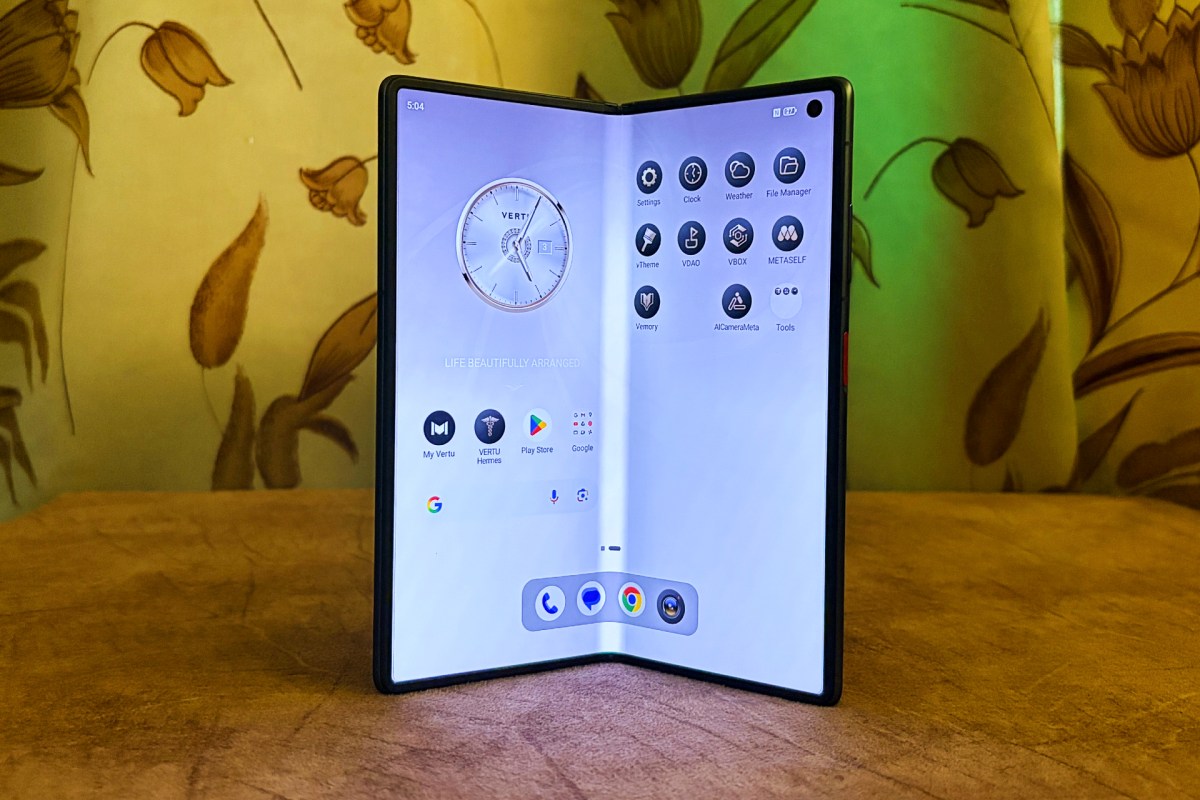
Vertu has launched the Alphafold, a $6,880 luxury foldable smartphone targeting affluent executives, centered on Hermes Agent—an AI assistant designed to automate business workflows across multiple apps. Testing revealed the AI shows promise in autonomous task execution and local file analysis but remains unfinished: it sometimes forgets document context, produces incorrect outputs like wrong reminder times, and occasionally hands off tasks incomplete. The device is built on ZTE/Nubia hardware but dressed in calfskin leather and titanium; security and data privacy claims are core to Vertu's pitch to enterprises, though they couldn't be independently verified.
Summaries like this, in your inbox every morning.
Sign up free →What happened
Vertu released the Alphafold, a $6,880 luxury foldable phone targeting executives, built on ZTE/Nubia hardware but wrapped in calfskin leather and titanium. At its center is Hermes Agent, a pre-installed AI designed to automate multi-step workflows like analyzing spreadsheets, managing schedules, and planning trips—areas where it outpaced Samsung's Gemini in willingness to act autonomously.
Why it matters
For executives, the pitch is an AI assistant that functions like a digital companion rather than just a chatbot. However, testing revealed Hermes remains unfinished: it sometimes delivers incomplete workflows, forgets document context days later (unlike Gemini), and occasionally produces wrong outputs—such as setting a 15-minute reminder for 9:08 p.m. instead of the requested time. Vertu has added specialist agents for legal and investment advice plus a human concierge escalation path, but the company itself notes responses should be independently verified before relying on them for high-stakes decisions.
What to watch
Security claims are central to Vertu's enterprise pitch—the company says Hermes conversations are encrypted, not used to train public models, and can run on private infrastructure. However, these protections couldn't be independently verified during testing. The Alphafold lacks wireless charging and is noticeably heavier (264 grams vs. Samsung's Galaxy Z Fold 7 at 215 grams), and Vertu continues rolling out server-side fixes, suggesting the AI experience will evolve over time.
The Alphafold arrives not as a smartphone box but as a luxury presentation case, with neatly arranged drawers containing a leather sleeve, charging cables, and accessories. The review unit came wrapped in genuine calfskin leather with titanium accents, weighing 264 grams—noticeably heavier than Samsung's Galaxy Z Fold 7 at 215 grams. The curved frame of the Alphafold makes it easier to unfold than the Galaxy Z Fold 7's flatter edges, though Samsung's design is sleeker and more comfortable to hold when folded for one-handed use. The Alphafold starts at $6,880.
Beneath the premium materials, the device shares striking similarities with the $1,100 ZTE Nubia Fold, from hinge design and dimensions to speaker and microphone placement. System information revealed ZTE identifiers in parts of the software. When asked, Vertu confirmed that the Alphafold was developed through a specialist supply-chain partnership with ZTE/Nubia for hardware platform, component integration, and production engineering, while Vertu handled luxury materials, software, quality control, and after-sales service. This approach is not new for Vertu; a 2023 Wired review of the MetaVertu found it appeared to be based on a ZTE Nubia device.
The real bet, however, is not the hardware but Hermes Agent—a pre-installed AI designed to analyze files, automate tasks across apps, remember conversations, and hand off requests to a human concierge. Testing revealed a more nuanced picture than Vertu's claims suggest. When asked to message a contact, navigate to the airport, switch to Do Not Disturb, and set a 15-minute reminder before a flight, Hermes sent the message, enabled Do Not Disturb, and opened Google Maps—but did not automatically begin navigation and set the reminder for 9:08 p.m. instead of 15 minutes later (the request was made at 2:32 a.m.). Running the same request on Samsung's Galaxy Z Fold 7 with Gemini produced a different result: Gemini asked follow-up questions (which airport, which reminder app) before proceeding, ultimately creating the reminder for the correct time. Hermes was more autonomous but less accurate; Gemini was more cautious but more precise.
In a second test, Hermes was asked to plan a business trip from Mumbai to Pune with a morning flight, hotel recommendation, and calendar entry. The agent found no direct morning flights and offered a Contact Butler button to escalate to Vertu's concierge, while also creating a calendar entry for 7 July instead of the requested dates of 18–19 July. Gemini, by contrast, continued planning by suggesting alternative travel options rather than handing off the task. When analyzing a locally saved financial spreadsheet, Hermes correctly summarized Q2 figures during initial testing. Days later, it no longer recognized the previously shared document and asked for it to be uploaded again. Gemini also required initial upload but retained context days later, still able to answer follow-up questions about the document and correctly identify the North region as generating the highest sales.
Vertu has built specialist AI agents focused on legal advice and investment insights, plus the option to escalate to a human concierge. However, the company itself notes that specialist-agent responses are AI-generated and should be independently verified before being relied upon for legal, financial, or other high-stakes decisions. Vertu also demonstrated an integrated enterprise resource planning system for accessing business data and workflows, though testing was limited to a demonstration environment. For security, Vertu says Hermes conversations are encrypted and not used to train public AI models, and users can choose where data is processed—with enterprise deployments supporting private infrastructure. The company backs these claims with a dedicated "A5" security chip for hardware-level protection, though these claims could not be independently verified during testing. The battery comfortably lasted more than a day during testing, but the device lacks wireless charging.
Vertu's strategy represents a deliberate fork from mainstream smartphone competition. While Samsung, Apple, and others race to pack AI features into mass-market devices, Vertu has chosen to build a luxury object for the ultra-wealthy—one where the phone itself is secondary to the AI agent bundled inside. The Alphafold is not pitched as a better foldable; it is pitched as a tool for executives, bundled with a concierge service and specialist advice agents (legal, investment) designed to augment rather than replace human judgment.
The partnership with ZTE/Nubia reveals practical limits to Vertu's positioning. Rather than design bespoke hardware, Vertu adapted an existing platform and added leather and premium materials—a approach that worked for previous models like the MetaVertu and continues here. What makes the Alphafold different is not the hardware but the software: Hermes Agent is built in-house and designed around real multi-step business workflows. During testing, this ambition was evident in Hermes's willingness to act autonomously across apps, a capability that outpaced Gemini in specific scenarios. Yet that same autonomy also produced errors—incorrect reminder times, forgotten context—suggesting the agent is still being refined. The company's active deployment of server-side fixes during the review period underscores that the experience is a moving target.
AI-summarized, only the topics you pick — one digest a day via Email, Slack, or Discord.
Free · takes 30 seconds · unsubscribe anytime
No comments yet. Be the first to share your thoughts!
Log in to join the discussion



Get curated AI news from 200+ sources delivered daily to your inbox. Free to use.
Get Started FreeFree · takes 30 seconds · unsubscribe anytime
1 minute a day. The AI essentials.
200+ sources · Email / LINE / Slack
