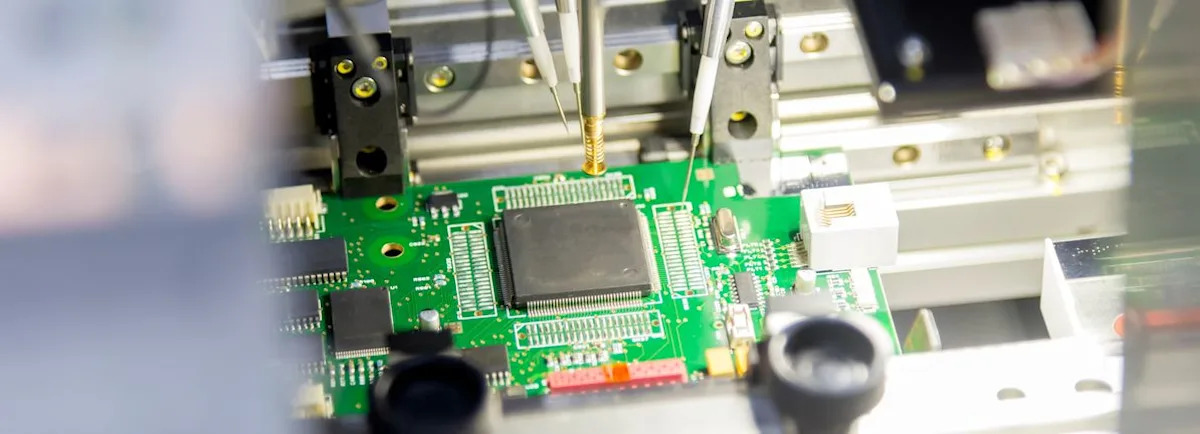
Amkor Technology has announced a multi-year $1.5b partnership with Nvidia to expand advanced semiconductor packaging and testing capacity in the U.S., backed by a sizeable prepayment. The stock is up 51.35% year to date and has returned more than 3x over one year, though it has fallen 21.5% in the past month. Analyst consensus values the stock at $92 per share versus the current price near $65, suggesting upside if Amkor's manufacturing lead and earnings growth materialize as projected.
Summaries like this, in your inbox every morning.
Sign up free →What happened
Amkor Technology announced a multi-year, $1.5b partnership with Nvidia that includes a sizeable prepayment to expand Amkor's advanced semiconductor packaging and testing capacity in the U.S. Over the past 30 days the stock is down 21.5%, but year to date it is up 51.35% and the 1 year total shareholder return is more than 3x.
Why it matters
The deal signals Nvidia's confidence in Amkor's manufacturing capabilities at a time when advanced chip packaging and testing are critical bottlenecks in AI hardware production. Amkor's revenue stands at $7.1b and net income at $436.1m, and the partnership could deepen ties to both fabless and foundry partners—positioning Amkor to secure new design wins and contracts that drive multi-year growth.
What to watch
The most-followed analyst narrative pegs Amkor's fair value at $92 per share (against a last close of $64.96), framing the stock as materially discounted if that view holds. That valuation assumes faster ramps in advanced packaging and testing, higher profitability over time, and uses an 11.49% discount rate to project long-range cash flows—assumptions investors should test against their own expectations.
Amkor Technology, a leading semiconductor packaging and testing services provider, has announced a multi-year, $1.5b partnership with Nvidia that includes a sizeable prepayment designed to expand Amkor's advanced semiconductor packaging and testing capacity in the United States. The deal underscores Nvidia's reliance on specialized outsourced manufacturers to handle the complex backend operations required for high-performance AI chips, as the demand for advanced packaging and testing has become a critical constraint in the broader AI hardware buildout.
Amkor's stock has experienced volatile trading in recent weeks. Over the past 30 days the share price has fallen 21.5%, and over 90 days it is down 16.8%. However, the longer-term picture is substantially more bullish: year to date the stock is up 51.35%, and the 1 year total shareholder return exceeds 3x. This divergence—short-term weakness against sustained long-term strength—has prompted investors to reassess whether the Nvidia partnership headline and broader growth prospects have already been fully reflected in the stock price.
Amkor's financial position reflects the scale of its operations: the company reported $7.1b in revenue and $436.1m in net income. The most widely followed analyst narrative values the company's fair value at $92 per share, compared with a last closing price of $64.96, suggesting the stock is materially discounted under that bull-case scenario. That valuation narrative is built on three main pillars: faster ramps in advanced packaging and testing capacity, expanding profit margins over time, and a specific path for earnings growth and valuation multiples. Analyst consensus also expects efficiency gains from expanded U.S. and global capacity, though some observers argue these projections may understate the scale of Amkor's potential manufacturing lead, particularly as rapid capacity buildouts in Vietnam and Arizona come online and Amkor deepens partnerships with leading fabless and foundry companies. The valuation uses an 11.49% discount rate to translate projected long-term cash flows and earnings into today's price—an assumption that materially influences the resulting fair-value estimate and warrants careful scrutiny from investors evaluating whether the bull case will materialize.
Amkor's $1.5b Nvidia deal arrives at a moment when the stock has already captured significant upside—51.35% year to date and more than 3x over the past year—raising the question of whether recent gains have already priced in the partnership's benefits. The company's current financial profile ($7.1b in revenue and $436.1m in net income) forms the foundation for analyst projections of future growth, but those projections hinge on assumptions about capacity ramps in regions like Vietnam and Arizona and on Amkor's ability to deepen ties with both fabless and foundry partners to win new design contracts.
The sharp 30-day decline of 21.5% against longer-term momentum suggests investor sentiment is recalibrating. The analyst consensus fair-value estimate of $92 per share (against the last close of $64.96) embeds expectations for faster ramps, margin expansion, and a specific earnings multiple path—but each of these assumptions carries execution risk. The 11.49% discount rate used in that valuation is a critical lever; a higher or lower rate would materially shift the implied fair value, making stress-testing that assumption important for investors assessing whether the stock offers real upside or has already priced in a rosy scenario.
AI-summarized, only the topics you pick — one digest a day via Email, Slack, or Discord.
Free · takes 30 seconds · unsubscribe anytime
No comments yet. Be the first to share your thoughts!
Log in to join the discussion



Get curated AI news from 200+ sources delivered daily to your inbox. Free to use.
Get Started FreeFree · takes 30 seconds · unsubscribe anytime
