Nvidia released PAIR, a free tool that turns idle home computers into a personal AI data center.
It supports recent Nvidia GPUs and Apple M4 chips.
The beta is out today for Windows, Linux, and macOS.
What happened
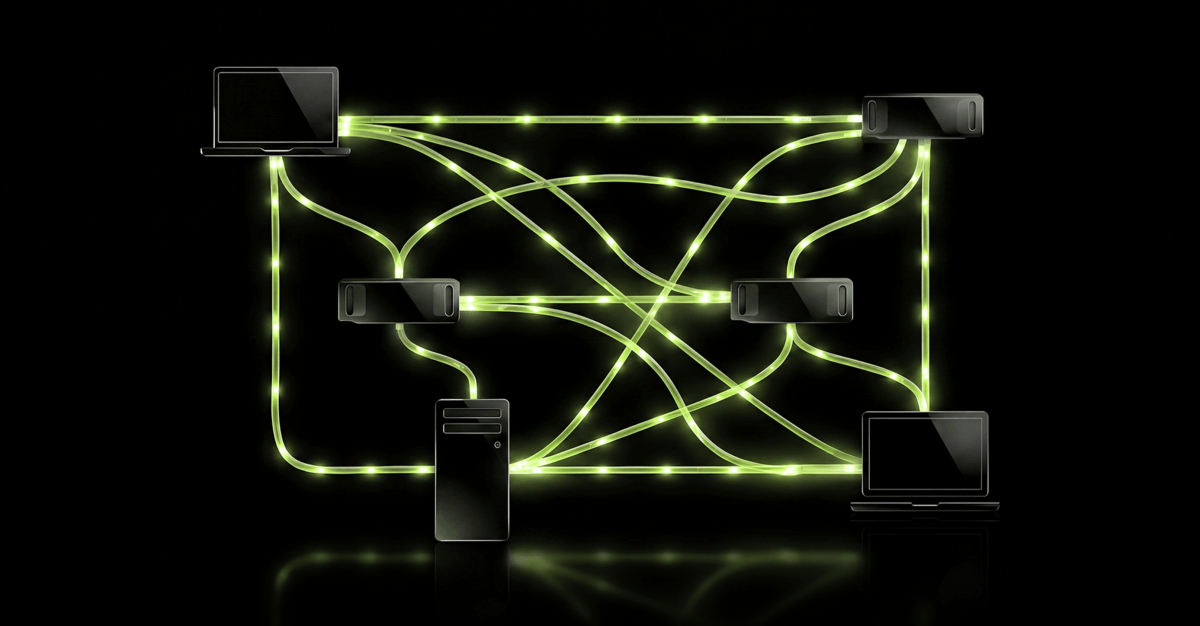
Nvidia has announced PAIR (Personal AI Router), a free open-source software tool that connects compatible home computers to work together on local AI inference tasks, such as those used by Ollama and LM Studio. It is not a hardware router, despite its name.
Why it matters
PAIR uses idle systems in your home to avoid interfering with other tasks, allowing a network of computers to work in parallel on complex agentic workflows. This should prevent bottlenecks on a single GPU and can adapt as devices join or leave the network, even if someone starts gaming.
What to watch
The PAIR beta is available today for Windows, Linux, and macOS. It works with Nvidia GeForce RTX 20-series and newer GPUs, RTX Pro GPUs, DGX Spark systems, and Apple M4 chips or newer. Security is handled via a six-digit pairing code and mTLS encryption.
Ask the AI about this article →
Nvidia's new PAIR tool is an attempt to tap into the underutilized computing power sitting in everyday homes. As Nvidia's product manager Seth Schneider illustrated, a single household with multiple powerful GPUs could pool together around 165 teraflops of compute—what he called "a treasure trove of free tokens"—to run local AI tasks that would otherwise strain a single machine. This could make agentic workflows, which break complex tasks into smaller jobs, more practical on home systems.
The announcement comes alongside simplified local setup for three AI agent apps—Perplexity Portable Computer, Hermes Agent, and OpenClaw—on Nvidia GPUs with Windows, reducing manual configuration to just a few clicks. These moves suggest a push to make local AI more accessible to consumers, though the realistic user base may be modest, as Schneider noted that most users will likely have just one laptop and one gaming PC.
While PAIR's name might suggest a hardware product, its software-only nature and free price point lower the barrier to entry. However, its success will depend on whether the effort of setting up a multi-device system appeals beyond early adopters, especially when cloud AI is so readily available. Still, for privacy-conscious users or those with powerful idle hardware, PAIR offers a way to keep AI processing in-house.
For example, today's edition would include:
AI-summarized, only the topics you pick — one digest a day via Email, Slack, or Discord.
Free · takes 30 seconds · unsubscribe anytimeWhat is AIToday? →
Ask AI anything about this article. Q&As are published on this page for other readers too.
On September 4, 2026, multiple AI services experienced outages
Meta Platforms stock rose 4% to $614.57 after the company released Muse Spark 1.3, an upgraded AI model
OpenAI, Google, and Meta can build AI infrastructure faster than the U.S
Nvidia has agreed to buy Hugging Face for $13 billion
OpenAI announced it would wind down its partnership with Cursor, the AI coding tool startup, because SpaceX—no…

Google has started rolling out voice assistant modes for Gmail, Docs, and Keep, called Gmail Live, Docs Live…