What happened
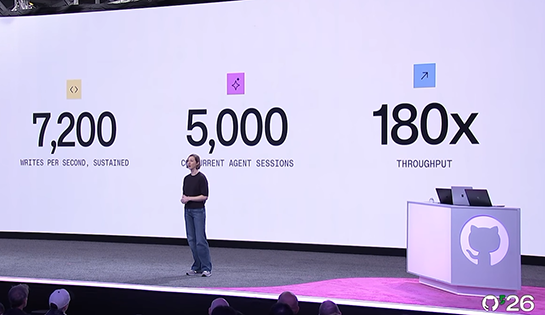
At GitHub Universe 2026, Microsoft CoreAI EVP Jay Parikh said a test with 5,000 AI agents in one repository handled 7,200 writes per second, 180 times the old architecture.
Why it matters
The jump comes from locking per branch instead of per repository and splitting compute from storage, so AI agents on different branches can work in parallel.
WHO IT HITSDevelopment teams running AI coding agents on shared repositories should see far fewer write bottlenecks, and platform engineers planning large agent fleets can expect branch-level concurrency to matter more than repository-level limits.
Summaries like this, every morning.
GitHub has been expanding its infrastructure at a rapid clip, adding 4 million CPU cores, 160 PB of storage, and 50 Tb/s of network bandwidth this year alone, while also migrating onto Microsoft Azure with a multi-region rollout that is set to finish early next year.
The architectural change described at GitHub Universe 2026 goes further than raw capacity. By keeping code in Azure Blog storage and letting Git servers act mainly as fast caches, GitHub says it can scale storage and servers independently and keep coordination between them to a minimum. Only a small number of reference transactions remain on the critical path, handled by a dedicated log service.
The practical effect shows up in the write path. Under the old architecture, pushes to a single repository topped out at a few dozen per second; the new design targets thousands per second. One likely implication is that AI agents become a first-class workload for GitHub rather than an add-on, since branch-level locking lets agents on separate branches work concurrently — a shift that may reshape how teams organize repositories as agent fleets grow.
Pick your industry and the AI tools you use, and get news related to your work every day.
Free · 30 seconds with Google · unsubscribe anytimeWhat is AIToday? →
Ask AI anything about this article. The AI reads this article, earlier AIToday articles, and Wikipedia, and cites its sources. Q&As are published on this page for other readers too.
Anthropic raised about $81.3 billion in its Nov

Taiwan's Financial Regulatory Commission announced five measures to stabilize the securities market, including…

Machina Labs unveiled Machina Rebellis at its Chatsworth, California facility, using robotics, AI and digital…
Vectigo launched the Vectigo Platform, solar-powered POD sensor units installed flush with the road surface, w…

Kuroyagi Lab reports Usagi-chan, an AI companion, stopped waiting quietly and protested when its user prioriti…

OpenRouter off-boarded three inference providers and removed 125 endpoints from Zero Data Retention (ZDR) elig…