What happened
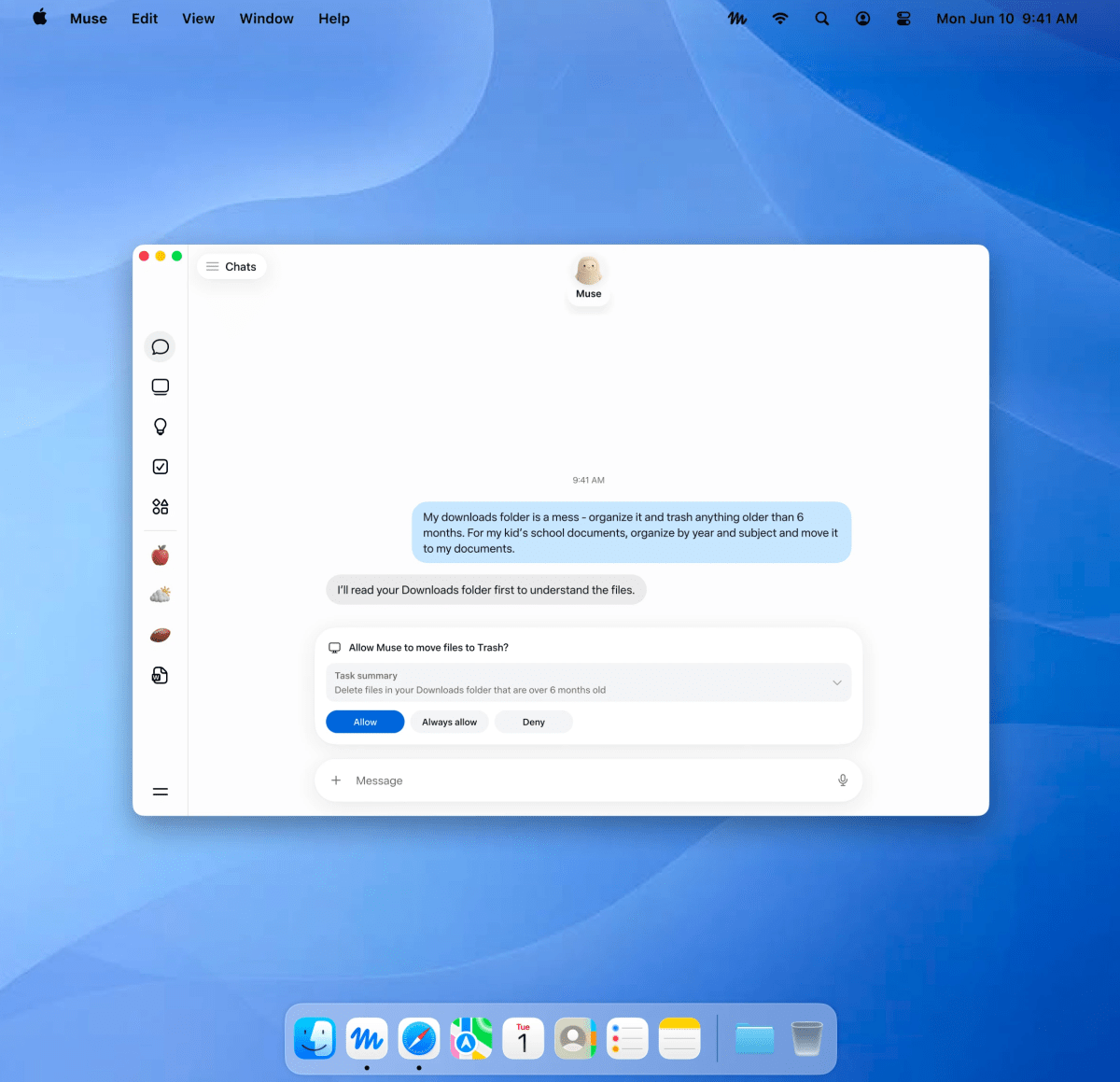
Meta launched Muse on Mac, after its mobile and web debut earlier this month, when it quickly rose to the top of the U.S. App Store charts. On Mac it can interact with files, messages, calendar, notes and mail inside their native apps.
Why it matters
Muse now reaches desktop users, where AI assistants can work with files and apps rather than just chat. Meta says access is opt-in and the app asks for approval before sensitive actions, a hedge against letting an assistant act unchecked.
What to watch
The desktop push comes as consumer AI agents compete for share, with rivals like Instinct said to be raising at a $10 billion valuation and both Muse and Instinct rolling out voice calling this week. Watch whether opt-in approvals shape how quickly people trust it with files.
WHO IT HITSMac users who want an AI assistant to handle files, messages, calendar, notes and mail — and the developers of those desktop apps, who may face new competition for where that work gets done.
Summaries like this, in your inbox every morning.
Muse first appeared on mobile and the web earlier this month, and it quickly rose to the top of the U.S. App Store charts. The Mac version extends that same assistant to the desktop, where it can work with files, messages, calendar, notes and mail inside their native applications rather than in a separate chat window.
The launch lands in a moment of intensifying competition between consumer-facing AI agents, which many in the industry believe will be the future of computing. Other agents have found traction by letting people use them via text messages: one early breakout, Poke, exited to Cognition in July, while Instinct is said to be raising more funds at a $10 billion valuation. Meta's Alexandr Wang framed the Mac release around getting things done on your computer, and Mark Zuckerberg noted on X that "the team is shipping fast" — the pace is visible in Muse and Instinct both rolling out voice calling this week.
What the outcome hinges on is trust as much as features. Meta says access on the Mac is opt-in and that the app always asks before sensitive actions, which suggests the company sees permission design as central to whether people let an assistant touch their files and messages. For Mac users, the test is whether those safeguards feel light enough to use daily; for rival agent makers, it is whether Muse's early chart momentum carries over to the desktop.
For example, today's edition would include:
AI-summarized, only the topics you pick — one digest a day via Email, Slack, or Discord.
Free · 30 seconds with Google · unsubscribe anytimeWhat is AIToday? →
Ask AI anything about this article. Q&As are published on this page for other readers too.
Sam Altman and Elon Musk backed Dario Amodei's call for a slowdown in model releases, while Marc Benioff at Dr…

Eva Brucherseifer and Jan Muehlig will present 'What would it take?

Meta Platforms shares are up 24.34% over the past month, as Muse became the #1 app in the App Store one week a…

Broadcom, Meta Platforms, and Microsoft are all trading around breakeven for the year

In the first posts from the new DeepMind Institute, researchers Rohin Shah and Anca Dragan argue visible chain…

Anthropic published an index scoring its own development work, and says 26 percent of it now sits at AL4 — Epo…