AIToday

11 LLM Evaluation Methods: From BLEU to Safety Scoring

Daily Dose of Data Science1h ago
11 LLM Evaluation Methods: From BLEU to Safety Scoring

Key takeaway

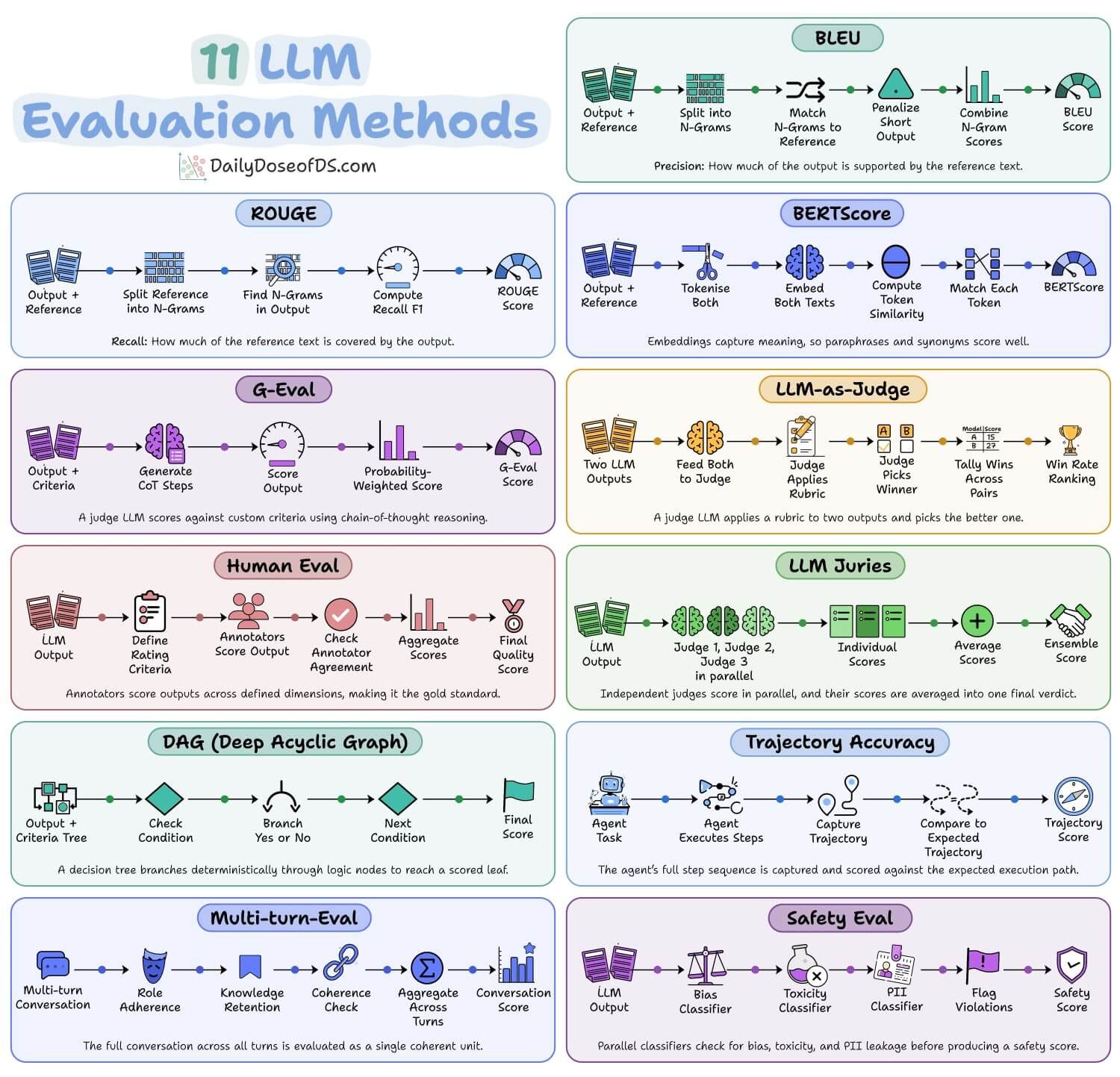
A comprehensive guide breaks down 11 evaluation methods for large language models, each suited to different tasks and assumptions about correctness. BLEU works for translation where exact wording matters; ROUGE prioritizes recall for summarization; newer methods like G-Eval and LLM juries handle subjective criteria and reduce judge bias. The key insight is that no single metric tells the full story—a model can give a correct answer in different words and score near zero on BLEU—so production systems typically combine multiple approaches, with safety evaluation (bias, toxicity, PII detection) functioning as a gate rather than part of an average quality score.

Summaries like this, in your inbox every morning.

Sign up free →

3 Key Points

  • What happened

    A technical guide outlines 11 evaluation methods for large language models, ranging from BLEU (n-gram overlap for translation) and ROUGE (recall-focused for summarization) to newer approaches like G-Eval (using an AI judge for subjective criteria), LLM juries (multiple judges to reduce bias), and safety evaluation (running toxicity and PII classifiers as a gate).

  • Why it matters

    A single metric like BLEU can give a model a near-zero score for correct answers phrased differently from the reference—a paraphrase problem that forces practitioners to blend multiple methods. Each metric encodes a different assumption about correctness; choosing the right combination affects whether a model is truly ready for production, not just whether it scores well on paper.

  • What to watch

    Many of these metrics (BLEU, ROUGE, BERTScore, G-Eval, LLM juries, trajectory accuracy, and moderation) are built into Comet Opik, an open-source LLM evaluation and observability platform, and run over traced production data.

In Depth

The article presents 11 evaluation methods, each designed for different use cases and correctness assumptions. BLEU splits output and reference into n-grams and measures overlap, working best for translation and constrained generation where reference wording is close to the only acceptable answer. It requires reporting corpus-level scores and multiple references when paraphrasing is acceptable. ROUGE flips BLEU's direction: it measures recall, meaning how much of the reference is covered by the output, making it the default for summarization and extraction where missing content hurts more than verbosity. ROUGE-L uses longest common subsequence and tolerates reordering better than ROUGE-2, but recall alone rewards verbosity, so it needs a precision-side metric alongside it. BERTScore embeds both texts, matches each output token to its most similar reference token, and reports precision, recall, and F1. It handles the paraphrase problem that breaks BLEU and ROUGE, though absolute values lie within a narrow high band, so scores are only meaningful when compared across systems, not read as raw accuracy. The embedding model must match the domain and language. G-Eval hands a task description and criteria to a judge model to generate chain-of-thought evaluation steps, then scores against those steps with the result weighted by token probabilities. It fits subjective criteria with no reference answer, like tone, instruction following, or domain correctness. Concrete checklists score far more consistently than adjectives, and running the judge at low temperature with calibration against a small human-labeled set is recommended. LLM-as-Judge pairs outputs pairwise and asks a judge to pick the better one—a practical way to compare two models, prompts, or retrieval configs when absolute scores drift. It requires randomizing output order to avoid position bias and controlling for length, since judges reliably prefer longer answers regardless of quality. Human evaluation has annotators score outputs across defined dimensions, with the aggregate serving as the reference for calibrating automated metrics. It belongs both in building the calibration set that validates a judge and as the final gate before release, requiring a defined rubric and measurement of inter-annotator agreement (low agreement signals ambiguous rubrics, not bad annotators). LLM juries run several judges independently and average their scores; a single judge carries stable bias including preference for its own model family, so using different model families is more effective than replicating one judge three times. DAGs (decision trees) score through deterministic branches where each node asks one narrow question and routes to the next, with the final leaf carrying the score—useful for rubrics with hard requirements like format compliance or mandatory disclaimers. Trajectory accuracy captures an agent's full sequence of thoughts, tool calls, and observations, scoring the path against the expected one; it matters because an agent can reach the right answer through a broken path, wasting tokens on redundant calls. Path and outcome must be scored separately to avoid a lucky correct answer hiding execution failures. Multi-turn evaluation treats an entire conversation as the unit, scoring role adherence, knowledge retention across turns, and coherence; per-turn scoring misses failures that only appear over time, like contradicting an earlier answer five turns later. Real conversation logs reveal rule-retention failures better than synthetic two-turn exchanges. Safety evaluation runs bias, toxicity, and PII classifiers in parallel over the output and flags violations as a gate, not as a quality score term—a single PII leak matters regardless of mean quality. Most of these methods ship built-in to Comet Opik, an open-source LLM evaluation and observability platform, including BLEU, ROUGE, BERTScore, G-Eval, LLM juries, trajectory accuracy, conversation-level metrics, and moderation, all running over traced production data.

Context & Analysis

LLM evaluation is not a solved problem. The article opens with a concrete failure: a model can produce the correct answer yet score near zero on BLEU if it paraphrases instead of matching the reference wording verbatim. This fragmentation exists because different applications demand different correctness assumptions. Translation needs precise wording (BLEU); summarization tolerates rewording as long as key content is covered (ROUGE); subjective tasks like tone or instruction-following have no reference answer at all. The guide maps this landscape by grouping metrics into families: n-gram overlap (BLEU, ROUGE), semantic similarity (BERTScore), model-as-judge approaches (G-Eval, LLM-as-Judge, juries), human annotation, and task-specific methods (DAGs for deterministic rules, trajectory accuracy for agent behavior, multi-turn eval for conversation consistency). A key pattern emerges: production systems interleave multiple methods rather than picking one. BLEU alone is unsafe; pairing it with BERTScore (which handles paraphrase) or human calibration validates the choice. Similarly, a single LLM judge carries predictable bias, but several judges from different model families average away noise without amplifying their correlated errors. Safety evaluation sits apart—it is a gate, not a quality metric, because one leaked PII instance invalidates a high average score.

FAQ

Why does BLEU give a near-zero score to a correct answer phrased differently?
BLEU compares n-gram overlap between the model's output and the reference text. A clean paraphrase—the right answer in different words—reads as a total miss because the word sequences do not match, even though the content is correct.
What is the difference between ROUGE and BLEU?
BLEU measures how much of the output is supported by the reference (precision-like); ROUGE flips the direction and measures how much of the reference is covered by the output (recall-like). ROUGE is the default for summarization because missing content hurts more than extra content.
Why use an LLM jury instead of a single judge model?
A single judge carries a stable bias, including a preference for outputs from its own model family. Running several judges independently and averaging their scores reduces that bias; using different model families in the jury is more effective than running the same model three times.
When should safety evaluation be used in the scoring pipeline?
Safety evaluation (bias, toxicity, PII classifiers) should be a gate, not a term inside an average quality score. A single PII leak matters regardless of how good the mean quality score looks, so folding safety into an aggregate risks shipping violations.

Get the latest Large Language Models news every morning

AI-summarized, only the topics you pick — one digest a day via Email, Slack, or Discord.

Free · takes 30 seconds · unsubscribe anytime

Discussion

No comments yet. Be the first to share your thoughts!

Log in to join the discussion

Related Articles

Stay ahead with AI news

Get curated AI news from 200+ sources delivered daily to your inbox. Free to use.

Get Started Free

Free · takes 30 seconds · unsubscribe anytime