What happened
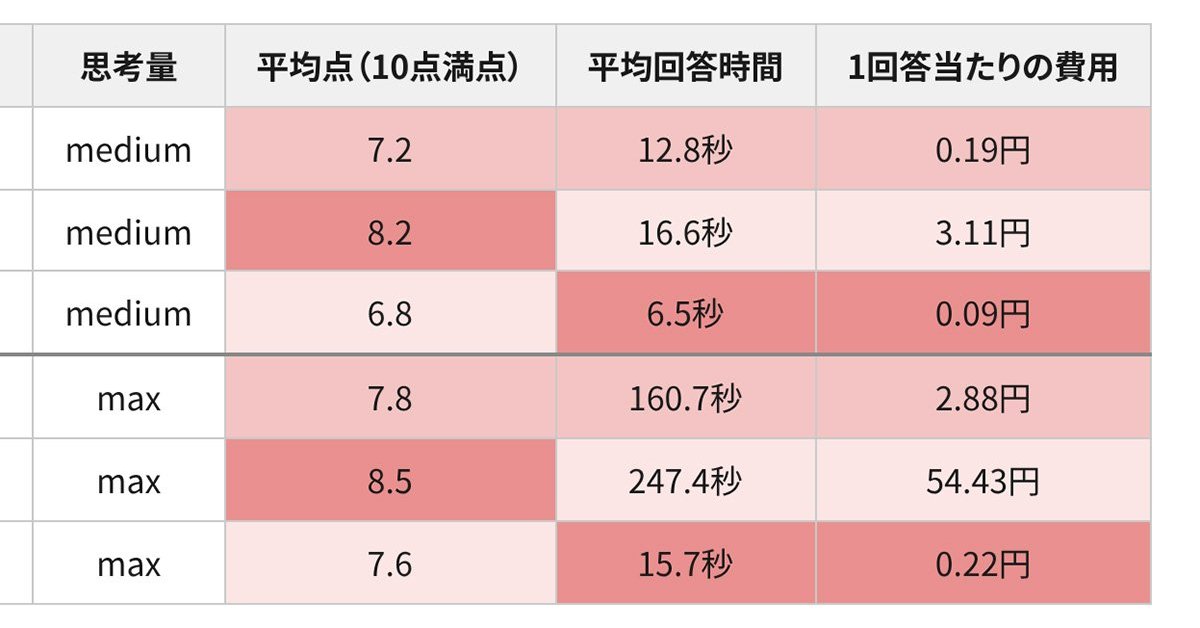
A Zenn write-up tested Opus 5.5, Fable 5.1, Sonnet 5.5 and Haiku 4.5 on design-doc review, code review, design writing and three implementations via headless runs (claude -p), with effort defaults left at medium for Opus 5.5 and Sonnet 5.5 and high for many others.
Why it matters
The results suggest you can run collection and post-plan implementation on the cheaper Sonnet 5.5 without losing quality, but you may need to raise effort or switch to Opus 5.5 when the task involves review or design work.
What to watch
The test is one user's own work materials, so results may differ on other codebases; the guidance for irreversible changes - max effort plus independent verification by a separate model - is a judgment call, not a measured guarantee.
WHO IT HITSEnterprise engineering teams running Claude Code subagents who can cut compute costs by defaulting Sonnet 5.5 for routine collection and implementation, while reserving Opus 5.5 or higher effort for reviews.
Summaries like this, in your inbox every morning.
The Zenn article is a practitioner's report from hands-on comparison runs, not a vendor benchmark. The author built six known-answer test cases from past review comments and incidents, ran them headless with claude -p, and had two separate models grade the outputs after anonymization.
The article's practical point is that effort and model choice should be decoupled by task risk. The author maps this to a three-dial model: model, effort, and a separate prompt-level instruction to actually verify claims against sources. Tasks where an error would directly affect a user's decision or deliverable call for Opus at high effort or above, while collection, aggregation, exploration, and post-plan implementation run on Sonnet at medium. The default effort values differ by model - medium for Opus 5.5 and Sonnet 5.5, high for many others - so leaving settings untouched can silently run heavy work shallow.
The author also flags a limit: some review angles, including whether tests can catch regressions, whether reused old branches roll back later fixes, and whether parallel request limits are respected, were missed by every model and every verification instruction tested. Manually adding those checkpoints to a procedure or agent definition may be more effective than switching models.
Pick your industry and the AI tools you use, and get news related to your work every day.
Free · 30 seconds with Google · unsubscribe anytimeWhat is AIToday? →
Ask AI anything about this article. The AI reads this article, earlier AIToday articles, and Wikipedia, and cites its sources. Q&As are published on this page for other readers too.
Circlia started a proof-of-concept for TASTE SIGNAL: visitors to Holland Village Cafe FUKUOKA taste cookies an…

In a webinar hosted by French Mathematical Society president Isabelle Gallagher, Fields Medal winner Hugo Dumi…

NVIDIA released Nemotron 3.5 Super VL, an open-weight model with 120 billion parameters that handles text, ima…

NVIDIA released Nemotron 3.5 Bolt 74B-A9B 24GB, an AI model for local agents that hits over 80 tokens per seco…
NVIDIA published a blog post titled "AI Security Is an Engineering Problem - How to Solve It at Every Layer of…

In the test, Haiku 5.5 on medium setting averaged scores close to Sonnet 5.5 on routine documents at about 1/1…