What happened
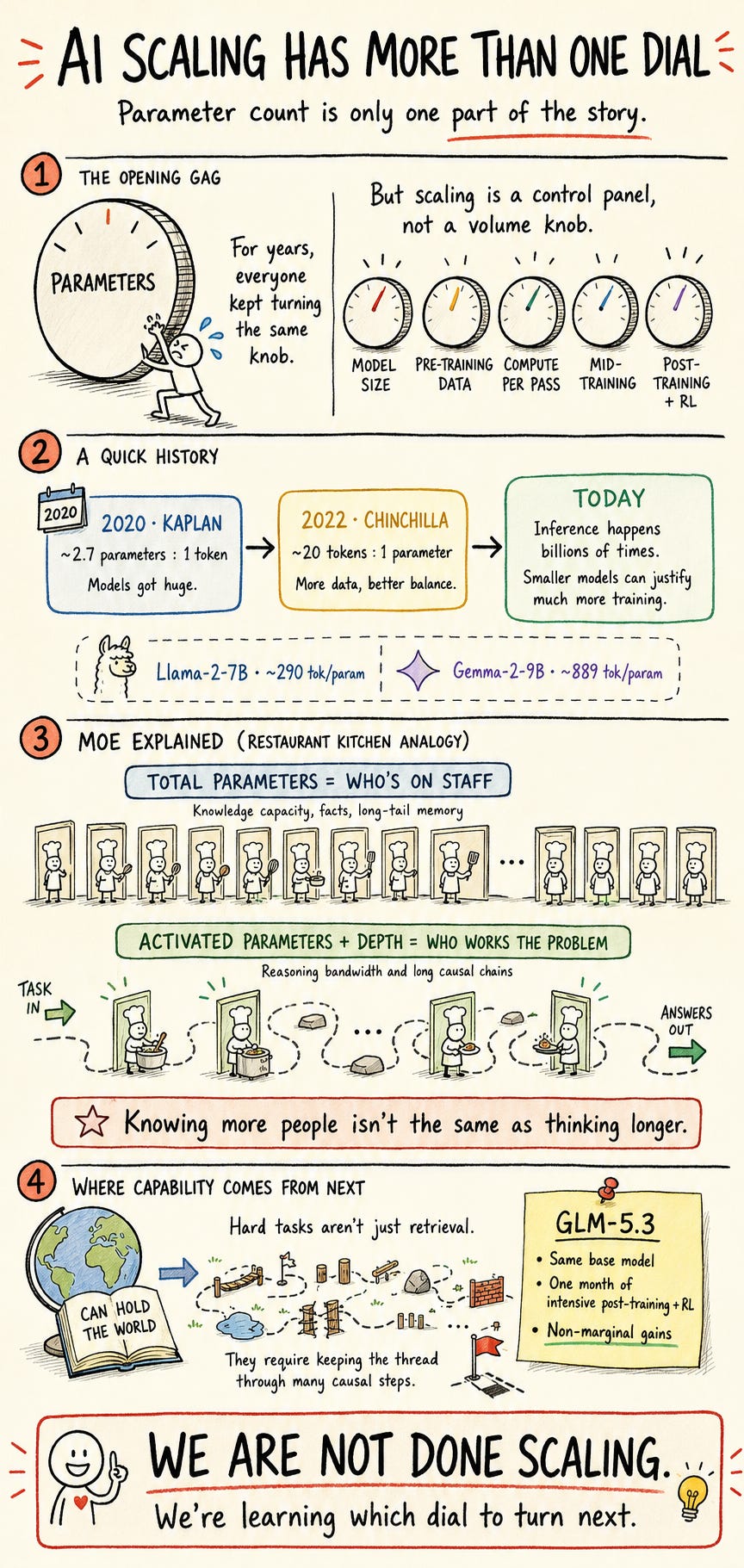
Prof Jie Tang of Z.ai announced that parameter count alone no longer determines model capability. GLM 5.3's improvements came solely from reinforcement learning on long-horizon environments—the same base model as GLM 5.2 but enhanced via roughly one month of extra RL. Tang identified five scaling knobs beyond parameters, including MoE sparsity with new XA-YB notation, and argued that advanced skills like finding software vulnerabilities require long causal chains (20+ inference steps) rather than raw parameter size.
Why it matters
The industry has long used parameter count as shorthand for model strength, but this shift signals that compute efficiency, data quality, and post-training strategy now matter far more. For businesses evaluating or building AI systems, it means comparing models by parameter count alone is misleading—reasoning depth, training recipe, and the environments used to refine behavior are what determine real-world performance on complex tasks.
What to watch
GLM 5.3 ranks #2 on Terminal Bench, #3 on Legal Bench, and #6 on Skills Bench among open-weight models. Several other labs are already adopting similar post-training approaches: Ornith-1.5 released in 9B dense, 35B MoE, and 397B MoE variants with end-to-end self-improvement; Microsoft's Agent Lightning moves Qwen3.5-9B on SWE-Bench Verified from 41.8% to 56.4% using modest compute and ~6K training examples.
Summaries like this, in your inbox every morning.
The shift Tang describes reflects a fundamental change in how the AI field understands model scaling. For years, parameter count served as a reliable proxy for capability—more parameters meant better performance. Chinchilla and subsequent scaling laws codified this relationship, but those assumptions broke down in what the article calls the "Inference Inflection world," where task-dependent token efficiency varies wildly (200–900 tokens per parameter). Tang's observation—that memorization favors more parameters while reasoning favors more post-training data and effective depth—explains why GLM 5.3 gained so much ground using the same architecture: the RL training environments were designed to teach long causal reasoning chains, not to expand memorization capacity.
This reframing has immediate practical consequences. Companies building or selecting AI systems can no longer rely on parameter count as a shorthand for comparing models. Instead, they need to evaluate training recipe quality, post-training strategy, and the conditions under which a model will operate. The broader trend visible across the article—from Ornith-1.5's synthetic environment generation to Microsoft's Agent Lightning and TrueForge's focus on the session and tool-orchestration layer—suggests the industry is redistributing effort away from model size and toward the infrastructure and training processes that unlock reasoning capability. For open-weight model developers, this creates both a challenge (building synthetic environments at scale is harder than adding parameters) and an opportunity (leaner architectures trained well can compete with larger ones).
Pick your industry and the AI tools you use, and get news related to your work every day.
Free · 30 seconds with Google · unsubscribe anytimeWhat is AIToday? →
Ask AI anything about this article. The AI reads this article, earlier AIToday articles, and Wikipedia, and cites its sources. Q&As are published on this page for other readers too.
WIRED's Boone Ashworth used Google Labs' newly launched Playground to build three games in one day, including…

CNBC published a piece looking at AI agents like Muse that can shop for consumers, and what that means for ret…

TheStreet reported that Morgan Stanley's test of the Roblox AI game maker revealed a catch

Raleigh deployed ServiceNow AI agents 'Ral-E' and 'Alli' to support 4,400 city employees, achieving 66% lower…

ServiceNow's Yevgeny Dibrov told CX Today that AI agents are multiplying as non-human identities across workfl…

Arista Networks announced an open Ethernet rack-scale portfolio, engineered with AMD, Arm, Broadcom, d-Matrix…