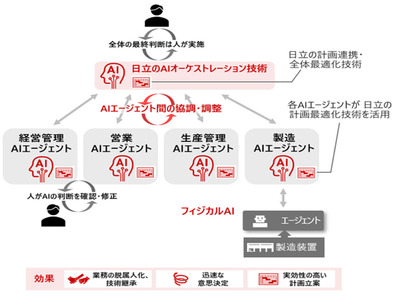
Hitachi developed AI orchestration that automates cross-department schedule adjustments in manufacturing. It links AI agents across sales, production, and procurement.
The service is set to launch during 2027.
It aims to handle sudden demand changes and delivery delays.
What happened
Hitachi announced on August 27, 2026 that it developed AI orchestration technology that automates schedule adjustments across departments like sales, production, and procurement when order changes or delivery date adjustments occur. The company will start offering it during 2027.
Why it matters
Manufacturers often struggle with cross-department planning when sudden demand changes or delivery delays happen, because each step from purchasing to shipping affects the others. While many companies have introduced AI agents per department to improve efficiency, coordinating plans across departments has remained difficult.
What to watch
The AI agents check constraints such as parts inventory, equipment resources, allowable overtime, and past customer negotiation results to propose schedules that can be executed safely on site. Plans are presented with pros and cons to staff, who make the final decision and can ask the AI to readjust conditions.
Ask the AI about this article →
Hitachi's announcement points to a specific pain point in manufacturing: coordinating schedule changes across departments. The technology builds on the company's existing optimization service, MLCP, which combines mathematical optimization and machine learning. The company has accumulated optimization know-how from deployments in manufacturing and distribution industries, which it now combines with large language models (LLMs). The approach is notable because it does not rely solely on LLM reasoning; instead, it pairs LLMs with MLCP to account for physical constraints like equipment, labor, and energy. The system also allows staff to request further adjustments, such as shortening delivery times, and the AI will recalculate and present a new plan. Hitachi plans to strengthen connections with ERP and MES systems to support data collection, decision-making, and execution instructions in one flow. The company will proceed with proof-of-concept trials with a wide range of users to test the system in the field and expand its functions.
For example, today's edition would include:
AI-summarized, only the topics you pick — one digest a day via Email, Slack, or Discord.
Free · takes 30 seconds · unsubscribe anytimeWhat is AIToday? →
Ask AI anything about this article. Q&As are published on this page for other readers too.
Chinese large-model developer Z.ai says it can now support large-scale inference using roughly 100,000 domesti…

AI system scaling has pushed interconnect requirements inside data centers from chips and boards up to racks…

Analyst Ming-Chi Kuo says Nvidia has revived the Rubin CPX AI accelerator with a substantially redesigned arch…
Palantir Technologies stock has posted multi-year gains, including an 11x return over 3 years

Apple has escalated its legal battle against OpenAI, claiming in a new court filing that OpenAI is actively de…
Samsung Electronics has locked up as much as 70% of its memory production capacity under long-term supply agre…