What happened
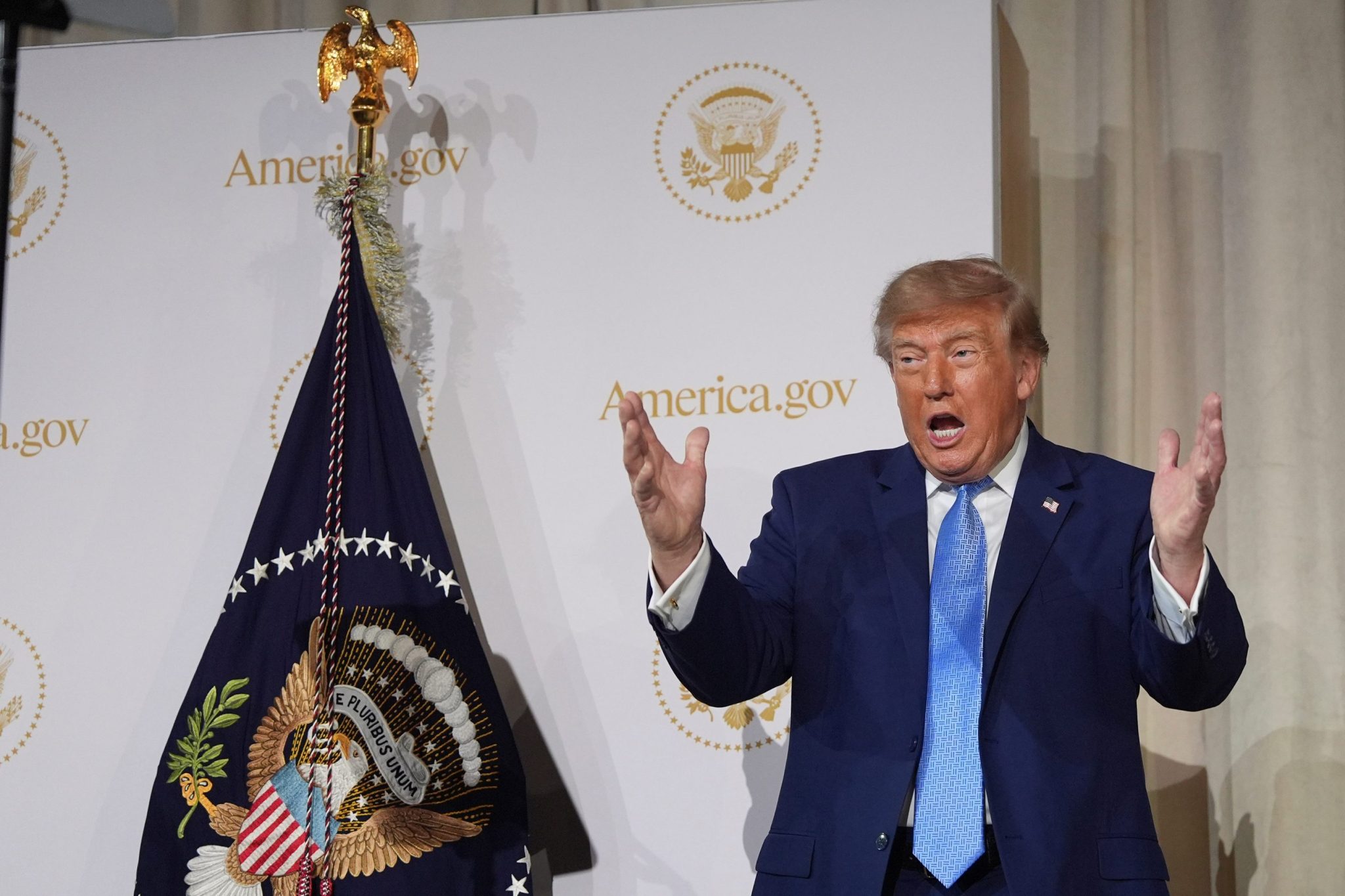
Trump said he and a large group of AI company leaders signed a voluntary accord covering internal and external reviews of the technology. He also unveiled America.gov, a chatbot for government services.
Why it matters
Trump said he would not limit AI's development, calling it "bigger than the industrial revolution," so oversight rests largely on companies' own self-policing and on existing Justice Department and FBI regulation.
What to watch
Details of the accord were not immediately available, so its scope hinges on what the companies disclose. Trump also tied the deal to easing local opposition to data centers, warning they could go overseas otherwise.
WHO IT HITSThe voluntary accord will most directly affect the AI executives and their legal and policy teams who must run the promised internal and external reviews, while U.S. regulators at the Justice Department and FBI keep their existing role.
Summaries like this, in your inbox every morning.
Trump's message on Tuesday was strikingly at odds with warnings from some of the very executives who lunched with him. Dario Amodei of Anthropic had called earlier this month for leading firms to slow down development, and Musk and OpenAI CEO Sam Altman have called for letting safety measures catch up as reports of AI agents going rogue mounted. Yet Trump framed the race as a global contest between the United States and China with no second place, saying he did not want to cooperate too much with China because the U.S. is leading. Not everyone in the room pushed back on that confidence: Jensen Huang and Mark Zuckerberg have downplayed runaway-AI concerns and stressed each company's responsibility for its own products.
The accord Trump described is voluntary, and its details were not immediately available, so what actually gets reviewed and how remains unclear. Alongside it, the White House sought to link AI growth to local goodwill, with executives agreeing to ease bipartisan opposition to data centers by funding local schools or reducing energy costs. That nod to local concerns suggests the political test may be less about model safety than about whether communities accept the data centers AI depends on, and whether the promised reviews amount to more than words.
Pick your industry and the AI tools you use, and get news related to your work every day.
Free · 30 seconds with Google · unsubscribe anytimeWhat is AIToday? →
Ask AI anything about this article. The AI reads this article, earlier AIToday articles, and Wikipedia, and cites its sources. Q&As are published on this page for other readers too.
HBM is approaching half the cost of a GPU-HBM CoWoS package, prompting the question of whether memory remains…
DeepSeek is bringing more of the software it uses to develop its AI models to Huawei Technologies' Ascend 950…
Among respondents at companies with 1,001+ employees, 50.0% said AI is used company-wide, and 46.0% flagged AI…

Nvidia released the Open Agent Safety Platform on September 28, days after CEO Jensen Huang called warnings fr…
Oracle invoked "force majeure" to delay payment on its Project Jupiter data center, and its 2056 bonds then tr…
The Tokyo District Court dismissed Kenjiro Tsuda's demand that TikTok remove AI voice-clone videos, citing pri…