What happened
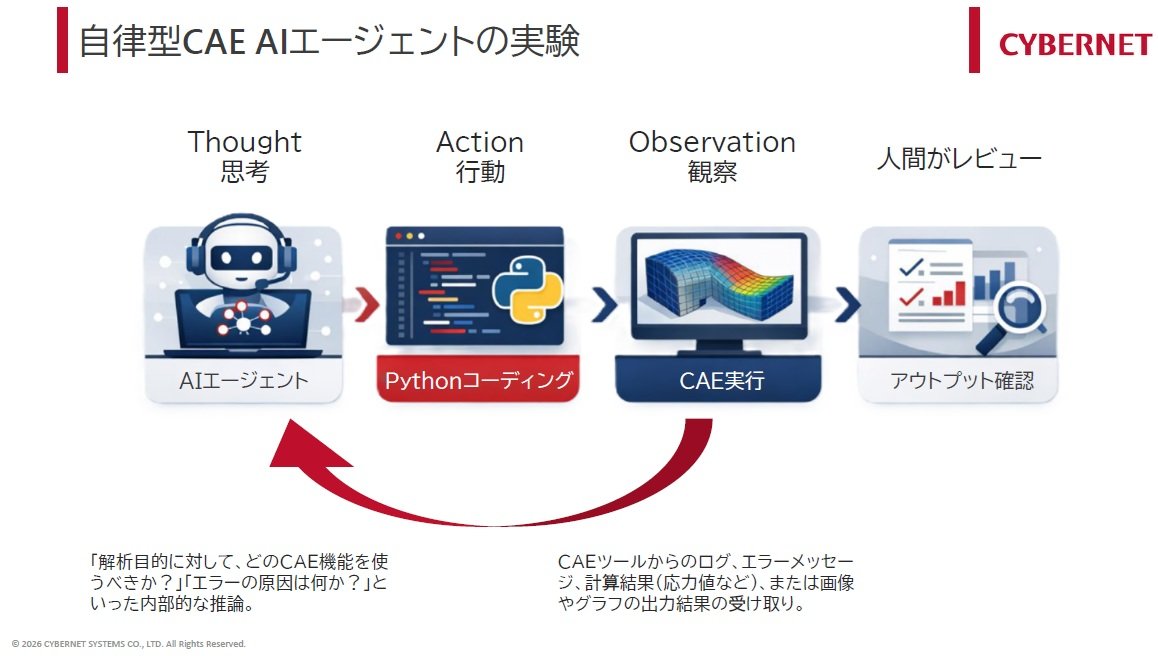
Cybernet Systems held the 'CAE University 2026' event on July 30, 2026, where a speaker demonstrated AI agents (using ChatGPT and OpenAI's Codex) generating Python code to run CAE tools (Ansys MAPDL or CalculiX) and iterate until getting a final output for human review.
Why it matters
The speaker argued that CAE analysis is 'essentially coding', so AI agents can handle it, shifting the human role away from operating tools toward model management, problem definition, measurement, and AI oversight—skills the speaker highlighted as key for the future.
What to watch
In the demo, the AI not only ran the analysis but also checked ambiguous inputs, switched solvers (from Ansys MAPDL to CalculiX) with the same workflow, and generated a report, showing that the human's role becomes defining the physical setup and judging the results.
Summaries like this, in your inbox every morning.
The demonstration at the Cybernet Systems event illustrates a broader trend in engineering software: CAE tools, once operated through graphical interfaces, are now being driven by code generated by AI agents. The speaker's point that CAE analysis is 'essentially coding' underpins this shift, as AI can handle the scripting and execution, leaving humans to define the physical problem and interpret the results. This mirrors changes in software development, where AI code generation has already begun to alter how work is done, suggesting that CAE analysts may similarly move toward higher-level responsibilities.
The demo also showed the AI's ability to handle ambiguity: when the prompt said 'a load of 10N', the AI checked whether that meant total force, distributed load, or stress, showing a level of understanding beyond simple instruction-following. This capability allows it to adapt, like switching from Ansys MAPDL to CalculiX without changing the workflow, which strengthens the case that AI agents can manage routine analysis tasks. However, the human retains a critical oversight role, especially in defining the analysis plan and reviewing the final results, which the speaker emphasized as essential skills for CAE engineers going forward.
Pick your industry and the AI tools you use, and get news related to your work every day.
Free · 30 seconds with Google · unsubscribe anytimeWhat is AIToday? →
Ask AI anything about this article. The AI reads this article, earlier AIToday articles, and Wikipedia, and cites its sources. Q&As are published on this page for other readers too.
In a SiliconANGLE essay, Imagine Art's M

The Motley Fool argued SpaceX is the better long-term AI stock than Micron, noting SpaceX's $1.25 billion-per-…
A Motley Fool contributor named Nvidia his top AI stock for 2027, arguing its price could double if it returns…

Hitachi started a service last month using AI models from OpenAI and Anthropic to monitor attacks and restore…
McKinsey's new research finds the U.S
A writer had Google Gemini read his health check results; Gemini warned of a future dialysis risk linked to hi…