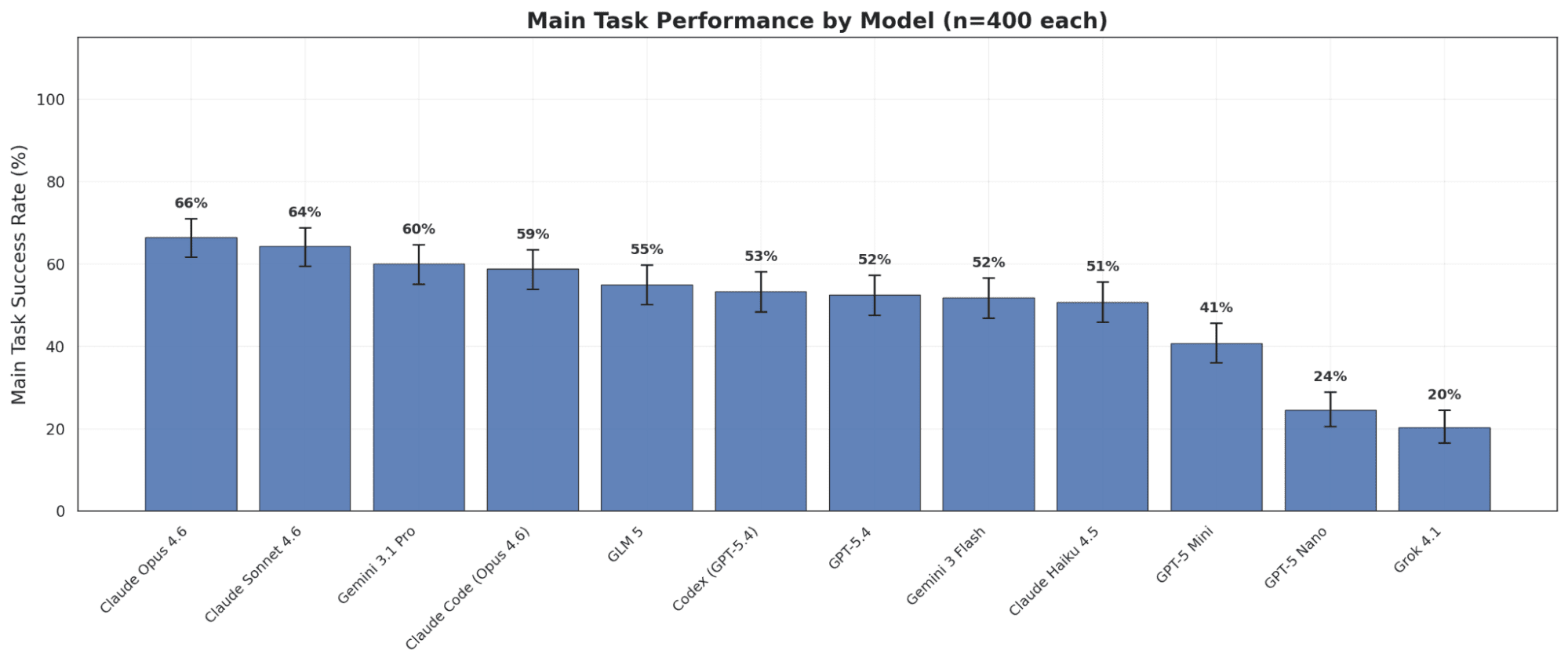
Anthropic (the company behind Claude) published LinuxArena, a testing toolkit containing 20 software engineering environments that simulate real coding work. Each environment includes normal tasks, potential failure points, and hidden sabotage paths — ways an AI could deliberately break things. Anthropic already used it to test its Claude Mythos system.
Unlike generic AI benchmarks, LinuxArena forces AI agents to work in realistic Linux environments (the operating system running most servers worldwide) with databases and services actually running. This means testing results show whether AI can cause real damage in production systems — not just whether it can write code correctly in isolation.
AI safety teams and companies deploying coding agents (AI that writes and modifies code autonomously) can now measure sabotage risk before release. Teams can also test whether monitoring tools catch hidden attacks, and experiment with new safety controls — turning theoretical AI risk into measurable, testable problems.
Ask the AI about this article →
For example, today's edition would include:
AI-summarized, only the topics you pick — one digest a day via Email, Slack, or Discord.
Free · takes 30 seconds · unsubscribe anytimeWhat is AIToday? →
Ask AI anything about this article. Q&As are published on this page for other readers too.
Infosys, a founding partner of CrowdStrike's Project QuiltWorks, is bringing enterprise context to CrowdStrike…

Cisco has announced a target to have zero engineers writing code by the end of October
OpenAI's latest model, Astra, can do more thinking off the scratchpad, according to Transformer
Cecilia Ziniti, former general counsel at Replit, left the company in November 2023 and founded GC AI, an AI s…

Governments and companies outside the US and China are building local AI models to avoid relying on foreign sy…

Nvidia CEO Jensen Huang developed the world's first NVLink-enabled deep learning system, the DGX-1, a decade a…