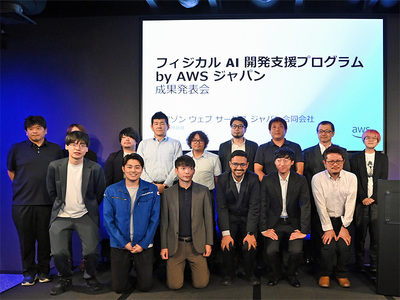
What happened
AWS Japan held a成果発表会 on August 31, 2026, where 13 projects from 14 companies presented results from its physical AI development support program. The program, started in January 2026, selected 51 companies (over half being startups) and supported them for about six months from a March kickoff.
Why it matters
Physical AI—systems where AI controls robots based on sensor data and language instructions—is being applied to real-world logistics, construction, and e-commerce tasks. For example, Daifuku and JDSC achieved 97 successful sorts out of 100 even with unlearned item combinations, and Mercari plans to automate about 20% of its own warehouses by 2028, cutting internal costs by up to ¥200 million annually.
What to watch
Concrete results highlight progress:豆蔵's VLA-based (Vision-Language-Action model) alignment achieved 85% success vertically and 80% horizontally, while竹中工務店 built training data for painting tasks despite lacking 3D data for wall rollers. Mercari's inspection automation addresses a step that takes 10 to 60 times longer than other warehouse processes.
Summaries like this, every morning.
The成果発表会 highlights the progress of AWS Japan's physical AI support program, which began in January 2026. By selecting 51 companies, over half startups, and supporting them for six months, AWS Japan aims to foster innovation in applying AI to physical tasks. The program addresses a gap in the market where AI is often limited to digital realms, but physical AI—where AI controls robots—has vast potential in logistics, construction, and manufacturing.
Notable achievements include Daifuku and JDSC's success in automating logistics picking, achieving 97 out of 100 successful sorts even with unlearned items. This demonstrates the model's adaptability. Similarly,竹中工務店 tackled the lack of 3D data for construction tools by creating their own, enabling robots to learn painting tasks. These examples show that physical AI can overcome domain-specific challenges with tailored data.
Mercari's focus on export inspection automation addresses a bottleneck that takes 10 to 60 times longer than other warehouse processes. By integrating force/tactile sensors and re-projection, they aim to automate 20% of warehouses by 2028, saving up to ¥200 million annually. This indicates that physical AI can deliver tangible cost savings and efficiency gains, making it a strategic investment for businesses.
Pick your industry and the AI tools you use, and get news related to your work every day.
Free · 30 seconds with Google · unsubscribe anytimeWhat is AIToday? →
Ask AI anything about this article. The AI reads this article, earlier AIToday articles, and Wikipedia, and cites its sources. Q&As are published on this page for other readers too.
Big venture rounds continued for OpenAI and others, while CoreWeave and SpaceX shares fell Thursday on fears o…

The author built a baseball news watcher, a web manga update checker, an AI news digest, and a Cloudflare poli…

Crystal Method, a Japanese AI company developing virtual humans, outlined its interview-support AI, designed s…

Over a 90-day run from July 6 to Oct 4, 2026, the creator published all 12 planned AI explainer videos but rea…
Memory is the current AI bottleneck, and Micron Technology's fiscal Q4 2026 revenue jumped to $54.23 billion f…
Canva launched Canva Craft, its first in-house image model, trained by Canva Research mainly on millions of de…