What happened
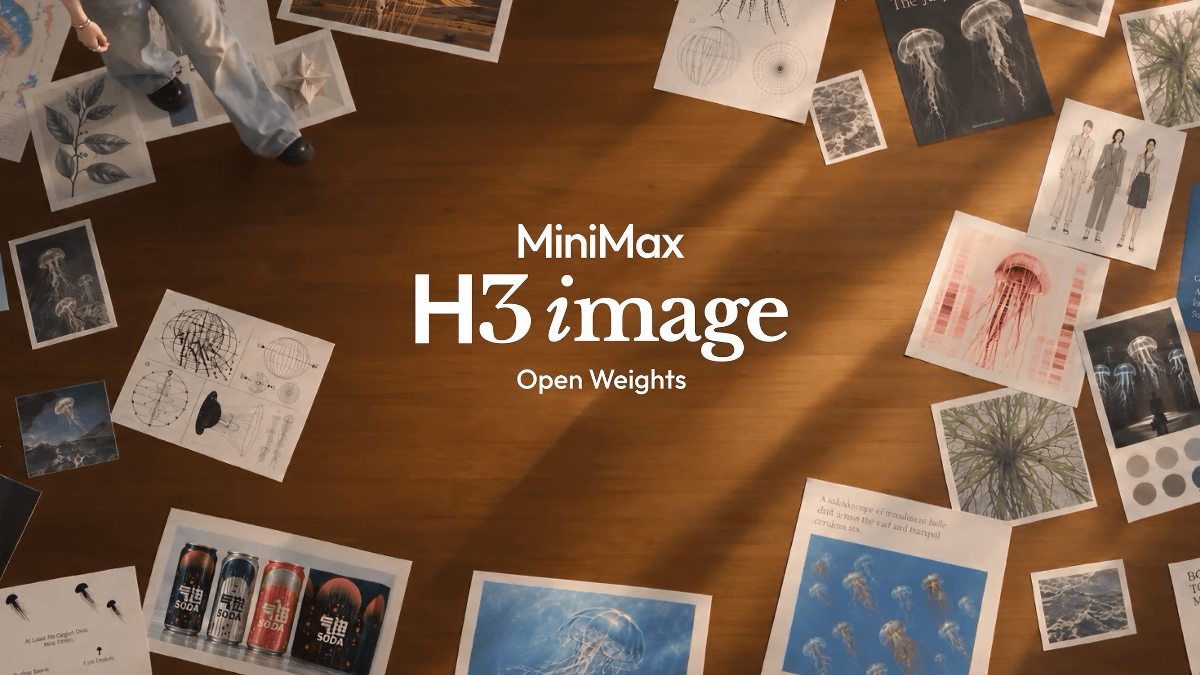
MiniMax released MiniMax-H3-Image, an open-weight image model derived from its MiniMax H3 video AI, generating 1600万ピクセル images directly and handling editing plus up to 16 reference images.
Why it matters
Most image AI makes a low-resolution picture first and then upscales it; skipping that step at this resolution could make high-detail work — text, textures, interior mockups — faster for teams that run models on their own hardware.
WHO IT HITSDesigners, game artists and others producing high-detail images on their own GPUs get a free-to-try open-weight option, since individual use in Japan is free under its community license.
Summaries like this, every morning.
MiniMax-H3-Image is a spin-off of the company's MiniMax H3 video model, and the pitch is aimed squarely at resolution. The usual route to a big image is to generate small and then hand it to an upscaler; MiniMax says its model produces 1600万ピクセル directly at a practical speed. That matters most for images where fine detail carries the meaning — text baked into a picture, textures added in editing, or interior mockups built from reference photos. The model accepts up to 16 reference images, and MiniMax showed examples including filling in terrain around a spot pinned on a map.
The distribution choices are as telling as the specs. The open weights are on Hugging Face under the MiniMax-H3-Image COMMUNITY LICENSE AGREEMENT, with free individual use in Japan. ComfyUI already supports it natively, with official workflows for both generation and editing — but those workflows default to 4 megapixels, so anyone wanting to judge the model's real capability has to switch the setting to 16 megapixels. For teams that run models on their own GPUs, that combination of open weights and existing tooling lowers the barrier to trying it.
Pick your industry and the AI tools you use, and get news related to your work every day.
Free · 30 seconds with Google · unsubscribe anytimeWhat is AIToday? →
Ask AI anything about this article. The AI reads this article, earlier AIToday articles, and Wikipedia, and cites its sources. Q&As are published on this page for other readers too.
Google's November Pixel Drop brings personalized suggestions (formerly Magic Cue), the Rambler voice input sys…
Stanislaus Hees, a 14-year-old Austrian developer, released Autark, an open-source tool that treats AI agents…

NaiveAI released Naive-N0.5-Flash, an open-weights coding model built on Xiaomi's 310B-parameter MiMo-V2.5, cl…
Hugging Face organizations can now subscribe on the Google Cloud Marketplace and link their account, moving us…
AWS published CloudFormation templates, Lambda code and SQL queries in its Amazon Bedrock Invocation Data Lake…

At NVIDIA's Agentic AI Day Japan 2026 on Nov 10 in Tokyo, JAIST's Shota Imai predicted competitive areas will…