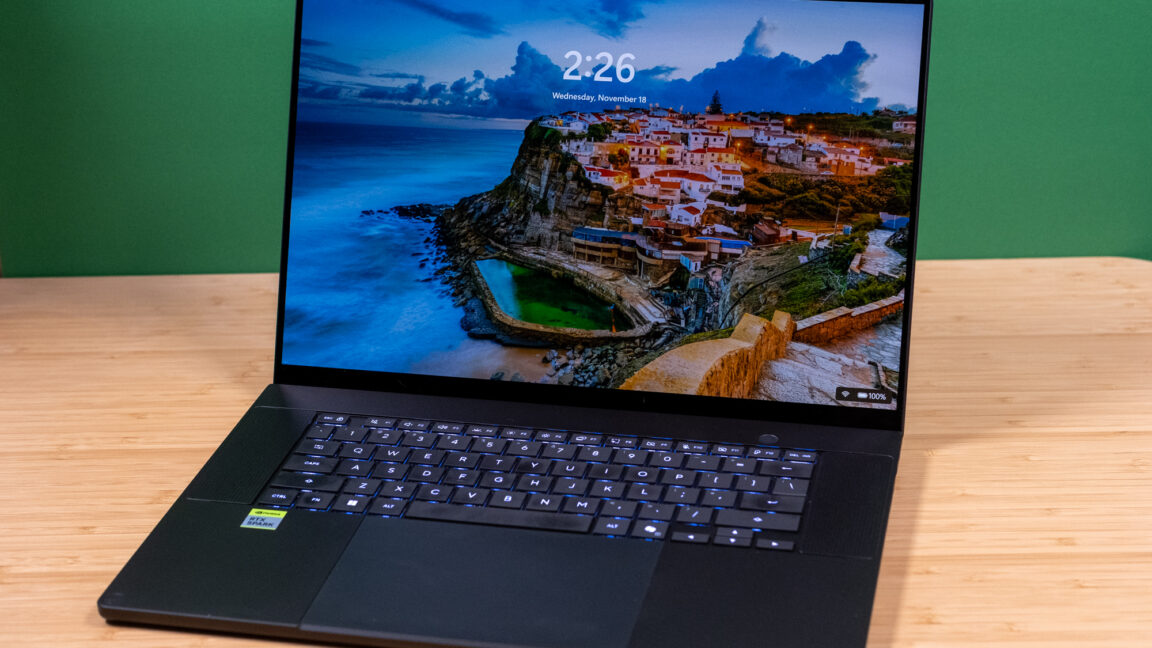
What happened
Ars Technica's Ryan Whitwam reviewed the Asus ProArt P16, which uses Nvidia's RTX Spark chip and up to 128GB of shared memory; the top configuration costs $7,000 and can load models with 100-plus billion parameters.
Why it matters
This lets users run powerful AI models without sending data to the cloud, but the high price and slow local inference mean it only makes sense for those with many AI projects in mind.
Summaries like this, every morning.
The Asus ProArt P16 represents a new category of laptop that prioritizes local AI processing over traditional gaming or productivity. By adopting Nvidia's RTX Spark chip, Asus is betting that users want to run AI models without relying on cloud services, which can be expensive and raise privacy concerns. The Spark's unified memory architecture allows the laptop to handle models that would typically require a dedicated workstation, but this comes at a cost: the top configuration is priced at $7,000.
In his testing, Ryan Whitwam found that while the ProArt P16 excels at running large models like Qwen Flash Next, the experience is not without friction. Local AI inference is noticeably slower than cloud-based alternatives, and the laptop's battery drains quickly under heavy AI loads. The machine also faces challenges in gaming due to its Arm-based architecture and emulation overhead, making it less appealing as a primary gaming device.
Despite these trade-offs, the ProArt P16 offers a glimpse of a future where AI runs locally on powerful personal computers. For now, it remains a niche product for early adopters who need to run multiple agents or value data privacy above all else. Asus plans to offer a 64GB model at a lower price, which may broaden its appeal as AI models become more efficient.
Pick your industry and the AI tools you use, and get news related to your work every day.
Free · 30 seconds with Google · unsubscribe anytimeWhat is AIToday? →
Ask AI anything about this article. The AI reads this article, earlier AIToday articles, and Wikipedia, and cites its sources. Q&As are published on this page for other readers too.
Nvidia shares jumped 8.7% in premarket trading, rebounding from their longest weekly losing streak since 2008…

Citigroup CEO Jane Fraser said the AI market was 'priced to perfection' and that capital has become 'a tad mor…

Anthropic went public last week with a 17% first-day stock pop, but the Claude maker's stock dropped 8% on Fri…
The guide maps four model-adaptation methods — prompt engineering, RAG, fine-tuning and continued pre-training…
OpenRouter ran Qwen3.8 27B through fp16, fp8 and fp4 endpoints from providers including Cerebras, Parasail, Co…

Jessica Wachtel ran each model once per test through its vendor API at default settings on a month-end close…


