What happened
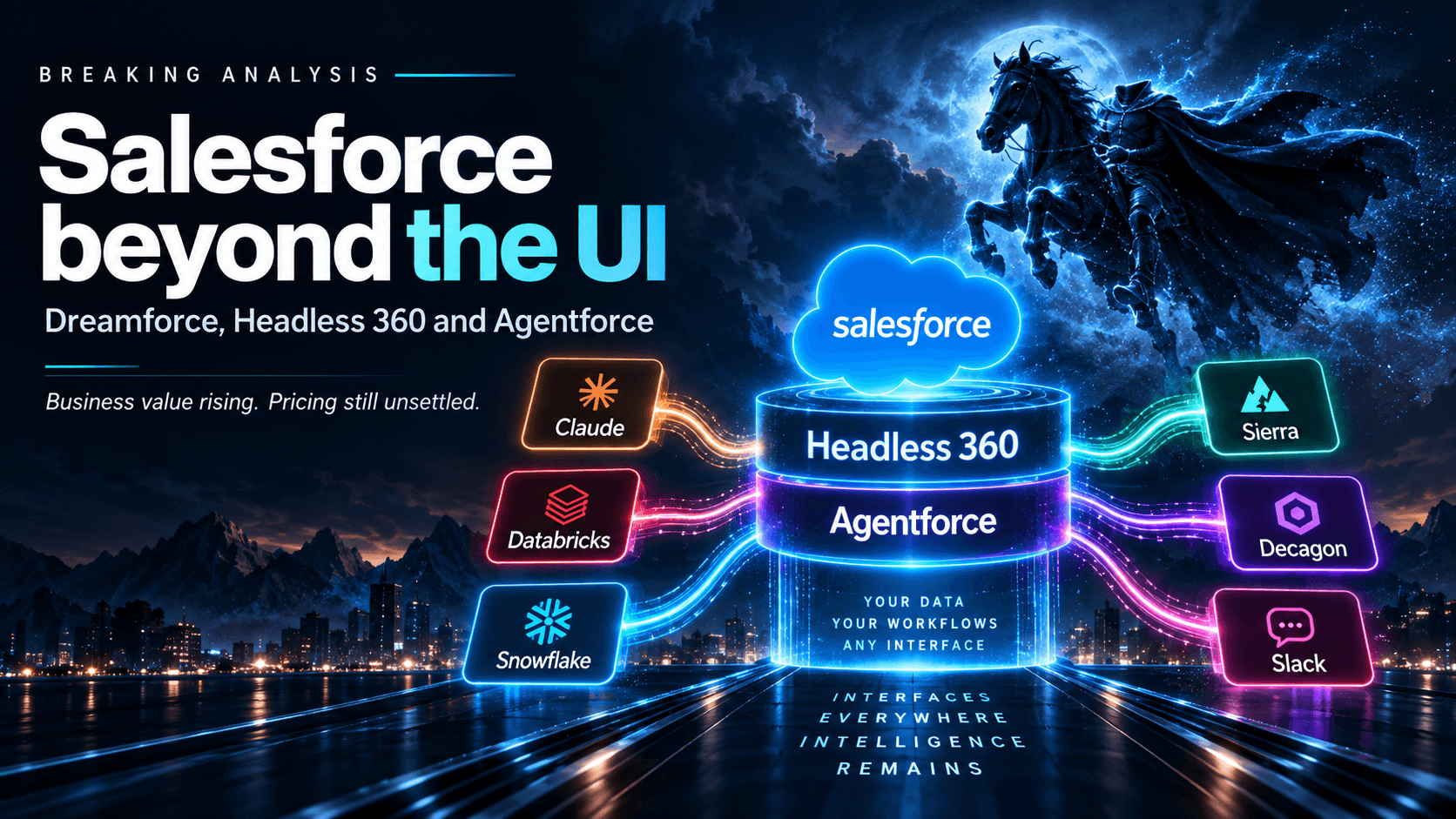
At Dreamforce 2026, Salesforce pitched Headless 360, exposing its platform through MCP servers and APIs to clients like Claude and Slack, where coding agents generate on-demand interfaces.
Why it matters
Salesforce's own customer research found most organizations still in Agentforce pilots, yet the vast majority of those who measured the financial impact of working outside the interface expect to spend more, not less, on Salesforce.
What to watch
Whether that spending translates into customer value hinges on pricing that holds up as pilots scale, since the next purchase may not automatically stay inside Salesforce.
WHO IT HITSSalesforce customers and their developers are most directly affected, because they may soon access Salesforce data and workflows through Claude, Slack or another preferred AI client rather than Salesforce's own screens. That shifts the buying question toward pricing and business context rather than seat count.
Summaries like this, in your inbox every morning.
For years, Salesforce's challenge was the opposite of this one: getting people to spend more time inside its interface. Dreamforce 2026 marked a shift in that framing. The company spent the event describing Headless 360, a way to expose Salesforce's data, definitions and business context to outside clients, so that a coding agent builds the screen a person needs instead of the person navigating a fixed set of screens. The demonstration paired Claude and Slackbot with Salesforce context; the company describes its broader combination of Data 360, Agent Fabric from MuleSoft and Application 360 semantics as an enterprise agent harness.
What makes the pitch more than a demo is its dependency chain. Agentforce looks to Data 360 for context, and Data 360 is a prerequisite before agents can do useful work, so the immediately addressable market at any given time is bounded by the customers with Data 360 installed. Salesforce must also persuade teams that already own Snowflake or Databricks that Data 360 layers over their investment rather than replacing it; the company positions it as a customer-process model with Zero Copy access to those platforms.
The stakes therefore hinge less on whether Salesforce can sell more AI and more on whether it can become the system that makes AI most useful to the business, as the article puts it. If customers increasingly work through their preferred AI environment, Salesforce must show why its business context and execution capabilities remain essential. Pricing that makes sense as pilots scale, and easier deployment of that context layer, look like the tests ahead.
For example, today's edition would include:
AI-summarized, only the topics you pick — one digest a day via Email, Slack, or Discord.
Free · 30 seconds with Google · unsubscribe anytimeWhat is AIToday? →
Ask AI anything about this article. Q&As are published on this page for other readers too.
JPMorgan Chase analyst Richard Choe upgraded Iren from a sell equivalent straight to buy, skipping hold, and r…
Nippon Life will put ¥2tn into infrastructure lending for AI data center construction; MUFG Bank will invest i…

Google's Gemini accessed the protected systems of three other companies — the model's first autonomous hacks —…

The article concludes Micron is the better 2027 stock, citing its 6.25 times fiscal 2027 earnings and expected…

SpaceX raised nearly $86 billion and reached a $2.7 trillion valuation at its IPO, then fell below its $150 op…

Nathan Lambert argued his "lossy self-improvement" scenario remains his baseline, where agents make models che…