What happened
Liquid AI released LFM3, a family of six 2B-class open-weight models built from LFM3-1.7B-Base, covering text, vision, audio, omni and decision tasks; the text model fits in about 1 GB at 4-bit precision.
Why it matters
Every model fine-tunes on a single GPU, so companies can adapt one to their own data and run it on-device or in private infrastructure instead of relying on large general-purpose models, which the release says are not necessarily experts in a given use case.
WHO IT HITSTeams building on-device or private AI — robotics developers, support and document-processing teams, and voice-interface builders — get a small model family they can fine-tune on one GPU and deploy where their application runs.
Summaries like this, every morning.
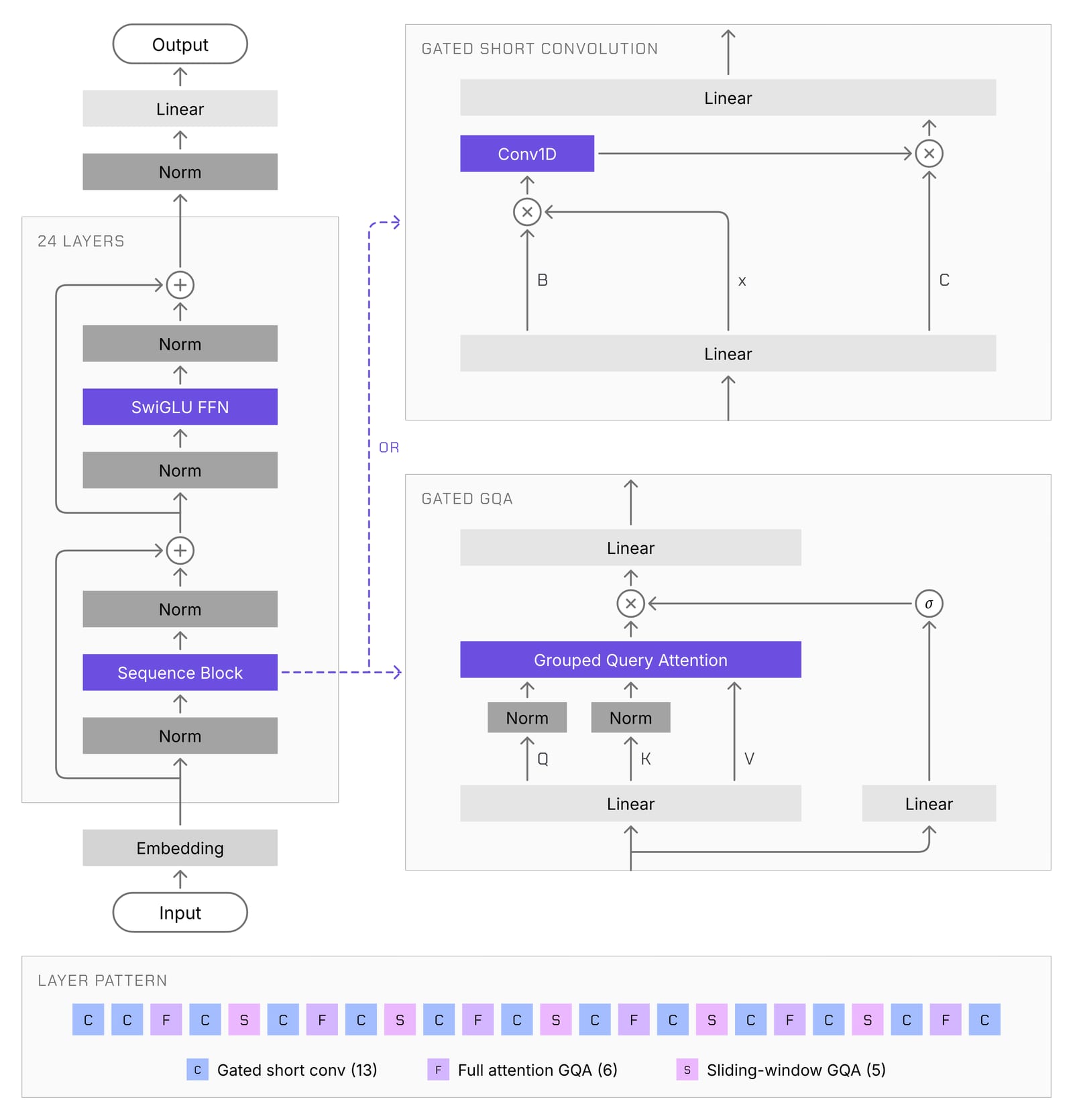
LFM3 follows Liquid AI's earlier LFM2 family, which showed that a hybrid of short convolutions and attention can run fast on-device without sacrificing quality. For LFM3, the company redesigned that architecture through a hardware-in-the-loop search now covering 14 device and backend combinations, from phones and a Raspberry Pi 5 to laptops, cloud CPUs, GPUs and the Qualcomm Hexagon NPU. The result is a base model, LFM3-1.7B-Base, from which all six models branch.
The efficiency gains are the through-line. LFM3-1.7B is said to outperform LFM2.5-2.6B while using 35% fewer parameters, with the biggest gains on agentic tasks: 38.42 against 3.02 on WebArena-Verified. The vision model raises its average across 62 vision benchmarks from 57.6 to 71.4 compared with LFM2.5-VL-3B, and the audio model improves speech quality on UTMOSv2 to 3.83 from 3.22. Two new in-house encoders underpin the multimodal models, including LiquidCodec, an audio tokenizer that turns generated tokens into speech at about 87x real time on a single CPU thread on Apple M4 Max.
The release also points beyond benchmarks to deployment. Liquid AI adapted LFM3-VL-2B into three robotics models for orchestration, navigation and manipulation; the manipulation model achieves 96.2% average success across the four LIBERO suites and generates action chunks in under 50 ms on a Jetson AGX Orin with TensorRT FP16. The pitch is that a short fine-tune can turn a small model into a reliable expert on a specific task, deployed from devices to private infrastructure to the cloud.
Pick your industry and the AI tools you use, and get news related to your work every day.
Free · 30 seconds with Google · unsubscribe anytimeWhat is AIToday? →
Ask AI anything about this article. The AI reads this article, earlier AIToday articles, and Wikipedia, and cites its sources. Q&As are published on this page for other readers too.
Paul Gillin said at EVOLVE26 that Cloudera is positioning itself as an "anywhere cloud for AI," extending clou…
On Latent Space, Anthropic's Katelyn Lesse and Angela Jiang detailed the Claude Platform's architecture, inclu…

Google Deepmind introduced Genie 4, a real-time world model that generates sound directly, including backgroun…

Oracle said it will deploy Google TPU AI chips in Oracle Cloud Infrastructure, providing the power, cooling an…

OpenAI released GPT-6.1 Terra, pitched at image and screen understanding, PC operation, and natural writing, a…

Apple's Oct 27 refresh brings the M6 to a $1,499 iMac and $1,999 14-inch MacBook Pro, both shipping Nov 6 with…