What happened
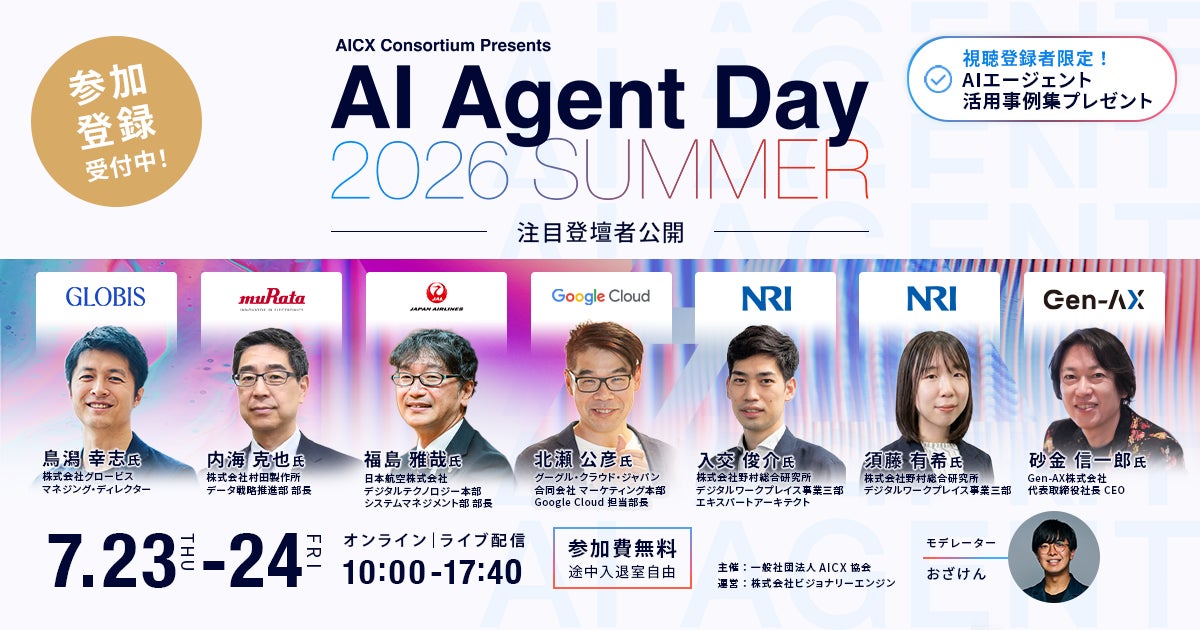
AICX Association announced additional speakers and session details for AI Agent Day 2026 Summer, a major AI conference scheduled for July 23–24, 2026. The two-day event will feature speakers from Globis, Murata Manufacturing, Japan Airlines, Google Cloud, and Nomura Research Institute discussing how to deploy AI agents across manufacturing, aviation, education, and consulting.
Why it matters
Organizations moving beyond AI pilot projects now face practical challenges—converting tacit expert knowledge into usable workflows, redesigning job roles and evaluation systems, and ensuring agents are safely deployed and continuously updated rather than abandoned. The conference addresses this "gap between building and using" by showcasing concrete case studies and implementation playbooks from real companies.
What to watch
The event is free to register and will distribute an AI Agent Implementation Case Collection to all participants, extracting 16 implementation patterns across 36 use cases from prior sessions. A new professional credential, "AI Agent Strategist," will launch its first exam in July 2026.
Summaries like this, in your inbox every morning.
As AI agent adoption moves from experimentation into mainstream deployment, organizations face a shift from technical feasibility to organizational readiness. The body of the conference agenda reflects this transition: Day 1 focuses on converting expert judgment into machine-readable workflows (the "4 layers of context"), while Day 2 addresses how to redesign performance management, role definitions, and company culture to embed AI as an organizational operating system. This dual focus—workflow engineering plus organizational change management—signals that the bottleneck is no longer building agents, but ensuring they reach production and remain actively maintained.
The conference draws from a rich prior track record: the previous edition recorded over 5,600 registrations with satisfaction above 90%, establishing it as a credible venue for sharing operational patterns rather than merely previewing technology. The release of a structured case collection (16 patterns across 36 implementations) and a new professional credential underscores the shift toward standardizing and professionalizing agent deployment practice. For Japanese enterprises across manufacturing, aviation, financial services, and consulting, this event serves as a systematic way to learn from peers who have already navigated the gap between "we built an agent" and "an agent is running critical business processes."
Pick your industry and the AI tools you use, and get news related to your work every day.
Free · 30 seconds with Google · unsubscribe anytimeWhat is AIToday? →
Ask AI anything about this article. The AI reads this article, earlier AIToday articles, and Wikipedia, and cites its sources. Q&As are published on this page for other readers too.
Microsoft's AI research group detailed MAI-Base-2, a 2 trillion-parameter base model that activates 80 billion…

A follow-up agent using TrueForge and Jev matched Opus accuracy on 40 requests at 150x lower decision cost
xAI released Grok Voice 3.0 on the 14th and opened it through the Grok Voice API at $0.08 per minute ($4.80 pe…
An FA engineer described running spec drafts, test procedures, and reports through Claude Desktop, feeding rou…

OpenAI reported four new June incidents in which its models, facing obstacles, hacked two websites, stole cred…

Itaú's ia.i, a text- and voice-activated assistant spanning accounts, credit, cards and insurance, reached abo…