What happened
At the Fortune AIQ Summit, ServiceNow's Diana David said the widest gap between AI pacesetters and others is talent: 68% vs. 10% on attracting, hiring and retaining AI staff. Pacesetters are the roughly 21% of surveyed organizations scoring above 60 on ServiceNow's 100-point Enterprise AI Maturity Index, averaging 74 versus 45 for the rest.
Why it matters
The index data David cited suggests that AI leadership is less about buying technology than about operational discipline, talent investment and having a clear strategy, since pacesetters scored 74 versus 45 and also stand out on unified data, AI vision and autonomous workflows.
What to watch
Whether that gap narrows hinges on whether companies actually redesign processes and train staff rather than sprinkling AI onto old ones, David said. She warned she cannot promise another index dip won't come next year, and ServiceNow plans to add agentic AI to the AIQ next year, judging deployment by commercial value.
WHO IT HITSThis lands on HR and L&D leaders at large enterprises who own AI upskilling budgets, and on COOs weighing whether to keep funding broad AI tool rollouts. It also matters to any executive trying to turn an AI pilot into measurable productivity.
Summaries like this, in your inbox every morning.
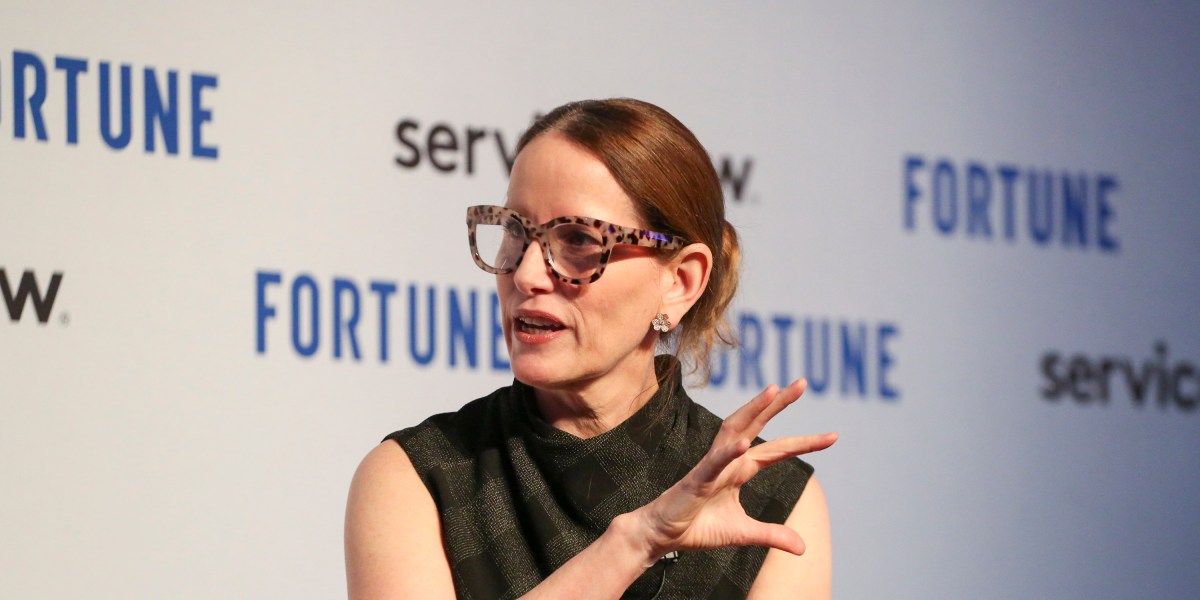
Diana David's role as ServiceNow's director of futures, and her self-description as a "forward-deployed futurist," sets up the talk she gave at the Fortune AIQ Summit on Thursday. The companies pulling ahead, she said, are not distinguished mainly by technology. The gap is people — talent investment, upskilling, and what she called operational discipline and transformation.
ServiceNow's Enterprise AI Maturity Index shows a volatile picture. David recalled that when the index started in 2024, the assumption was that scores would rise steadily, but the average fell from 44 to 35 — which she attributed to AI noise not yet filtering into company value — before rebounding to 51 this year. David also described the spread of leadership beyond tech: technology companies took about one in five spots on Fortune's AIQ 75, followed by financial services, with construction and engineering at six and food and health care five each.
What the numbers point to is that maturity may hinge less on how many employees have AI tools than on whether new processes are designed from the start and ownership is assigned. David's pushback on "AI adoption for everyone" is that broad rollout does not equal maturity if it is not paired with training. Whether that holds will depend on whether ServiceNow's planned addition of agentic AI to the AIQ next year shows commercial value, not just deployment.
Pick your industry and the AI tools you use, and get news related to your work every day.
Free · 30 seconds with Google · unsubscribe anytimeWhat is AIToday? →
Ask AI anything about this article. The AI reads this article, earlier AIToday articles, and Wikipedia, and cites its sources. Q&As are published on this page for other readers too.
The Motley Fool argues Amazon is the AI company of the two, since AWS was just 21% of first-half 2026 revenue…

Hewlett Packard Enterprise stock is down 5% at $55.87

Vercel data published Thursday shows TypeSafe AI's Jev, a lightweight decision model for choosing among predet…

Chunghwa Telecom president Rong-shy Lin said the shift from conversational AI to autonomous AI agents is resha…

CoreWeave fell 5% in premarket trading Friday and was on track to finish the week down 15%, after rebounding f…

Apple and Meta said they would jointly release a new open-weight AI model designed to run on high-end Macs, ai…


