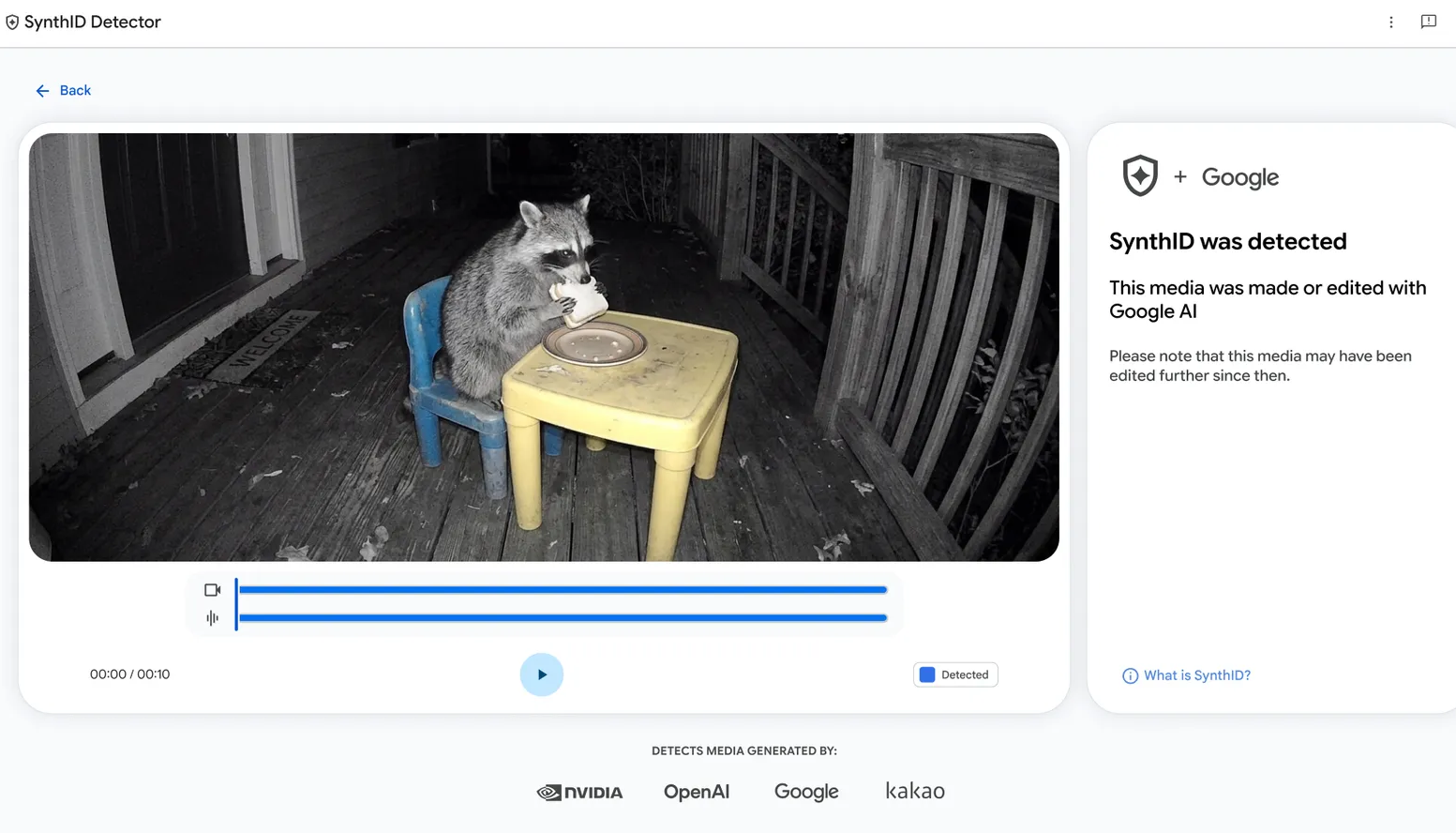
What happened
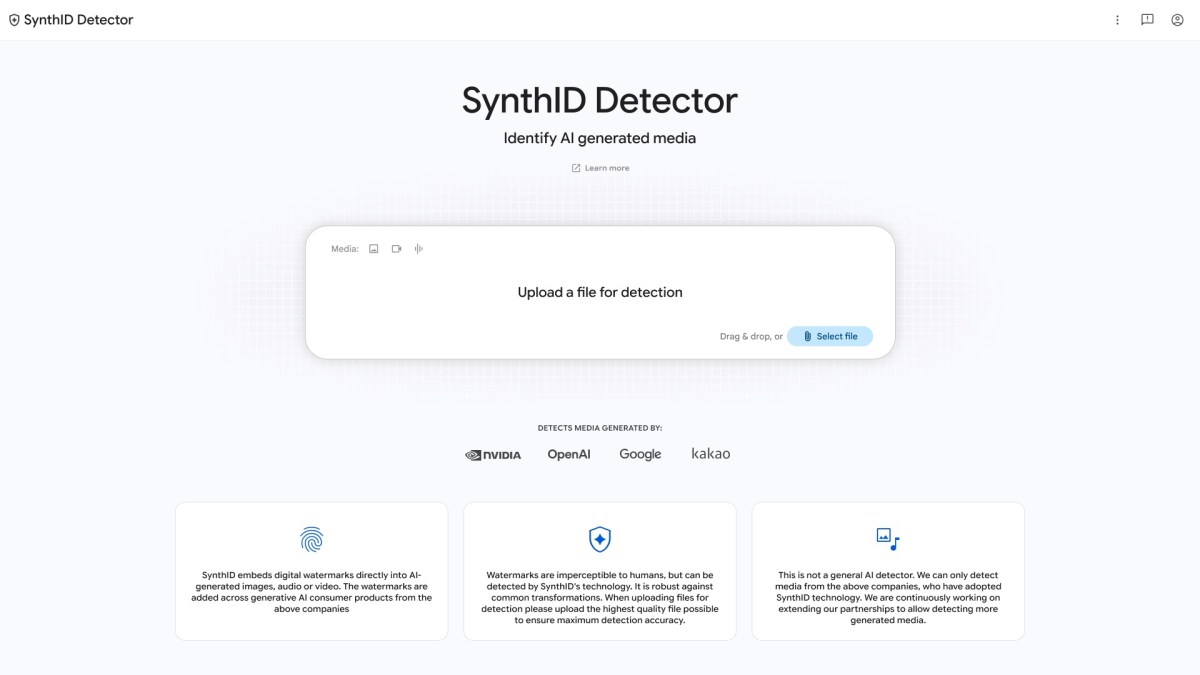
Google LLC launched the web-based SynthID Detector, which flags AI-made images, video and audio from Google, OpenAI Group PBC, Nvidia Corp. and Kakao Corp.; users must sign in with a Google, OpenAI or Apple account.
Why it matters
Google first developed SynthID in 2023 as an imperceptible watermark on AI-generated content, but spotting it previously required special tools available only to journalists and other media professionals, so detection was severely restricted.
What to watch
Google says it will add detection for Apple Inc.'s AI tools such as Image Playground in a few weeks, and it said on the tool's website that it is "continuously working on extending our partnerships" to detect more AI-generated media.
WHO IT HITSThis lands on media professionals, fact-checkers and platform trust-and-safety teams who need a free way to check whether images, video or audio were AI-generated — though they can only flag content that carries a SynthID watermark.
Summaries like this, in your inbox every morning.
Google has been developing SynthID since 2023, when it introduced the imperceptible watermark that now underpins the detector. Until now, the company made different versions of its detection tool available to journalists and other media professionals, but availability was severely restricted. It also offered other routes to the same question — the Circle to Search smartphone feature and uploading content to Gemini to ask whether it was created with AI — and the dedicated detector is meant to make those capabilities more accessible.
The tool's usefulness is bounded by the watermark itself. Because it is designed to find hidden SynthID marks, it struggles with AI-generated content that lacks them. Anthropic PBC's Claude and xAI Corp.'s Grok do not use SynthID, and none of the many open-weights Chinese AI models do either, so the detector will miss a great deal of AI-generated material regardless. It also cannot separate fully synthetic images from merely AI-edited ones. Meta Platforms Inc. has experimented with its own watermarking for Muse Image, but that system is useless against images from third-party models.
Google's reach and the fact that several technology heavyweights are already on board may put it in the best position to drive a universal watermarking standard, and the company says it is working on extending partnerships. Whether that happens — and whether it includes the Chinese model makers — is likely to determine how reliable AI-content detection ever becomes.
Pick your industry and the AI tools you use, and get news related to your work every day.
Free · 30 seconds with Google · unsubscribe anytimeWhat is AIToday? →
Ask AI anything about this article. The AI reads this article, earlier AIToday articles, and Wikipedia, and cites its sources. Q&As are published on this page for other readers too.
Higgsfield updated its AI influencer tool so users can insert a custom character into existing videos, as the…
The FCC is considering allowing more political robocalls before the midterms, including those created with AI

Google launched Playground, a browser-based AI platform that lets adults in the US create games using only tex…

Qwen released Qwen-Image-2.1 on September 20, 2026 with a 7B generation transformer, 32 layers, a 2048×2048 de…

Google launched a new public site using SynthID to verify whether an image, video, or audio clip is AI-generat…
Using Spine 4.2 and a tool called Riggy, a developer got AI to rig and animate four RPG monster moves from one…