What happened
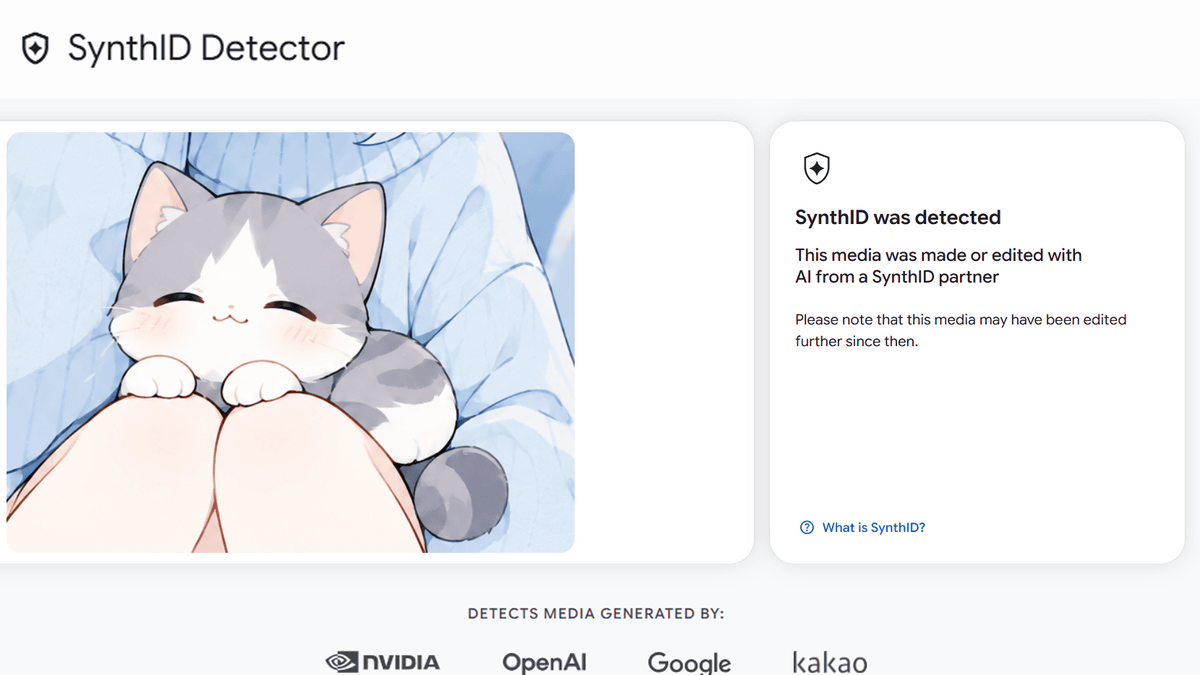
Google said on October 7, 2026 that SynthID Detector is now available worldwide in English, after limited testing. Users log in with Google, Apple, or ChatGPT to upload a file for detection.
Why it matters
The tool gives a way to check whether uploaded content carries a SynthID watermark, rather than relying on guesswork. A watermark not showing up does not prove content is human-made.
WHO IT HITSPeople who handle images and videos as part of their work, such as editors, publishers, and social media teams, may get an easy way to check whether a file from a text-to-image tool carries Google's watermark. The check only covers SynthID-supporting models, so a negative result cannot be read as proof of human authorship.
Summaries like this, every morning.
Google says that since it released SynthID in 2023 it has watermarked 180 billion images and videos, and 240,000 years of audio content, with 1 million daily verification requests. That scale is the backdrop for opening the detector to the public.
In a test, an image generated with Gemini prompted detection and a correct attribution to Google's AI. An image made with the same prompt in ChatGPT was labeled as made or edited with OpenAI. After cropping to just the cat and editing brightness, SynthID was still detected, but the tool no longer attributed it to OpenAI.
A comic panel from GIGAZINE's series produced no SynthID detection. The detector only looks for SynthID, so content from generative AI that does not embed it cannot be identified, and a miss does not prove the content is human-made.
Pick your industry and the AI tools you use, and get news related to your work every day.
Free · 30 seconds with Google · unsubscribe anytimeWhat is AIToday? →
Ask AI anything about this article. The AI reads this article, earlier AIToday articles, and Wikipedia, and cites its sources. Q&As are published on this page for other readers too.
The November 22 paper "Perplexity and Intelligence," signed by chief scientist Jakub Pachocki, ties GPT-3.5 to…

Mathematician Levent Alpöge, working at Anthropic, announced a Claude-generated proof of the Riemann hypothesi…

The New York Times emailed freelancers requiring them to avoid Adobe Photoshop 2027 (release 28.0.0 and later)…
After critics screenings last week ahead of the November 25th premiere, viewers including director Patrick Tom…

Anthropic researchers developed Siren, a honeypot that puts AI agents in one of 26 simulated sandboxes with de…
Pinterest said this week that parents can now control how much AI-generated content their children see, alongs…