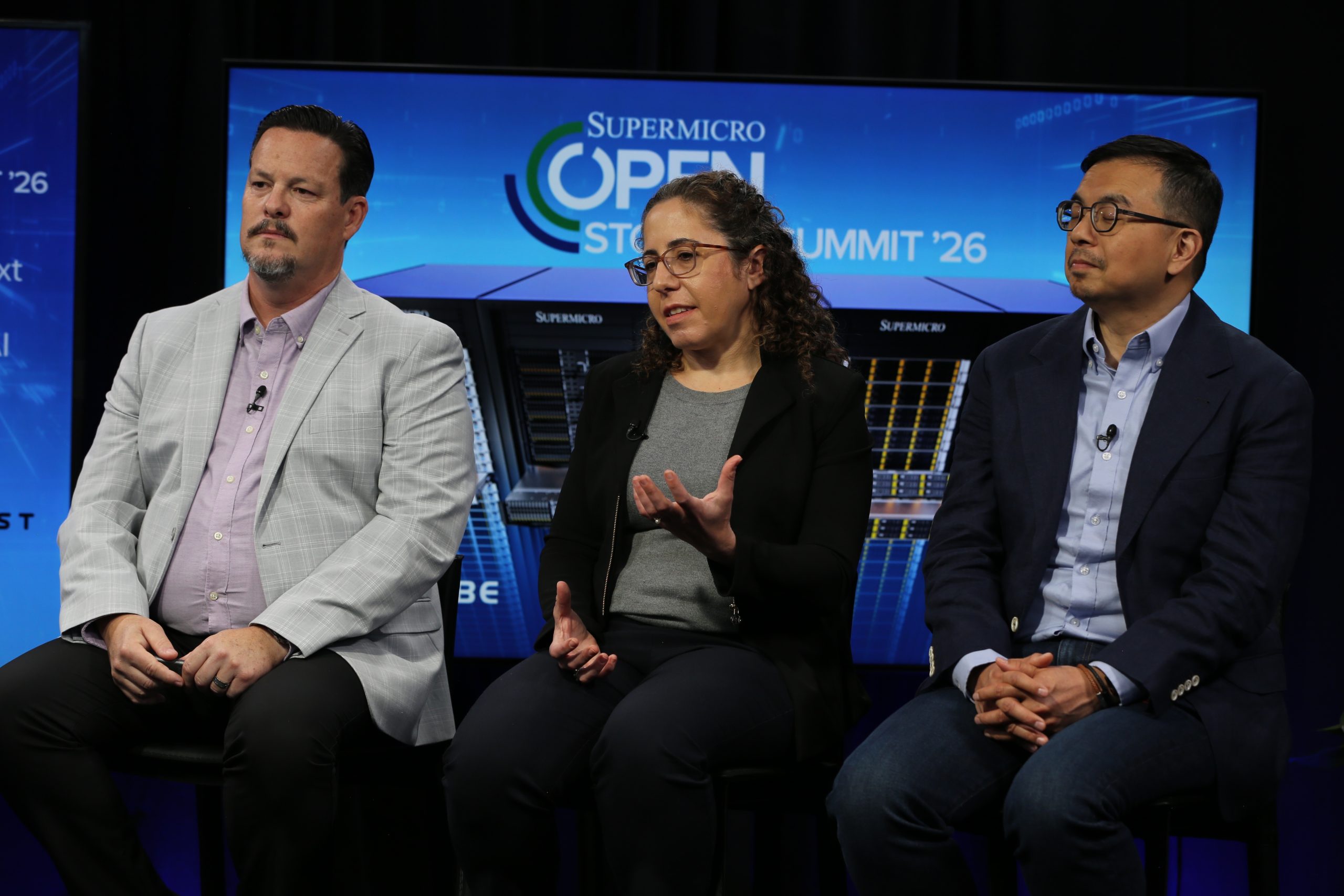
What happened
At the Supermicro Open Storage Summit, Solidigm, Vast Data, and Super Micro Computer discussed how AI storage infrastructure must add tiers, including SSDs and KV cache, to handle longer agentic AI contexts. Vast Data reported 20 times faster time-to-first-token and 90% savings in GPU time with Nvidia Dynamo.
Why it matters
As agentic AI grows, GPU memory alone can't hold all context, so storage tiers balance proximity, capacity, and speed. KV cache offload replaces expensive compute with storage, reducing latency and saving on GPU costs, which are very expensive.
What to watch
Supermicro's CMX proposal targets large AI clusters, introducing a G3.5 tier as an AI-native KV cache. Solidigm's D7-PS1010 and D5-P5336 SSDs address different points in the storage hierarchy, which is still evolving.
Summaries like this, in your inbox every morning.
The discussion at the Supermicro Open Storage Summit highlights a shift in AI infrastructure priorities. As organizations move from training models to deploying agentic AI, the focus is on inference, where storage plays a new role. The growth of context windows means GPU memory alone is insufficient, prompting the need for additional storage tiers that balance proximity, capacity, and speed. Solidigm's SSDs, Supermicro's systems, and Vast Data's AI Operating System form a layered approach to manage data during inference.
The concept of KV cache offload is central, as it allows replacing expensive GPU compute with storage. Vast Data's reported 20 times faster time-to-first-token and 90% GPU time savings illustrate the potential benefits. This approach is not a one-size-fits-all solution; as Supermicro's Lee noted, different deployments may require different combinations of memory, local SSDs, and network storage. The architecture is evolving, with new tiers like G3.5 emerging to address specific needs.
The implications for businesses are significant. As AI inference becomes more prevalent, managing storage infrastructure becomes crucial for performance and cost. The collaboration among companies like Solidigm, Supermicro, and Vast Data suggests a trend toward integrated solutions rather than single components. This evolution is likely to continue, as the industry seeks to optimize AI workloads and reduce the high costs associated with GPU usage.
Pick your industry and the AI tools you use, and get news related to your work every day.
Free · 30 seconds with Google · unsubscribe anytimeWhat is AIToday? →
Ask AI anything about this article. The AI reads this article, earlier AIToday articles, and Wikipedia, and cites its sources. Q&As are published on this page for other readers too.
Chunghwa Telecom president Rong-shy Lin said the shift from conversational AI to autonomous AI agents is resha…
CoreWeave fell 5% in premarket trading Friday and was on track to finish the week down 15%, after rebounding f…
Apple and Meta said they would jointly release a new open-weight AI model designed to run on high-end Macs, ai…

Investors put $38.5 billion into Asian startups in Q3, per Crunchbase data

A longtime Anthropic investor told Fortune he expects shares priced around $1.8 trillion, below the company's…

In Q2, billionaires or their funds sold six 'Magnificent Seven' AI stocks