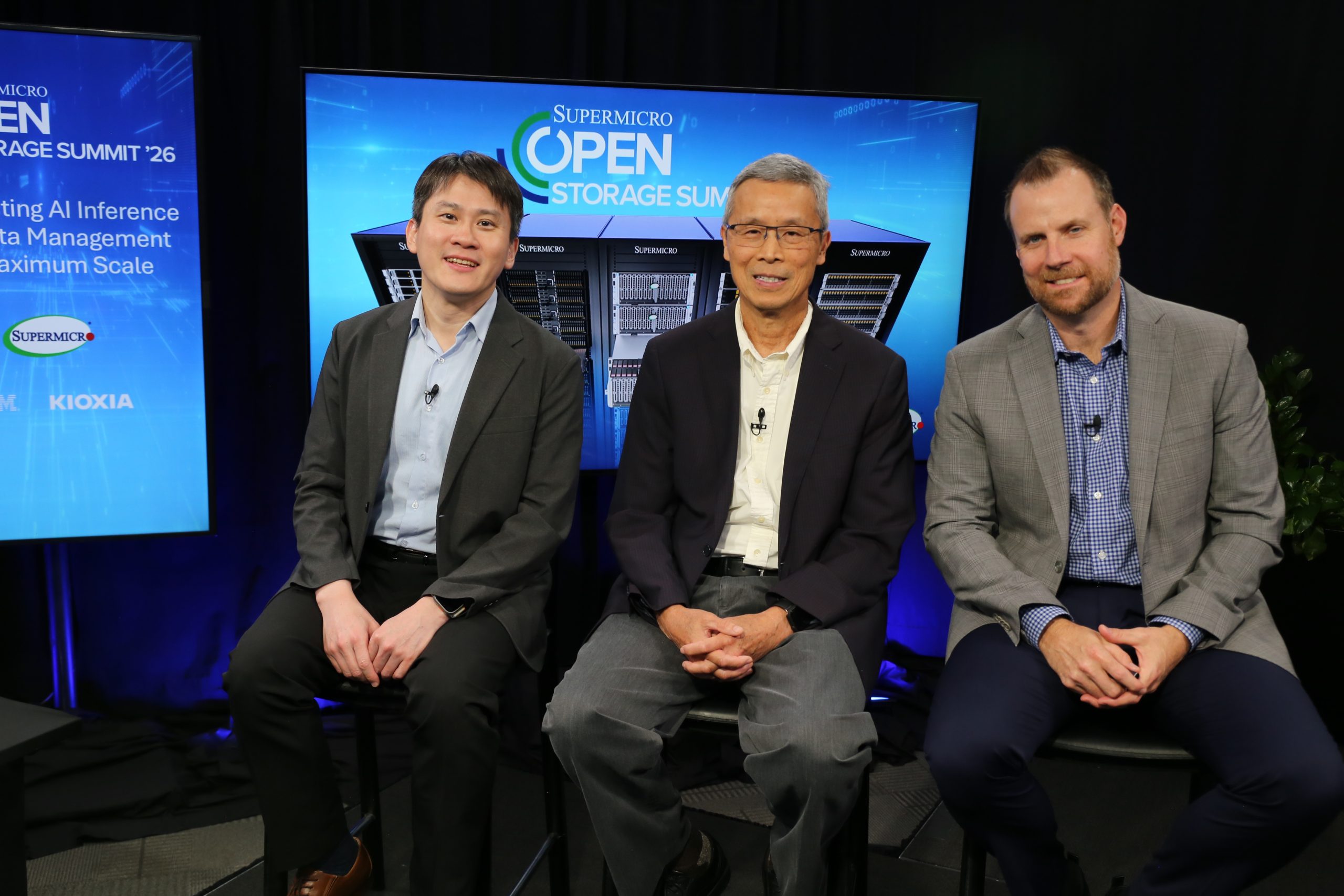
AI inference is no longer just about GPU speed—the industry is now reshaping entire data center infrastructure around storage latency, network bandwidth, and power consumption.
A joint test by Supermicro, IBM, Nvidia, and Kioxia showed that caching context in shared storage rather than GPU memory can achieve subsecond response times while maintaining high efficiency even under real-world network congestion, suggesting that full-stack system design tailored to specific workload types (chat, batch, or agentic) is becoming essential for cost-effective inference at scale.
What happened
AI inference infrastructure is evolving beyond GPU performance alone—storage latency, network bandwidth, data movement, and power consumption now determine token production cost and speed. Supermicro, IBM, Nvidia, and Kioxia tested a reference design combining Nvidia's HGX B300 with IBM Storage Scale as a shared KV cache, achieving subsecond time-to-first-token responses and maintaining 18× efficiency gains (down from 22× in ideal conditions) when heavy network traffic was added to simulate real-world conditions.
Why it matters
Different workload types—interactive chat, batch inference, and agentic systems—require different infrastructure tradeoffs. Organizations face a challenge: data is scattered across enterprises in structured, unstructured, and multimodal forms, spanning mainframes and other environments. The new approach allows cached context to be reused without keeping all data in limited GPU memory, addressing both latency and power efficiency constraints that data centers increasingly face.
What to watch
Kioxia's newer BiCS8-based CM9 drives showed 76% improvement in random read operations per second per unit of power and over 100% improvement in random write operations compared to the preceding CM7 generation, signaling how next-generation storage technologies can improve power efficiency in inference workloads.
Ask the AI about this article →
The AI inference landscape is shifting from a GPU-centric paradigm to a holistic data center redesign. While GPU performance remains foundational, the body makes clear that storage latency, network bandwidth, data movement, and power consumption now equally determine the economics and speed of token production. This reflects a maturation of AI deployment: as generative and agentic applications move into production at scale, organizations encounter system-level bottlenecks that no single component can solve.
The challenge is compounded by workload diversity. Interactive chat applications prioritize low-latency response times, batch inference emphasizes raw throughput, and agentic systems with expanding context windows create novel demands. Retrieval-augmented generation (RAG), which injects fresh or proprietary data into model prompts on the fly, further complicates the stack—it requires fast, reliable access to scattered enterprise data without ingesting massive amounts into centralized AI factories, a problem the body identifies as data sovereignty and data gravity. The Supermicro reference design addresses this by combining Nvidia's compute hardware with IBM's shared KV cache storage and Kioxia's power-efficient drives, allowing context to live outside GPU memory and be reused dynamically.
The test results—maintaining 18× efficiency gains even under real-world network stress—suggest that coordinated infrastructure design tailored to workload type can sustain performance at scale. Power efficiency improvements in Kioxia's newer drives (76% gain in random reads, over 100% in random writes per unit power) underscore that next-generation storage technologies, not just compute upgrades, are now critical to the inference bottleneck.
AI-summarized, only the topics you pick — one digest a day via Email, Slack, or Discord.
Free · takes 30 seconds · unsubscribe anytime
Ask AI anything about this article. Q&As are published on this page for other readers too.
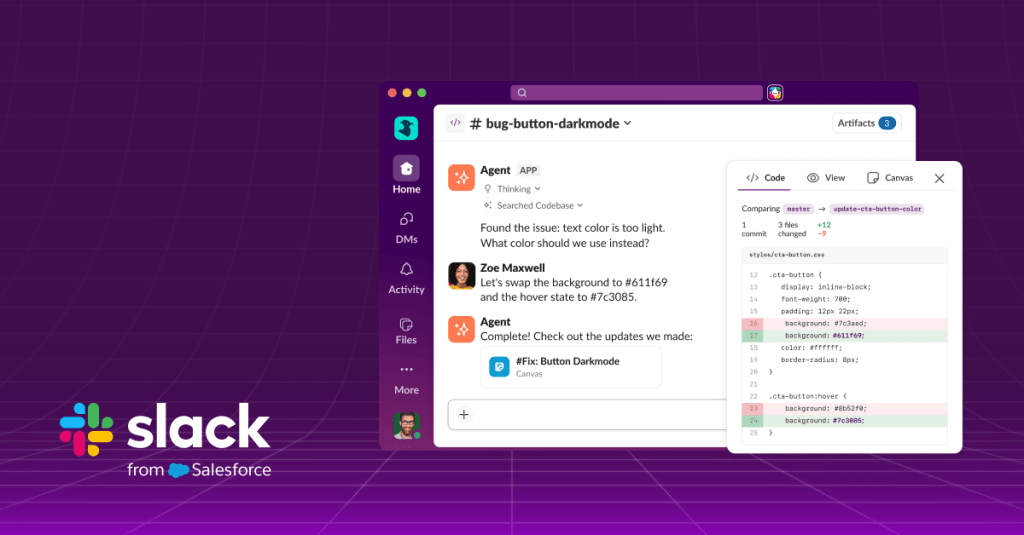
Slack introduced Slack Code, a new feature that lets teams collaborate with AI coding agents (Claude, Devin, G…
Cisco is transforming its digital customer experience (DCX) strategy by embedding AI throughout customer journ…

Mastercard CEO Michael Miebach introduced "Agent Pay" last April, a payment framework that allows AI agents to…

SpaceX closed a $60 billion acquisition of Cursor, a popular code editor with over 50,000 companies in its use…

Enterprise AI teams are now running a median of three orchestration platforms (software that coordinates AI ag…

Adobe announced general availability of audio generation capabilities in Firefly, its creative AI suite