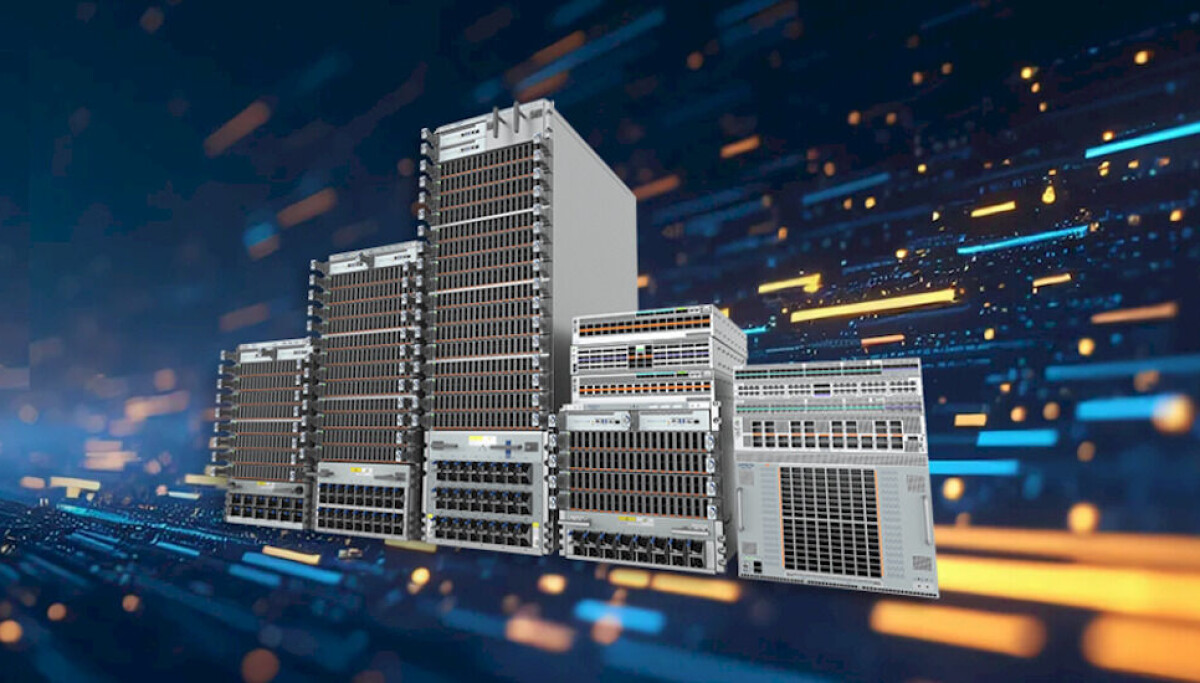
Arista Networks lifted its 2026 revenue guidance by $1.1 billion to $12.6 billion after reporting Q2 revenues of $3.04 billion—up 37.7 percent—driven by surging demand for AI datacenter networking across three layers: scale-up (GPU interconnects), scale-out (multi-node coupling), and scale-across (inter-datacenter links).
The company is capturing roughly a third of the emerging scale-across market, where Ullal projects a $3 billion switching opportunity in 2026 expanding to $15 billion by 2030, while software subscriptions jumped 4.3X year-over-year as customers adopt Arista's monitoring and operating-system tools instead of building them independently.
What happened
Arista Networks reported Q2 product revenues of $2.61 billion, up 38.8 percent, with services revenues up 31.3 percent to $430.5 million. Total Q2 revenues reached $3.04 billion, up 37.7 percent year-over-year — the first time the company broke $3 billion in a single quarter. The company raised its full-year 2026 guidance by $1.1 billion to $12.6 billion, representing 44 percent growth compared to 2025.
Why it matters
Arista is benefiting from three concurrent network buildouts inside AI datacenters: scale-up networks (linking GPU/XPU memory within a node), scale-out networks (coupling multiple nodes loosely together), and scale-across networks (linking datacenters and regions). CEO Jayshree Ullal indicated scale-across networks alone represent a roughly $3 billion switch opportunity in 2026, with Arista capturing about a third, plus a $1 billion optics market expanding to $15 billion in switches and $5 billion in optics by 2030. The company's software subscription revenue jumped 4.3X year-over-year, showing customers are also adopting its EOS network operating system, CloudVision data tracking, LANZ latency analyzer, and other monitoring tools rather than building these in-house.
What to watch
Arista's forecast for AI back-end and front-end networks is $3.6 billion for full-year 2026 (up $100 million), representing around 2.1X growth year-over-year. Scale-up adoption depends partly on whether customers move away from Nvidia's proprietary NVLink and NVSwitch toward open Ethernet alternatives; Ullal noted the shift from InfiniBand to Ethernet took two to three years, suggesting a similar timeline for NVLink displacement. The company held $13.34 billion in cash and equivalents (up 50.9 percent year-over-year) and $9.7 billion in customer purchase commitments (up 2.7X year-over-year), positioning it to invest tactically.
Arista Networks reported second-quarter revenues of $3.04 billion for the period ended in June, up 37.7 percent year-over-year and representing a 12.1 percent sequential increase from Q1 2026. Crucially, this marked the first time the company surpassed $3 billion in quarterly sales. Product revenues rose to $2.61 billion, up 38.8 percent, with growth spread across product lines and segments. Services revenues climbed to $430.5 million, up 31.3 percent, driven by adoption of Arista's EOS network operating system, CloudVision data tracking, LANZ latency analyzer, Path Tracer link analyzer, DANZ Monitoring Fabric packet broker, and Connectivity Monitor jitter and packet loss tools. The body estimates that software subscriptions alone reached approximately $137.2 million, up 4.3X year-over-year, with software and subscriptions combined hitting $567.7 million, up 58 percent.
On the bottom line, operating income grew 39.7 percent to $1.38 billion, while net income rose 36.5 percent to $1.21 billion, representing a robust 40 percent of revenues. The company's balance sheet strengthened considerably: cash and equivalents increased 50.9 percent to $13.34 billion year-over-year, deferred revenues jumped 69 percent to $6.87 billion, and customer purchase commitments surged 2.7X to $9.7 billion. This combination of large forward commitments and substantial cash reserves gives Arista negotiating leverage with component suppliers—a critical advantage in the tight supply-chain environment the body describes as endemic to IT equipment suppliers serving hyperscalers.
Looking ahead, Arista raised its full-year 2026 guidance by $1.1 billion to $12.6 billion, implying 44 percent annual growth versus 2025. Within that, the company is forecasting AI back-end and front-end network revenues of $3.6 billion for 2026 (up $100 million from prior guidance), representing around 2.1X growth year-over-year. Campus-focused networking is expected to reach approximately $1.25 billion, up 53.4 percent. CEO Jayshree Ullal broke down the AI network opportunity into three categories. Scale-across networks—those linking datacenters and regions together—are expected to represent about 30 percent of the AI back-end/front-end revenue category in 2026, or $1.08 billion. Scale-up networks, which link GPU and XPU memory within a single node or rackscale system, and scale-out networks, which loosely couple multiple nodes to share work, are expected to combine for the remaining 70 percent, or $2.52 billion.
Ullal characterized the broader scale-across opportunity as roughly a $3 billion market for switch gear and $1 billion for optics in 2026. Arista's implied market share in this segment is approximately a little more than a third. By 2030, scale-across switching is projected to grow to around a $15 billion opportunity, with another $5 billion for related optics. A major constraint on scale-up expansion is Nvidia's proprietary NVLink and NVSwitch ecosystem. The body quotes Ullal as saying: "Where it's non-Nvidia, Arista will be excited and will be working more closely both in the scale up and scale out – in some cases to build custom racks with their custom processors so that we can better tune our network with the behavior for their inference or training engine. In the Nvidia cases, it's going to take a bit longer. I feel a little bit like two or three years ago we were talking about InfiniBand and now we don't mention InfiniBand. But it took two or three years to move to Ethernet. So it will take time to go from a proprietary scale-up that's been around a long time with NVLink to these other alternatives, even if Ethernet is really good." This suggests that displacement of NVLink by Ethernet-based alternatives may take two to three years, similar to the historical shift from InfiniBand.
Arista Networks is capturing accelerating demand from three distinct network layers emerging within AI datacenter architecture. The company's Q2 results—with $3.04 billion in total revenues, up 37.7 percent—reflect a shift from traditional cloud networking toward specialized AI infrastructure that requires scale-up networks (linking GPU memory within a single node), scale-out networks (coupling multiple nodes into larger systems), and scale-across networks (linking separate datacenters and regions). The body notes that this AI-driven revenue surge is significantly larger than the cloud networking wave a decade earlier, visible in Arista's deferred-revenue chart. The company's $9.7 billion in customer purchase commitments (up 2.7X year-over-year) and $13.34 billion in cash reserves (up 50.9 percent) suggest customers are committing capital early and Arista has room to negotiate aggressively with component suppliers—the core advantage the body describes as essential to IT infrastructure suppliers in a tight supply-chain environment.
A critical dynamic the body surfaces is software-centric stickiness. Arista's software subscription revenue grew 4.3X year-over-year, and services revenues (bundling EOS network operating system, CloudVision monitoring, latency and packet-loss analytics tools) grew 31.3 percent. The body explains that large enterprises, sovereigns, and AI builders lack the engineering resources to replicate these tools in-house; they have no practical choice except to buy Arista's full stack or adopt fragmented open-source alternatives. This shift from hardware-only to integrated software-plus-hardware positioning widens Arista's defensibility and margin: operating profit hit $1.38 billion (39.7 percent growth) and net income $1.21 billion (36.5 percent growth), with a healthy 40 percent net margin.
The scale-across opportunity illustrates Arista's market position most concretely. Ullal stated that the scale-across market represents about $3 billion in switch revenue in 2026, with Arista capturing roughly a third—implying substantial market share. By 2030, that market is expected to expand to $15 billion for switches plus $5 billion for optics. Scale-up adoption, by contrast, remains constrained by Nvidia's proprietary NVLink ecosystem, which still dominates AI training clusters. The body quotes Ullal noting that the shift from InfiniBand to Ethernet took two to three years, and she expects a similar timeline for NVLink displacement. This indicates that while Arista is well-positioned today in scale-across and scale-out, major upside in scale-up depends on how aggressively non-Nvidia accelerators or open alternatives gain adoption—a multi-year cycle.
AI-summarized, only the topics you pick — one digest a day via Email, Slack, or Discord.
Free · takes 30 seconds · unsubscribe anytime
Ask AI anything about this article. Q&As are published on this page for other readers too.
QumulusAI announced a GPU-as-a-Service agreement with DRW, a global trading firm, to supply a dedicated NVIDIA…

OpenAI introduced Premium Seats for ChatGPT Business, priced at $125 per user per month ($100 with annual bill…

Anthropic pledged to embed machine-readable watermarks in Claude-generated text and digitally signed provenanc…

OpenAI announced that its unreleased model Astra had produced solutions to 10 long-standing mathematics proble…

Anthropic confirmed it will add watermarks to text generated by Claude and other models to comply with the EU…

TSMC has roughly doubled its CoWoS and SoIC packaging capacity annually for several years and is now running C…

The AI news that matters, in one minute each morning.
Sign up free