Summaries like this, in your inbox every morning.
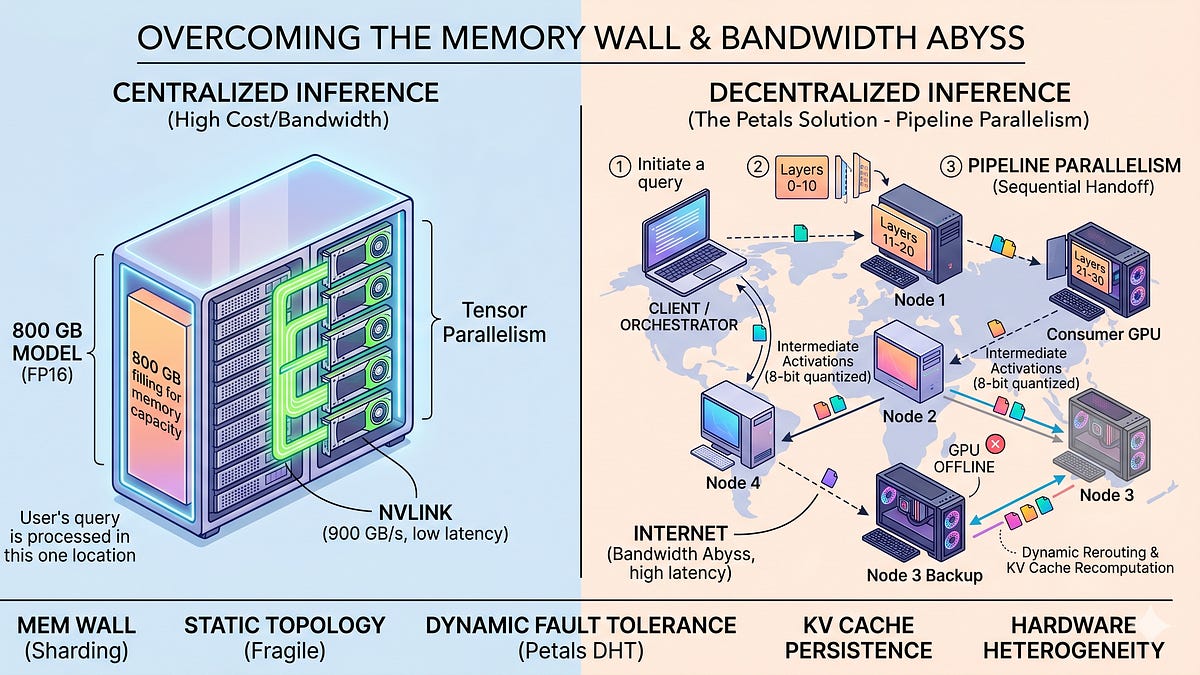
Sign up free →A 400-billion-parameter model at FP16 precision requires roughly 800 GB of memory, exceeding any single GPU's capacity and forcing distributed inference across multiple devices.
Three parallelism methods exist: data parallelism (identical copies on separate GPUs), pipeline parallelism (model split vertically by layers), and tensor parallelism (single layer split horizontally with all-to-all synchronization). Tensor parallelism works within centralized racks using NVLink's 900 GB/s bandwidth and microsecond latency, but over the open internet—offering 10 to 100 MB/s with tens to hundreds of milliseconds latency—would cause GPUs to spend 99 percent of time waiting for network round trips rather than computing.
Pipeline parallelism becomes the only viable route for decentralized scenarios, accepting sequential layer execution but enabling point-to-point communication between stages rather than collective synchronization; however, this creates bootstrap problems (minimum GPU threshold before inference is possible) and weight migration challenges when network composition changes.
No comments yet. Be the first to share your thoughts!
Log in to join the discussion


Get curated AI news from 200+ sources delivered daily to your inbox. Free to use.
Get Started FreeFree · takes 30 seconds · unsubscribe anytime
1 minute a day. The AI essentials.
200+ sources · Email / LINE / Slack
