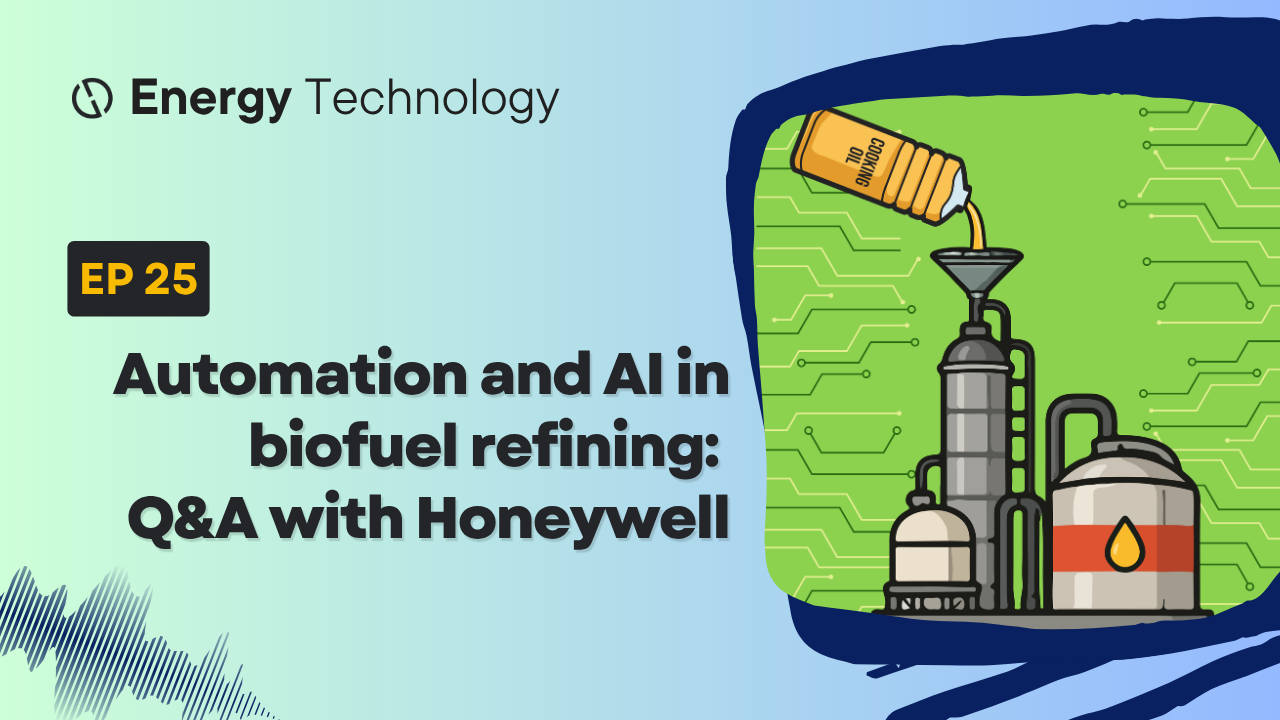
Honeywell's Lewis Sweet explained how integrating AI with automation can solve critical bottlenecks in biofuel refining—namely, handling inconsistent feedstocks and contaminants that conventional refineries cannot manage. By using AI to predict and adjust reactor behavior in real time, producers can cut off-specification delays from 6–12 hours to around 2 hours, reducing costs and moving facilities closer to economic parity with traditional fuels. More detailed carbon calculations powered by AI could also enable price differentiation and make renewable projects more financially viable as the market matures.
Summaries like this, in your inbox every morning.
Sign up free →What happened
Honeywell Process Automation's general manager Lewis Sweet outlined how AI combined with automation can help biofuel refineries handle feedstock inconsistency and contamination—challenges that conventional refineries, designed for consistent crude inputs, are not equipped to manage. AI allows predictive control that can reduce off-specification delays from 6–12 hours to around 2 hours, Sweet said.
Why it matters
Biofuel demand is rising due to decarbonisation targets in hard-to-abate sectors, but supply-side bottlenecks limit growth. By using AI to predict reactor behavior and adjust control settings in real time, producers can cut costs, improve on-spec uptime, and move closer to market parity with conventional fuels. More granular carbon footprint calculations—potentially down to molecular level—could also enable price differentiation as the market matures.
What to watch
The scientific understanding of biofuel feedstock composition and contamination is still emerging; biofuels contain super-long organic carbon chains (C60) and unexpected contaminants that conventional fuel models (which measure up to C15 or C16) were never designed to detect. Sweet noted that Honeywell and the broader industry are still learning how to build accurate mathematical models to handle this complexity.
Lewis Sweet, general manager for sustainable fuels and chemicals at Honeywell Process Automation, discussed how automation and artificial intelligence are converging to address a critical constraint in biofuel refining: the chemical inconsistency of feedstocks and the sophistication required to process them profitably at scale.
The core problem is structural. Biofuel demand is surging because decarbonisation targets across hard-to-abate sectors (steel, cement, shipping) are pushing regulators and producers to seek low-carbon alternatives. Conventional refineries, however, are designed to handle a small number of well-characterized crude inputs. Biofuel feedstocks—used cooking oil, agricultural residues, algae, and other waste streams—are neither consistent in quality nor well-categorized. They arrive contaminated with fertiliser residues, food particles, and a vastly wider range of organic compounds than crude oil. This mismatch between feedstock variability and refinery design creates operational risk and cost. When a reactor encounters an unexpected contaminant or chemical composition, it drifts off-specification; conventional refineries can spend 6 to 12 hours recovering, during which the product is unsaleable.
Sweet explained that AI, integrated with existing automation and control systems, can collapse this delay. Instead of waiting to observe a problem and then correcting it, AI can predict what the reactor will do based on incoming feedstock properties, then adjust control parameters—reactor temperature, pressure, catalyst loading—before the deviation occurs. In practice, he said, this can shrink a 12-hour off-spec window to 2 hours. The financial impact is direct: every hour a facility runs at on-specification capacity generates margin; every hour lost to off-spec operation or idle time is foregone profit. Biofuel producers, operating on thin margins relative to crude-oil refineries, cannot absorb these losses and remain price-competitive. By tightening operational discipline through predictive AI, they move measurably closer to economic parity with conventional fuels.
A second opportunity lies in carbon accounting. Current industry practice calculates carbon intensity using a "soft sensor"—a mathematical model that estimates emissions based on feedstock custody and supply-chain assumptions. A tonne of used cooking oil sourced from China carries a different carbon footprint than the same feedstock from Japan or Brazil, because transportation distances, modes (truck, rail, barge), and supply-chain practices differ. As a refinery's utility consumption, reactor severity, and feedstock blend change, the estimated carbon footprint changes too. However, Sweet noted that these models are coarse. AI and advanced analytics could offer molecular-level insight into feedstock composition and refinery emissions, enabling much more accurate carbon-intensity labeling. This could unlock a price-premium market: as regulation and customer preferences increasingly favor low-carbon fuels, producers who can credibly demonstrate sub-threshold carbon intensity could command higher margins and attract investment. Such granular measurement could make renewable fuel projects "more financially viable," Sweet said.
Yet Sweet was candid about limitations. The scientific understanding of biofuel feedstock composition and contamination is still young. Conventional fuel models measure hydrocarbon chains up to C15 or C16; biofuels contain super-long organic chains (C60) plus contaminants—fertiliser wash-off, French fry crumbs in used cooking oil—that scientists and engineers are only beginning to catalog and model. Honeywell itself, he said, is still learning. Building accurate mathematical models that capture this complexity will require sustained research. However, Sweet emphasized that "any directional improvement" in modeling accuracy and responsiveness directly lowers financial and operational risk for biofuel producers, improving the sector's chances of reaching scale.
Biofuel demand is accelerating due to decarbonisation mandates in hard-to-abate sectors—industries where electrification or hydrogen are not yet viable. The constraint, however, is supply-side: refineries that were engineered and optimized for crude oil inputs cannot easily process the chemical diversity of waste-derived feedstocks (used cooking oil, agricultural residues, etc.) without costly reconfiguration and operational risk. Honeywell's argument is that AI layered on top of traditional automation creates a feedback loop that addresses this mismatch. Rather than following fixed control recipes, AI can observe incoming feedstock properties in real time, predict how the reactor will respond, and adjust control parameters proactively—cutting the window of off-specification operation from hours to minutes. This matters because every hour a facility runs at off-spec or idle costs money; the closer a biofuel producer can run to nameplate capacity without product quality penalties, the nearer it moves to price parity with conventional fuels, which is the economic hurdle biofuels must clear to scale. Sweet notes that a second layer of value lies in carbon accounting. Today, carbon intensity is estimated using models based on supply-chain custody and rough feedstock classification; with finer-grained analytics, producers could calculate carbon footprints at near-molecular resolution, potentially opening a price-premium market for low-carbon biofuels. However, he also flags that the scientific foundation for this is immature—the biofuel industry is only beginning to catalog the hundreds of feedstock types and contaminants (organic chains up to C60, food fragments, fertiliser residues) that conventional fuel models never needed to model. Directional improvement in these models, even if imperfect, reduces financial and operational risk.
No comments yet. Be the first to share your thoughts!
Log in to join the discussion



Get curated AI news from 200+ sources delivered daily to your inbox. Free to use.
Get Started FreeFree · takes 30 seconds · unsubscribe anytime
1 minute a day. The AI essentials.
200+ sources · Email / LINE / Slack
