What happened
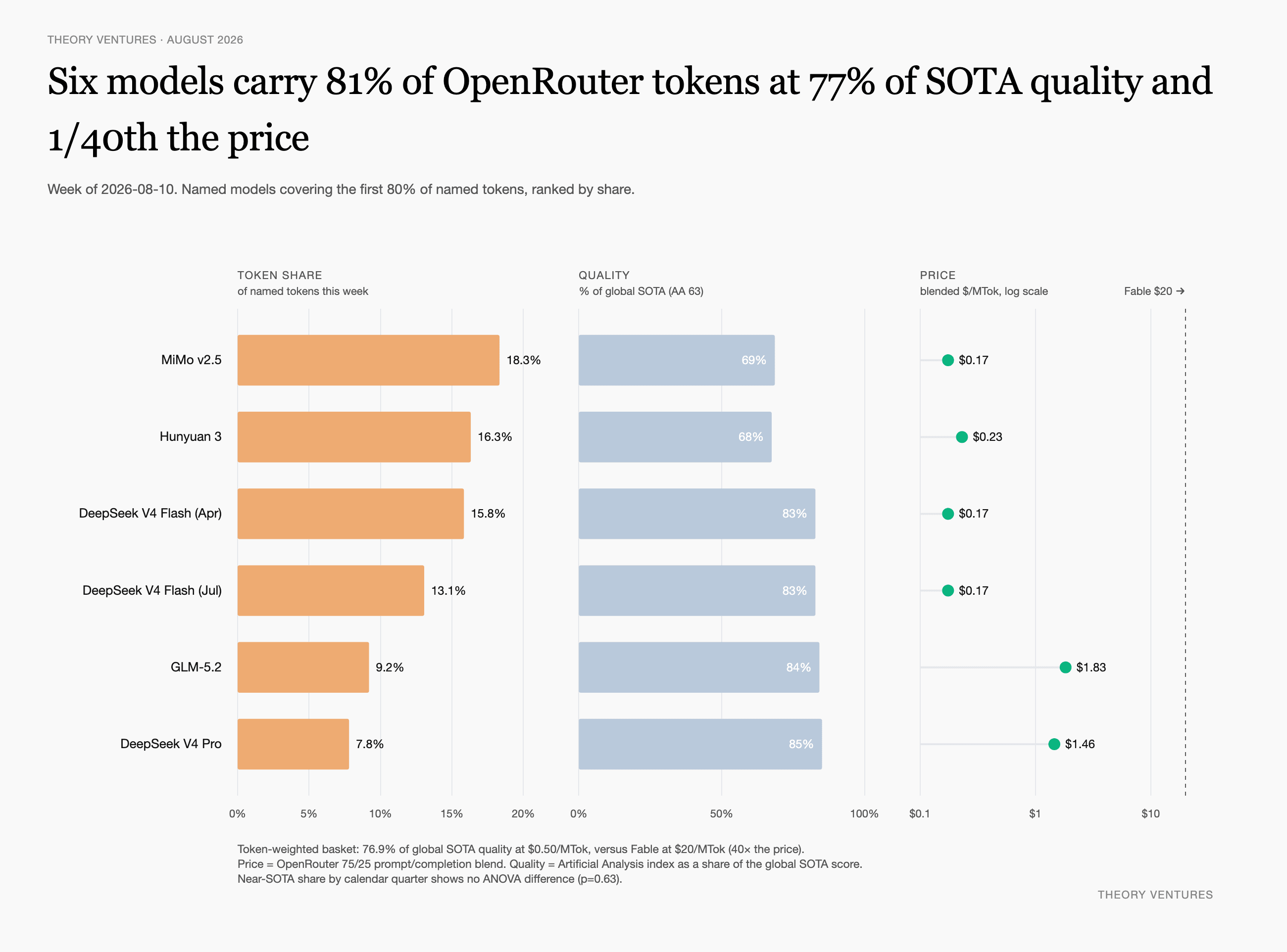
Despite state-of-the-art models being two-thirds smarter than last November and new models shipping every three days, 84% of tokens on OpenRouter use non-frontier models. Six cheaper models account for the supermajority of token volume, delivering about 77% of frontier performance at 2.5% of Claude Fable 5's price ($0.50 per million tokens vs. $20).
Why it matters
Buyers are price-elastic. Fable 5, despite costing substantially more than alternatives, captured only 6% of Anthropic tokens and 11% of Anthropic spend one month after launch, while generating roughly 75% as much model-attributed revenue as OpenAI's priciest mainline tier. This signals that for many workloads, performance "good enough at a meaningful discount" is winning over frontier capabilities. The best open-weight model reached 80% of frontier performance by May, up from 48% a year earlier, narrowing the gap further.
What to watch
Frontier models retain advantages in software architecture and security design, where the best available model justifies its premium. However, if share stops shifting toward state-of-the-art and cheaper alternatives remain sufficient, the economics of training runs become unsustainable—a nine-figure investment must win share to pay for itself, and that bar will rise over time.
Summaries like this, in your inbox every morning.
The article presents a striking divergence between AI capability progress and actual buyer behavior. State-of-the-art models have improved significantly—two-thirds smarter than last November—and the pace of release remains intense at two new models every three days. Yet this frontier innovation is not translating into dominant market adoption. Instead, 84% of tokens on OpenRouter route to non-frontier models, a gap that reflects rational economic decision-making rather than capability gaps.
The core dynamic is price elasticity. Six cheaper models generate 77% of frontier performance at 2.5% of Claude Fable 5's cost, and actual spending patterns confirm buyers respond to this trade-off. Fable 5, despite launching with frontier capabilities, captured only 6% and 11% of Anthropic's tokens and spend respectively a month after release, while generating less total model-attributed revenue than a pricier OpenAI tier. This pattern repeats across vendors: buyers consolidate on models that clear their workloads efficiently, not on capability alone. The best open-weight model's improvement from 48% to 80% of frontier performance in a year compounds this pressure—the performance gap that justifies premium pricing is shrinking.
The article identifies two distinct Pareto frontiers. Frontier models retain clear value for software architecture and security design, where the best available option justifies its cost. But application deployment optimizes differently: toward cheaper, fine-tuned, or open-source alternatives. If this second frontier becomes the dominant use case—and the data suggests it is—then the venture economics of frontier training runs face a rising bar. A nine-figure investment must recoup its cost through market share, yet each new state-of-the-art release should capture less share than the last, because the alternative already performs well enough.
Pick your industry and the AI tools you use, and get news related to your work every day.
Free · 30 seconds with Google · unsubscribe anytimeWhat is AIToday? →
Ask AI anything about this article. The AI reads this article, earlier AIToday articles, and Wikipedia, and cites its sources. Q&As are published on this page for other readers too.
Chunghwa Telecom president Rong-shy Lin said the shift from conversational AI to autonomous AI agents is resha…

CoreWeave fell 5% in premarket trading Friday and was on track to finish the week down 15%, after rebounding f…
Apple and Meta said they would jointly release a new open-weight AI model designed to run on high-end Macs, ai…

Investors put $38.5 billion into Asian startups in Q3, per Crunchbase data

A writer and entrepreneur opened his daily to-do list and found 156 items, and concluded that an AI assistant…

A longtime Anthropic investor told Fortune he expects shares priced around $1.8 trillion, below the company's…