What happened
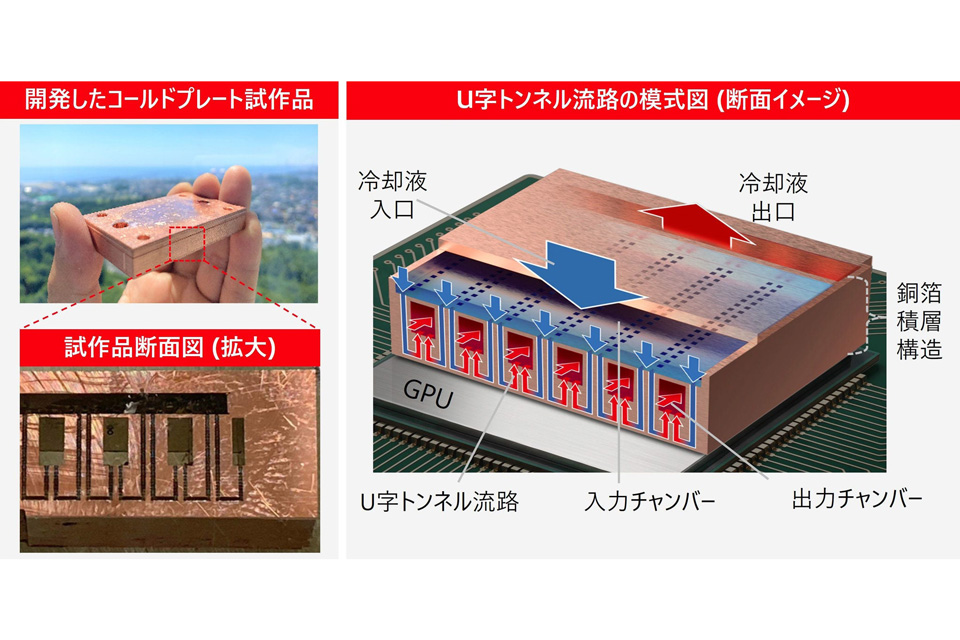
Hitachi unveiled a prototype GPU cold plate whose "U字トンネル流路" sends coolant straight at the GPU's hot spots, with thousands of micro-channels in parallel.
Why it matters
Keeping cold and warmed coolant apart lets it cool GPUs with higher-temperature fluid, and Hitachi expects this to cut cooling power by 30%.
WHO IT HITSOperators of AI data centers and data-center cooling and facility engineers stand to benefit, since lower cooling power draw would ease the load from rising GPU heat and GPU counts.
Summaries like this, in your inbox every morning.
Hitachi's prototype targets a specific bottleneck in AI data centers: the heat thrown off by GPUs. As GPUs generate more heat and are packed in greater numbers, the pumps, chillers and cooling towers that dump that heat outdoors carry a heavier load, and power consumption climbs with it. Hitachi's answer is to change the geometry inside the cold plate. Rather than running coolant along the GPU face, its "U字トンネル流路" drives fluid in the thickness direction toward the heat-generating parts, then turns it back toward the outlet. Because the incoming cold coolant and the warmed outgoing coolant stay apart, the mixing that degrades cooling performance is suppressed. Hitachi also says it shortened each channel to reduce friction and arranged thousands of micro-channels in parallel, preserving flow area within the same cold plate size. The company says this balances high cooling performance with low pressure loss, and lets it cool GPUs with higher-temperature coolant, so the temperature difference with outside air can be used to dissipate heat more efficiently. That is the basis for the expected 30% cut in cooling power. Whether that figure holds in real data centers, and when the design reaches customers, is not stated in the announcement.
Pick your industry and the AI tools you use, and get news related to your work every day.
Free · 30 seconds with Google · unsubscribe anytimeWhat is AIToday? →
Ask AI anything about this article. The AI reads this article, earlier AIToday articles, and Wikipedia, and cites its sources. Q&As are published on this page for other readers too.

