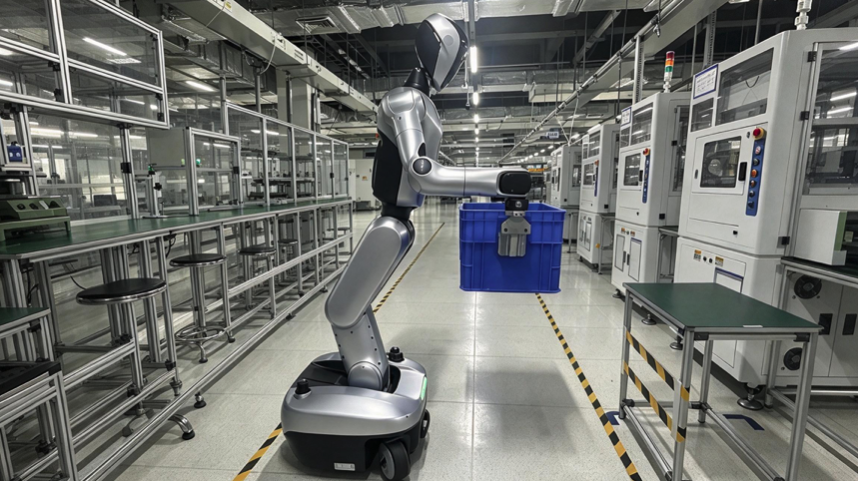
What happened
FMC³ Robotics launched the Doceo series, four linked technologies — RealCap, Hub, Cloud and Driver — that record workers' visual, depth, movement and tactile data and feed it into robot training.
Why it matters
The company argues the real shortage is qualified physical-world data, so collecting it on live factory floors could cut the engineering and retraining needed when manufacturing tasks change.
WHO IT HITSManufacturing and production engineers at industrial robot users stand to benefit, since the approach aims to reduce the engineering and retraining required when factory tasks change. Robot integrators working with different control systems are also directly affected through the Doceo Driver component.
Summaries like this, every morning.
FMC³ Robotics is betting that the bottleneck for industrial robots is not algorithms but data. Its Doceo series is built around collecting information directly from factory operations while workers carry out their normal duties, rather than relying entirely on dedicated robot training facilities or simulated environments. Dr. Joachim Fetzer, president of Europe at FMC³ Robotics, frames the gap as one of qualified physical-world data that reflect how a task is actually performed, including errors and corrections.
The four components form what the company calls an industrial learning loop. RealCap gathers the raw signals, Hub synchronizes and annotates them, Cloud trains and tests models using data infrastructure from Vector Informatik, and Driver connects the results to different robotic platforms. Beyond the product, FMC³ is advancing two proof-of-concept projects — bin handling at a consumer electronics plant and electrode sheet handling at a battery cell facility — that will show how well human manufacturing experience translates into reliable robot operations.
The company is also working with Vector Informatik and PEM Motion on a planned German joint venture to standardize industrial data infrastructure, with the objective of making training data more consistent, traceable and reusable across factories and applications. If that works, the payoff FMC³ describes is less engineering and retraining when manufacturing tasks change.
Pick your industry and the AI tools you use, and get news related to your work every day.
Free · 30 seconds with Google · unsubscribe anytimeWhat is AIToday? →
Ask AI anything about this article. The AI reads this article, earlier AIToday articles, and Wikipedia, and cites its sources. Q&As are published on this page for other readers too.
SOMPOホールディングス and NTT signed a partnership agreement on 2026年11月11日 to push physical AI into nursing care, sta…
XPENG announced plans to launch five new right-hand-drive models in the UK over the next 12 months, beginning…

After an 18.5% stock drop, Jensen Huang resigned as CEO on Nov

Qvyon launched with $8 million led by MaC Venture Capital and released Mimic Core, a platform that turns real…
Viam launched the Viam Launchpad, a six-month program giving founders usage credits, engineering support, and…
Panasonic Holdings said on November 11 it will strengthen physical AI development with a roughly 250-person te…