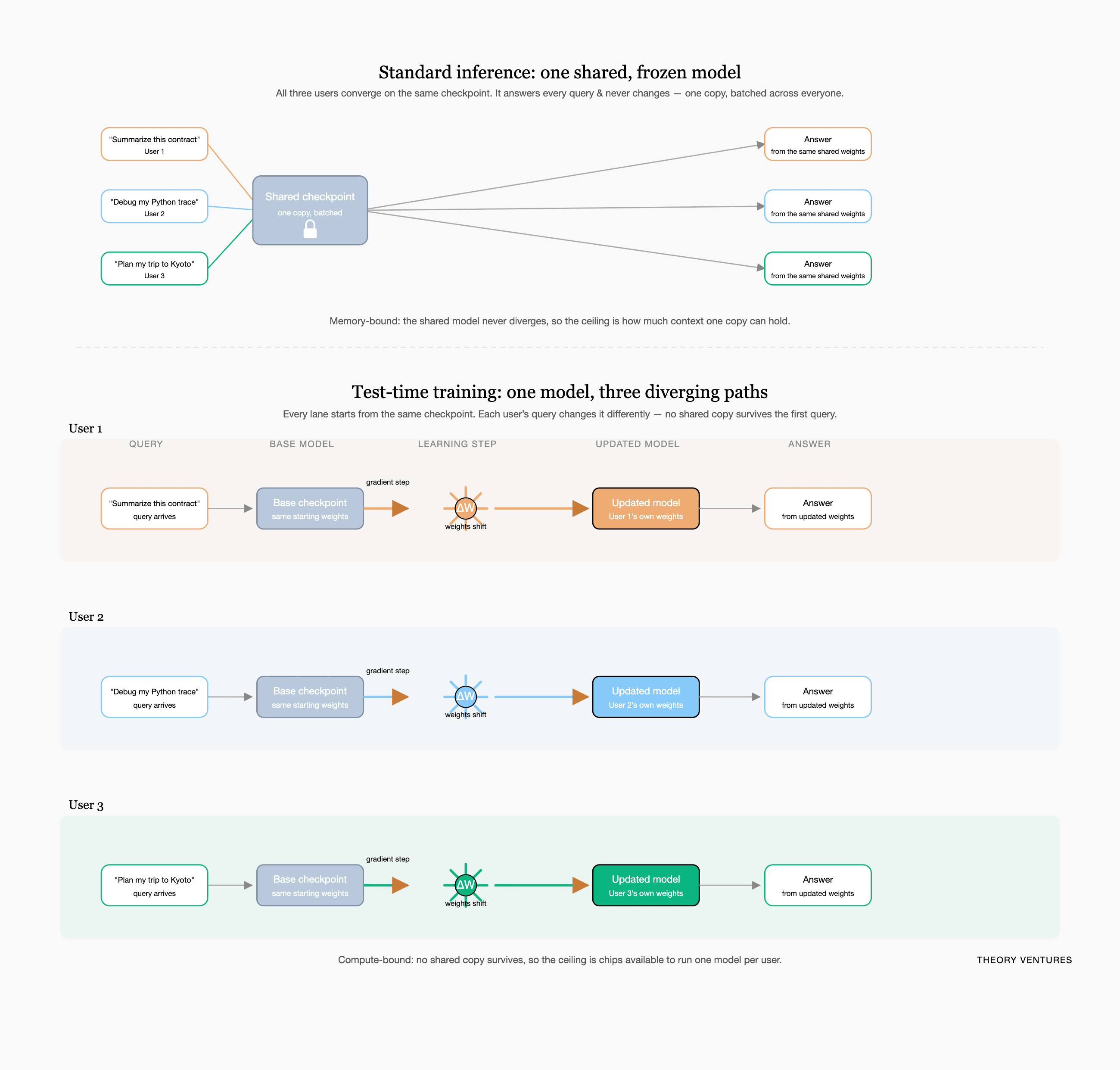
Test-time training is a technique where AI models update their weights while processing a prompt, rather than staying frozen.
This approach flattens memory requirements, removes the cost of serving separate model instances per user, and speeds inference—but creates a tradeoff between supporting long context windows and efficiently serving many users.
The economics favor test-time training for long-running sessions like coding agents, but frozen models remain better for one-off queries.
What happened
A technique called test-time training allows AI models to update their weights (internal parameters) as they work through a prompt, rather than remaining frozen. The model takes a gradient step on each prompt, causing its weights to change during inference—analogous to a GPS learning a persistent shortcut rather than making a one-time detour.
Why it matters
This approach trades off three key constraints. It keeps memory flat instead of requiring linearly growing storage for attention values (KV-cache), eliminates the provider cost of maintaining a separate model instance per user, and speeds up inference. However, it creates a tension: providers must choose between serving long context windows (which benefit from test-time training) and serving many users efficiently with a shared frozen model. The tradeoff depends on the use case—a coding agent that runs long sessions can recoup its per-user cost, while a one-off query works just as well on a cheaper shared model.
What to watch
The practical boundary between use cases where test-time training pays for itself (long interactive sessions) versus those where a frozen model remains optimal (single queries). This shapes which workloads providers optimize for and how they price inference.
Ask the AI about this article →
Test-time training represents a shift in how inference economics are framed. Traditionally, serving models has meant keeping weights static and managing the computational and memory costs of processing sequences—particularly the growing KV-cache that stores attention information. This article grounds the technique in a concrete tension: providers face a choice between optimizing for long context (where test-time training's persistent learning and flat memory offer advantages) or optimizing for throughput (where a frozen, shared model minimizes per-query cost and infrastructure overhead).
The framing as a GPS learning a shortcut clarifies what is at stake: test-time training is not about the model becoming better at language in general, but rather adapting to the specific patterns in the current conversation or task. This adaptation persists within a session but does not carry over (since each user or session gets its own model instance). The cost-benefit analysis therefore depends entirely on session length and complexity—a coding agent that runs for hours can justify the per-user overhead, while a factual lookup query cannot.
AI-summarized, only the topics you pick — one digest a day via Email, Slack, or Discord.
Free · takes 30 seconds · unsubscribe anytime
Ask AI anything about this article. Q&As are published on this page for other readers too.

