What happened
General Intuition, a startup developing foundation models for embodied AI, raised $320 million(約510億円) at a $2.3 billion(約3700億円) valuation. The company trained its model on millions of hours of video game data and demonstrated it can both play video games for hours and power a quadrupedal robot after fine-tuning on just eight minutes of real-world robotics data.
Why it matters
CEO Pim de Witte argues that embodied AI will follow the same pattern as language AI—companies will eventually shift from collecting millions of hours of task-specific robot training data to starting with a general foundation model and fine-tuning it. This could mean roboticists need only minutes of real-world data instead of hundreds of thousands or millions of hours.
What to watch
General Intuition's end goal is not to build robots itself, but to become the foundation model for other robotics companies. The startup claims its current model achieved zero-shot performance on a robot using only front-camera input, with no other sensors, in an office setting with moving people and objects.
Summaries like this, in your inbox every morning.
General Intuition's pitch echoes a pattern the tech industry has already seen with language models: before OpenAI's GPT-3, companies built specialized natural language processing models from scratch with task-specific training data, but most organizations now start with a general-purpose model like GPT, Claude, or Llama and fine-tune it to their needs. De Witte and the startup's lead investor Vinod Khosla argue that action data—information about how humans interact physically with their environment—is the key to building spatial-temporal reasoning that transfers across different robots and settings. Rather than treating each robot model or environment as its own problem, a foundation model with a base level of reasoning about space and time could reduce the data collection burden to minutes instead of millions of hours.
The startup's demonstration carries symbolic weight: the robot's ability to operate in an uncontrolled office environment with only front-camera input and no other sensors, after eight minutes of fine-tuning, is positioned as evidence that meaningful transfer learning is already possible. This suggests that companies building autonomous machines—whether self-driving cars, warehouse robots, or humanoid systems—may soon be able to rely on a shared foundation rather than collecting custom datasets at scale. The $320 million(約510億円) valuation reflects investor confidence in this thesis, though the real test will be whether General Intuition can scale the model across sufficiently diverse robotics applications to become the infrastructure layer its backers envision.
Pick your industry and the AI tools you use, and get news related to your work every day.
Free · 30 seconds with Google · unsubscribe anytimeWhat is AIToday? →
Ask AI anything about this article. The AI reads this article, earlier AIToday articles, and Wikipedia, and cites its sources. Q&As are published on this page for other readers too.
Amazon introduced Bee Frontier, a wearable personal AI, for $74.99 in Onyx, Lavender and Sage, and Bee Eclipse…

Citi has become the latest US bank to restrict AI agents from accessing accounts, per the Financial Times

Aparna Nair, IBM's chief talent, leadership, and culture officer, said generalists alone "will cut it" in the…
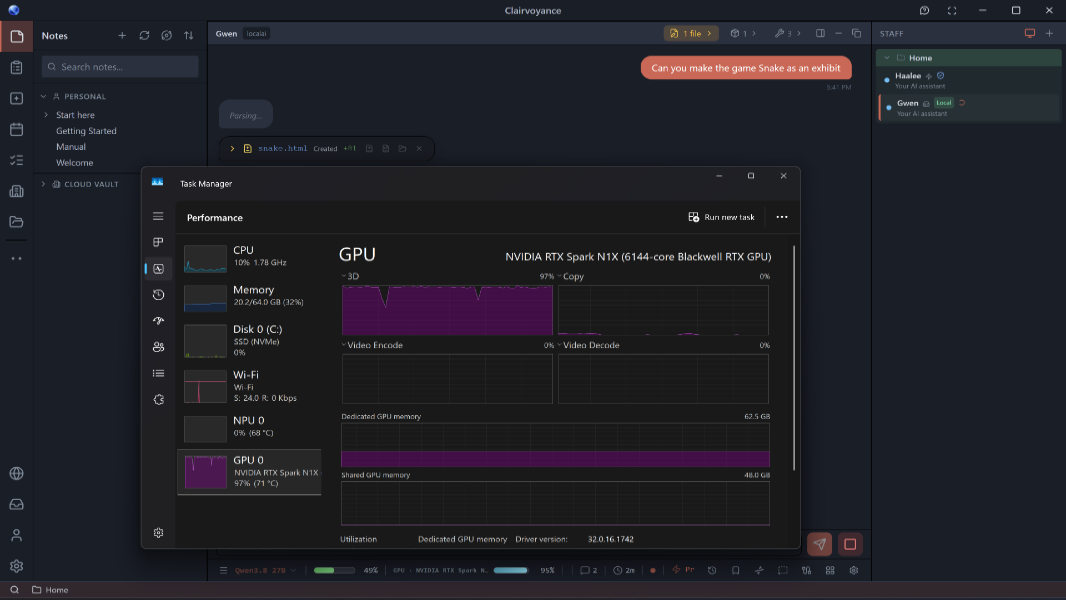
Microsoft and Nvidia are promoting RTX Spark, a new class of Windows PCs for local AI, with a top configuratio…
Dell says its AI Data Platform uses a four-engine architecture and a Unified Semantic Layer to connect siloed…

Microsoft AI CEO Mustafa Suleyman told employees that MAI-Base-2, announced Thursday, is a stronger pre-traine…