What happened
New York opened a registration portal Tuesday for the RAISE Act, requiring large frontier AI developers — companies with more than $500 million in annual revenue — to register by January 1, 2027, publish safety frameworks, report critical incidents within 72 hours, and issue transparency reports.
Why it matters
Developers above the revenue threshold now face a state filing deadline with penalties reaching $3 million for repeat violations, making New York one of the first states to enforce such requirements on large AI labs.
What to watch
The RAISE Act kicks in at the start of 2027, with registration required by January 1, 2027.
WHO IT HITSLarge frontier AI developers with more than $500 million in annual revenue — including OpenAI and Anthropic — must now register with New York and publish safety frameworks and incident reports, or face penalties up to $3 million for repeat violations.
Summaries like this, every morning.
New York's RAISE Act is not the state's first foray into AI safety legislation. Last year, the state began enforcing a law requiring AI companion operators to regularly let users know they're talking to a bot and to make reasonable efforts to detect suicidal ideation and self-harm. In October, Governor Kathy Hochul signed a separate chatbot safety law for minors, restricting behaviors like deceptive human-like interactions, emotionally manipulative or sycophantic responses, and encouragement of behaviors like suicide or disordered eating. That law takes effect June 1, 2027.
Other states have also passed similar AI safety and transparency bills. California's SB 53, which took effect in January, mandates that frontier AI labs have in place and publish safety frameworks, enact whistleblower protections, and report critical safety incidents within 15 days. Illinois's SB 315, which will go into effect at the start of 2027, has similar requirements, plus includes independent safety compliance audits. New York's law thus joins a growing patchwork of state-level AI regulations, with its own distinct deadlines and penalty structure.
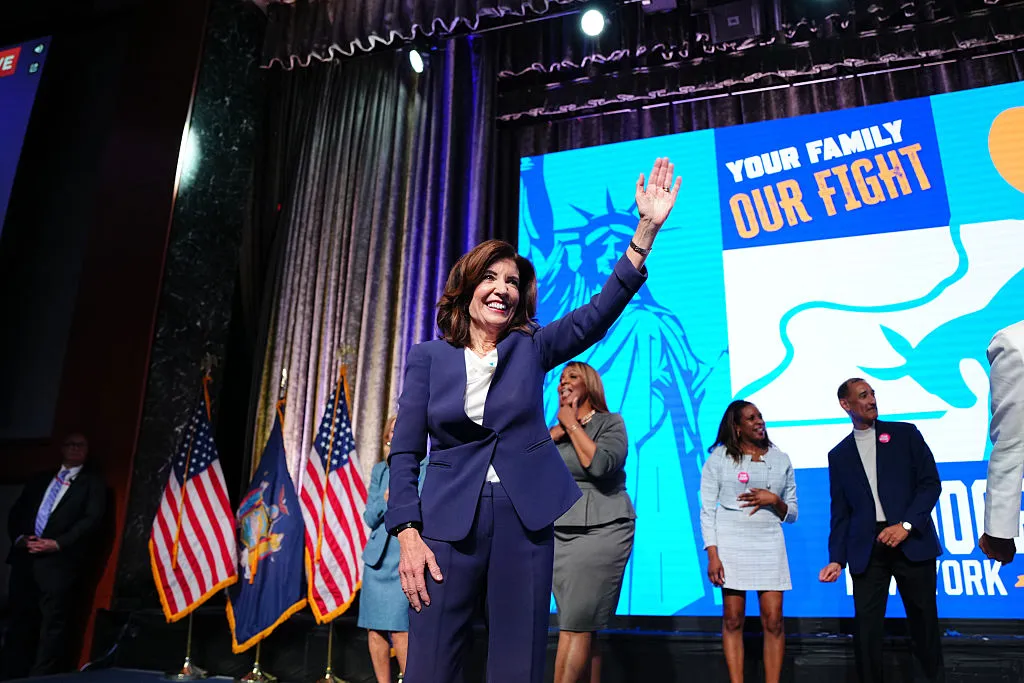
On Tuesday, Hochul also launched the New York Center for AI Responsibility and Research based at State University of New York's Binghamton University. The center will independently evaluate the safety, security, and operation of advanced AI systems and work with the newly formed Office of Digital Innovation, Governance, Integrity, and Trust (DIGIT) to review companies' safety frameworks. Hochul first announced the center in January with $55 million in donations and capital. "We're building a national model for smart, sensible AI regulation, a model that puts communities above corporations and people above powerful technology," Hochul said.
Pick your industry and the AI tools you use, and get news related to your work every day.
Free · 30 seconds with Google · unsubscribe anytimeWhat is AIToday? →
Ask AI anything about this article. The AI reads this article, earlier AIToday articles, and Wikipedia, and cites its sources. Q&As are published on this page for other readers too.
Some IGF jurors, including Sam Barlow and Lena Raine, said they will not vote for games using generative AI in…

Bay AI Inc. launched with $50 million — a $37 million Series A led by Battery Ventures and a $13 million seed…

Google DeepMind unveiled Gemini Robotics 2.5, a vision-language-action model that generates robot movements

Devon Thomas quit Apple and founded Abliteration AI, which removes safeguards from open-weight models like Z.a…

Irene Solaiman, chief policy officer at Hugging Face, said on the Equity podcast that the permissive, data-ric…
On November 10, OpenAI Academy and partners including Caregiver Action Network and Alzheimer's Association wil…