Thirty-seven researchers from leading universities and tech companies have published a provocative paper proposing that scientists abandon traditional papers in favor of an "Agent-Native Research Artifact" (ARA) format optimized for AI agents to read, reproduce, and extend research autonomously.
Lead author Jiachen Liu, who earned her Ph.D. from the University of Michigan in 2025 and cofounded the Agent Native Research Lab in May, argues that AI agents are becoming autonomous contributors to research rather than tools, and that current papers waste roughly 80 percent of research knowledge by omitting failures and implementation details.
The proposal addresses a centuries-old friction in scientific collaboration while acknowledging concerns about AI hallucination—Liu is working on formal systems combining neural and symbolic AI to ensure all claims are logically rigorous and verifiable.
What happened
Researchers from top universities and tech companies published a paper arguing that scientists should stop writing traditional papers and instead use an "Agent-Native Research Artifact" (ARA) format designed for AI agents to read and extend scientific work efficiently. Lead author Jiachen Liu, who completed her Ph.D. in computer science from the University of Michigan in 2025, cofounded the Agent Native Research Lab in May to develop this infrastructure.
Why it matters
Traditional papers lose roughly 80 percent of research information—the failures, decision-making, and fine-tuning details that don't make it into the final narrative. The authors argue that as AI agents become autonomous contributors in research (not just assistants), infrastructure built around their needs from the start will unlock new collaboration opportunities across enterprises and academia, addressing a longstanding pain point in how scientists share work.
What to watch
Liu is developing a formal system using neurosymbolic techniques (combining neural networks with symbolic logic) to prevent AI hallucination and ensure all claims are mathematically verifiable and self-consistent within the ARA protocol. The paper itself is published online in ARA form as a proof of concept.
Ask the AI about this article →
The proposal emerges from a specific moment in AI development. Liu notes that by end of 2024, when the Cursor coding agent was released, she recognized AI's potential to replace her research work—yet still required significant manual infrastructure and human guidance. Since then, she observes, large language models have accumulated nearly complete undergraduate-level knowledge, and Ph.D.-level knowledge will soon follow. At that inflection point, humans cannot provide additional intellectual value to the AI, requiring instead infrastructure that allows AI agents to evolve autonomously. The ARA format is positioned as a first step toward that infrastructure.
The proposal also responds to a longstanding friction in scientific practice. Liu emphasizes that the scientific paper itself—invented 350 years ago—was a pivot point that unlocked faster progress by replacing researchers' tendency to hide work from peers. Now, she argues, AI creates another pivot point: the opportunity to document research in a more efficient format from first principles. Critics of AI in research note that while AI-enabled work can boost individual careers, it may generate fewer new ideas and topics; however, some biologists have begun to see promise in AI as a co-scientist. Liu's framing shifts the question from whether AI should assist humans to how humans and AI systems should share infrastructure when AI becomes an autonomous participant.
For example, today's edition would include:
AI-summarized, only the topics you pick — one digest a day via Email, Slack, or Discord.
Free · takes 30 seconds · unsubscribe anytimeWhat is AIToday? →
Ask AI anything about this article. Q&As are published on this page for other readers too.
CBTS Technology Solutions LLC launched Forge Agents, a platform that turns a plain-language job description in…

Imec CEO Patrick Vandenameele said at SEMICON Taiwan 2026 that the Belgian research center is broadening its c…
Alphabet's AI Overviews now reach over 2.5 billion monthly users through Google Search, and its ad business ge…
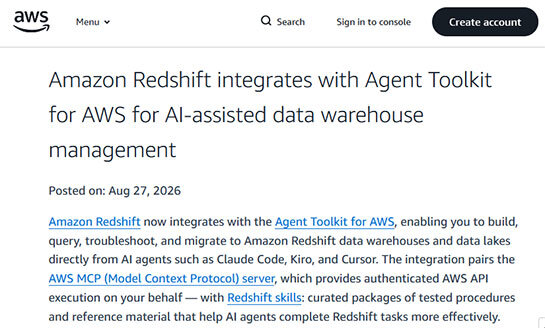
Amazon Web Services (AWS) has integrated its fully managed data warehouse service, Amazon Redshift, with Agent…
Visual Studio Code 1.135 now includes an experimental 'Rubber Duck' feature that lets developers request a sec…
Sonos announced a new app update with generative AI features, a new soundbar called the Beam Ultra, and its se…