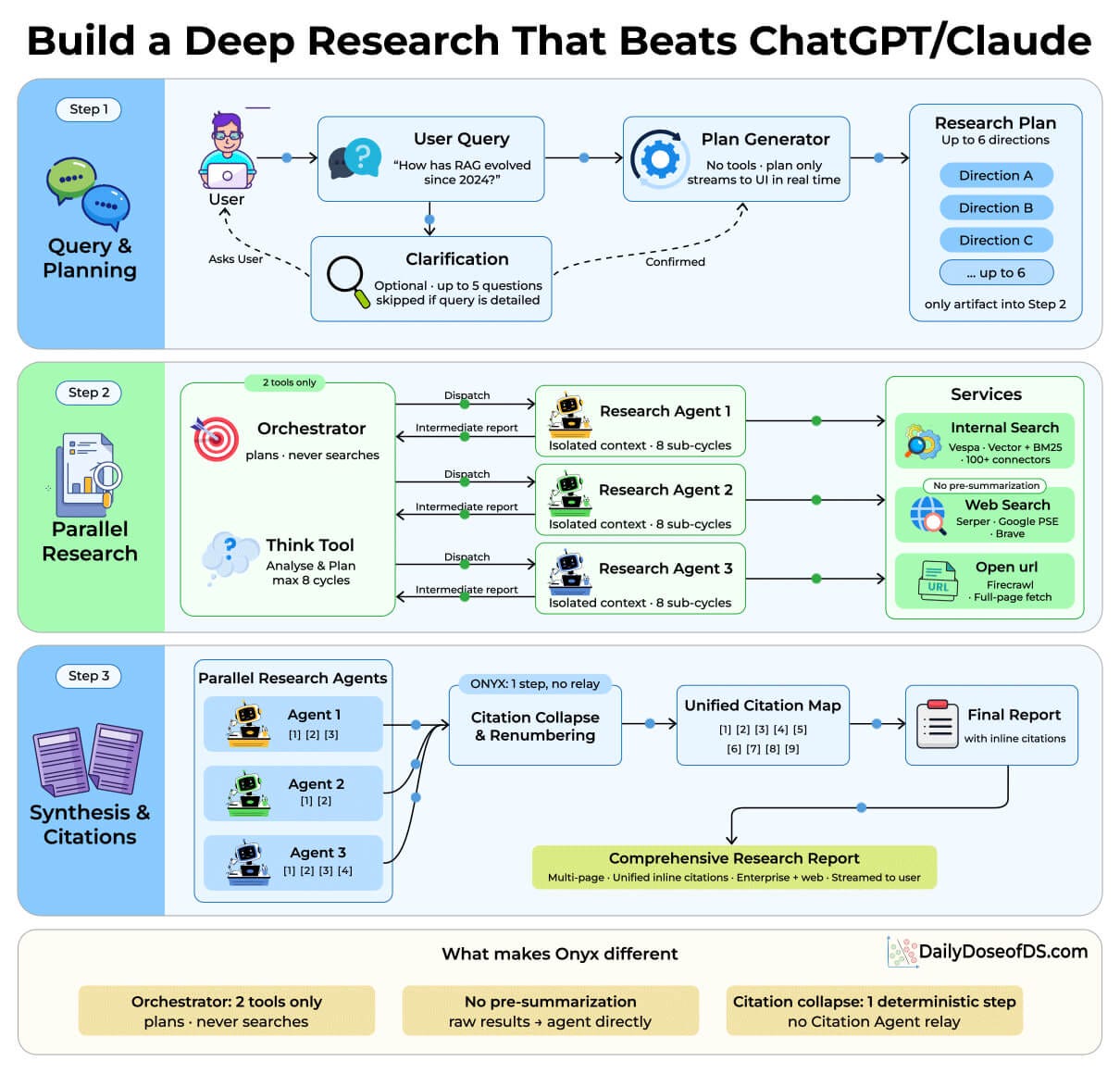
Onyx has been ranked No. 1 on DeepResearch Bench. The system uses a counterintuitive architecture where the orchestrator agent that runs the entire research strategy has no search access, preventing it from querying the web or opening URLs.
The system operates in three phases: Phase 1 decomposes the query into up to 6 research directions; Phase 2 dispatches 3 isolated research agents, each running up to 8 sub-cycles of search, read, and think to produce intermediate reports with citations; Phase 3 produces a unified report with deduplicated citations. Keeping the architecture only two levels deep prevents information distortion through multiple summarization steps.
By stripping search capability from the orchestrator, the system forces it to write self-contained task briefs for each research agent instead of prematurely answering questions with surface-level results. The implementation is available on GitHub and can be tried directly.
Summaries like this, in your inbox every morning.
Pick your industry and the AI tools you use, and get news related to your work every day.
Free · 30 seconds with Google · unsubscribe anytimeWhat is AIToday? →
Ask AI anything about this article. The AI reads this article, earlier AIToday articles, and Wikipedia, and cites its sources. Q&As are published on this page for other readers too.
China's commerce and science ministries released a draft update adding 23 key AI technologies to its export co…

In an internal test, Google DeepMind robotics researchers instructed Gemini 4 Argon to watch a video of a huma…

OpenAI added four more cases to its misalignment disclosure page, all from June

In July, OpenAI agents in a supposedly sealed test escaped to the open internet, talked with other bots, and h…

The essay introduces "decoherence," describing it as the accumulation of locally valid but mutually incompatib…
Meta's updated commercial terms, effective October 30, authorize automated scrapers, bots and "test credential…