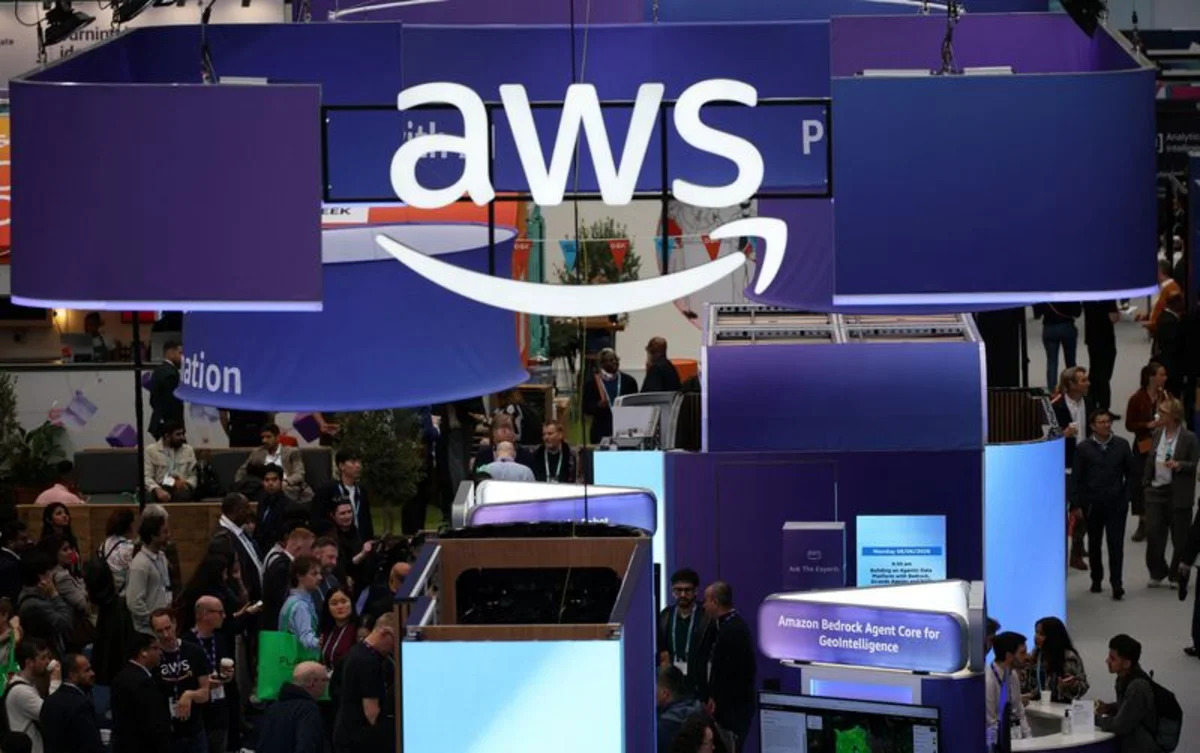
Amazon's stock surged more than 12% after AWS reported 37% revenue growth to $42.2 billion in Q2, beating analyst expectations and signaling strong monetization of the company's AI investments.
The rally contrasted with recent tech peers who have struggled with negative cash flow from rising AI spending, positioning Amazon as a winner in the market's shift toward rewarding companies that convert AI bets into revenue.
However, the company's free cash flow turned sharply negative at $7.6 billion on a trailing 12-month basis, reflecting the capital intensity of the infrastructure buildout.
What happened
Amazon shares jumped more than 12% before the bell on Friday after AWS posted 37% revenue growth to $42.2 billion in Q2, beating analysts' consensus estimate of 31.21% growth. The stock rally put Amazon on track to add about $300 billion in market value, even as the company raised planned capital expenditure to $220 billion.
Why it matters
The market is rewarding Amazon for successfully monetizing its AI investments through AWS demand, contrasting sharply with Alphabet's recent stumble over rising AI-related spending and negative cash flow. CEO Andy Jassy said computing capacity proved insufficient despite the capital spending increase, signaling sustained customer demand. At least five brokerages raised their price targets following the results.
What to watch
Amazon's free cash flow swung sharply negative, burning $7.6 billion on a trailing 12-month basis in Q2, versus $18.2 billion in positive free cash flow a year earlier—a shift driven by AI infrastructure spending. The company's price-to-earnings ratio of 24.67 now exceeds both Microsoft's 22.94 and Alphabet's 19.35, reflecting investor confidence in its AI-driven growth trajectory.
Amazon's second-quarter earnings report on Friday sent the stock soaring more than 12% before the bell, putting the e-commerce and cloud giant on track to add about $300 billion in market value. The driver was AWS, which posted 37% revenue growth to $42.2 billion in the quarter ended June 30—a pace that handily beat the consensus analyst estimate of 31.21% growth according to LSEG data. This marked the company's strongest cloud growth in over four years, and it arrived amid investor concerns that massive AI infrastructure spending across the tech industry could weigh on profitability and cash flows.
Amazon's leadership framed the results as evidence of supply constraints rather than demand weakness. CEO Andy Jassy told investors that demand remained so strong that the company's computing capacity proved insufficient to serve customers despite raising its capital spending to $220 billion—a 10% increase from prior guidance. The company's capacity crunch signals that AWS customers are ordering more AI services than Amazon can currently provision, a problem that typically argues for continued heavy investment but also suggests durable revenue growth ahead.
The market's response to Amazon contrasted sharply with Alphabet's experience the previous week. When Google's parent reported its first negative cash flow stemming from AI-related spending, shares stumbled. At Amazon, investors looked past a similarly troubling swing in free cash flow—the company burned $7.6 billion on a trailing 12-month basis in Q2, compared to $18.2 billion in positive free cash flow a year earlier—and instead celebrated AWS momentum. At least five brokerages raised their price targets on the stock. J.P. Morgan said in a research note: "We're encouraged by the strength in the core AWS business, which has a high correlation with AI revenue, and we expect this relationship to further strengthen over time as more AI workloads move into full-scale production and drive additional demand for core services."
The divergence reflects what market observers call an increasingly "idiosyncratic" environment. According to Jake Behan, head of capital markets at Direxion, "The market is becoming increasingly idiosyncratic, rewarding companies that can successfully monetize AI investments while penalizing those with longer-duration paths to generating returns." Amazon's valuation now reflects this premium: the company trades at a price-to-earnings ratio of 24.67, exceeding both Microsoft's 22.94 and Alphabet's 19.35. Big technology spending on AI is set to exceed $700 billion this year and has pressured free cash flow across the industry, but Amazon has secured investor belief that its AWS business will turn that spending into sustained profit.
Amazon's strong AWS performance on Friday revealed a deepening divide in how the market values artificial intelligence spending. While big technology firms face a collective $700 billion spending surge this year—straining balance sheets across the board—Amazon managed to thread the needle by demonstrating that AWS demand is scaling faster than the capital it must deploy. The 37% AWS growth beat consensus by a comfortable margin, and CEO Andy Jassy's comment that computing capacity remained insufficient despite the spending increase offered powerful evidence that the company is demand-constrained rather than demand-starved.
The contrast with Alphabet's recent stumble is instructive. Both companies are burning enormous sums on AI infrastructure, yet the market treated Amazon's negative free cash flow swing as acceptable (even forgiven it entirely) while penalizing Alphabet for reporting negative cash flow. The difference appears to be one of narrative: Amazon can claim that AWS revenue growth and customer demand outpace its ability to supply capacity, while Alphabet faced questions about when its AI spending would deliver returns. J.P. Morgan's note on the "high correlation between AWS and AI revenue" and the expectation that this relationship would "further strengthen over time" captures the investor thesis: AWS is a proven monetization channel for AI workloads, not a speculative bet.
AI-summarized, only the topics you pick — one digest a day via Email, Slack, or Discord.
Free · takes 30 seconds · unsubscribe anytime
The Monte Jade Science and Technology Association of Taiwan (MJ Taiwan) elected Maverick Shih, chairman of Ace…
ASE Technology Holding has raised its 2026 capital expenditure budget to a record US$10.5 billion, the second…
Apple became the world's most valuable company this month, surpassing Nvidia, which had briefly held the $5 tr…
The world is running short on high-bandwidth memory (HBM), the specialized chips that feed data to AI systems

Microsoft is reframing its artificial intelligence approach, moving away from the goal of building a single be…
Tokyo Electron raised its operating profit outlook for April–September 2026 on July 30, citing continued inves…
The AI news that matters, in one minute each morning.
Sign up free