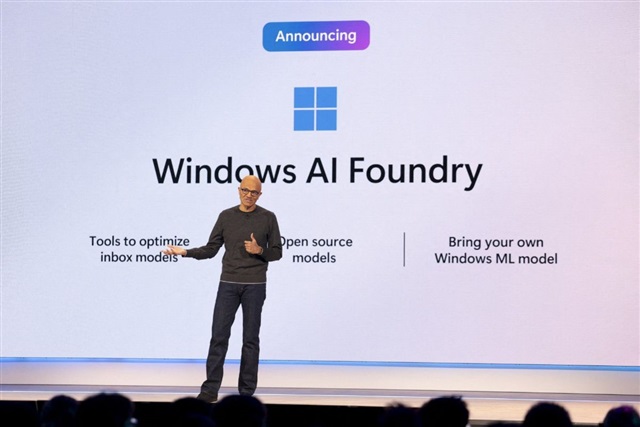
Microsoft is abandoning the strategy of developing a single dominant AI model in favor of positioning itself as a platform where enterprises can choose from multiple models.
This approach potentially expands its addressable market among business customers while hedging against any single AI model becoming the industry standard.
What happened
Microsoft is reframing its artificial intelligence approach, moving away from the goal of building a single best model and instead positioning itself as the platform where customers can choose among many models.
Why it matters
This shift appears designed to broaden Microsoft's enterprise reach while reducing its reliance on any one AI leader—a potentially significant strategic move in how the company competes in the AI market.
What to watch
The success of this platform approach depends on how many models customers actually adopt and whether Microsoft can maintain its competitive position while hosting competitors' solutions.
Microsoft is reshaping its artificial intelligence strategy away from the pursuit of a single dominant model and toward a multi-model platform strategy. Under the old framing, the company's goal was to build or control the single best AI model—a winner-take-most vision that concentrated value in a proprietary technology. The new positioning casts Microsoft as a platform layer: a place where enterprise customers can evaluate, deploy, and manage multiple AI models from different providers, all within a unified environment. This shift carries both strategic advantages and risks. On the advantage side, it dramatically broadens the addressable market. Rather than selling only to customers who prefer Microsoft's own models, the company can now serve any enterprise that wants a stable, integrated cloud environment for AI workloads—regardless of which model provider they favor. It also reduces Microsoft's exposure to the risk that another AI leader (whether OpenAI, a new startup, or the open-source community) will establish unassailable technical or market dominance. On the dependency side, Microsoft becomes less reliant on any single AI provider's continued success or loyalty, insulating the company from shifts in the competitive landscape. The platform approach leverages Microsoft's existing strengths: deep enterprise relationships, Azure cloud infrastructure, integration with productivity software (Office, Dynamics), and the breadth of its developer ecosystem. By making itself indispensable as the operating environment rather than as the model provider, Microsoft aims to secure a durable competitive advantage that outlasts any single model generation.
Microsoft's repositioning reflects a pragmatic realization about the AI market landscape. Rather than betting the company's future on developing or owning the dominant model—a costly and uncertain endeavor—the company is leveraging its existing platform strength (Azure cloud, enterprise relationships, integration depth) to become the vendor-neutral environment where customers deploy whatever AI solutions work best for their needs. This approach hedges Microsoft against the risk that another organization (such as OpenAI, Anthropic, or an open-source collective) will establish a clear technical or market lead that diminishes the value of Microsoft's own models. By hosting and supporting multiple model options, Microsoft maintains switching costs and customer lock-in through integration, tooling, and ecosystem depth rather than through a single technological superiority.
AI-summarized, only the topics you pick — one digest a day via Email, Slack, or Discord.
Free · takes 30 seconds · unsubscribe anytime
The Monte Jade Science and Technology Association of Taiwan (MJ Taiwan) elected Maverick Shih, chairman of Ace…

ASE Technology Holding has raised its 2026 capital expenditure budget to a record US$10.5 billion, the second…

Apple became the world's most valuable company this month, surpassing Nvidia, which had briefly held the $5 tr…

The world is running short on high-bandwidth memory (HBM), the specialized chips that feed data to AI systems

Amazon shares jumped more than 12% before the bell on Friday after AWS posted 37% revenue growth to $42.2 bill…

A Dutch bookseller received an email from a company called 2077AI requesting 3,001 book titles—mostly academic…

The AI news that matters, in one minute each morning.
Sign up free