What happened
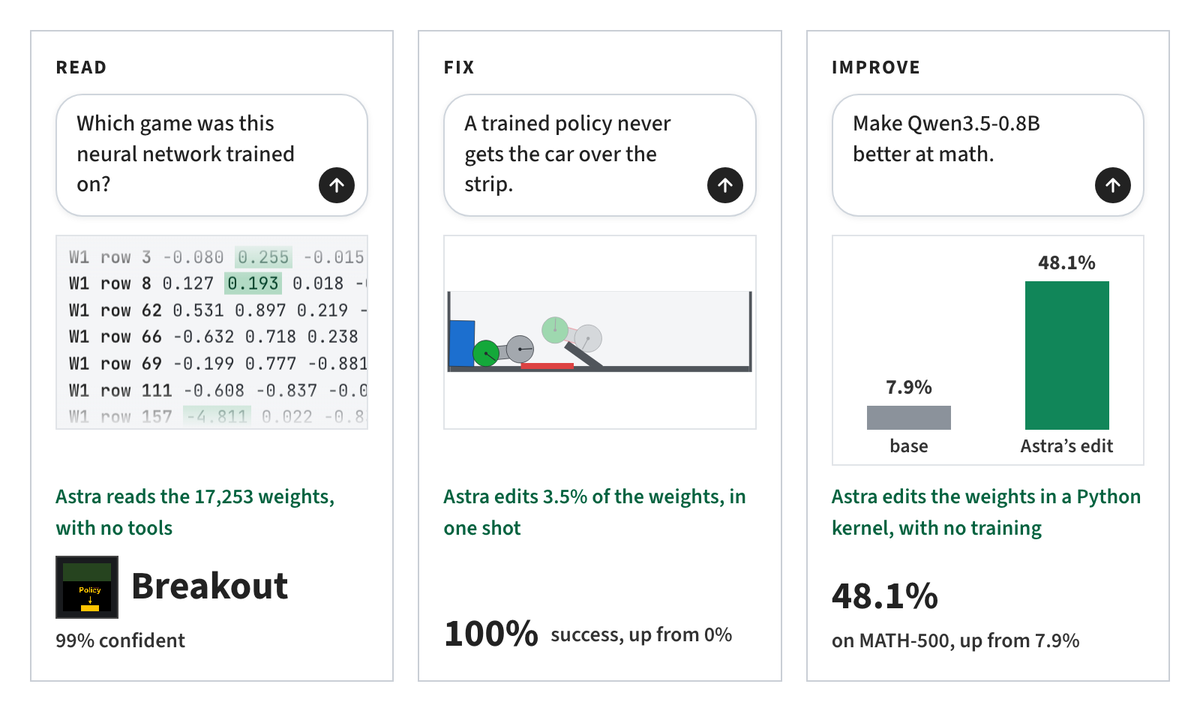
Asked to improve Qwen3.5-0.8B's math without gradients, GPT-6 Astra traced its reasoning loops to the weights and edited 0.016% of them, raising MATH-500 from 7.9% to 48.1% under the same sampling settings.
Why it matters
The same weight correction also generalized to instruction following, tripling IFEval, which suggests reasoning-driven weight edits can fix more than the one targeted behavior.
WHO IT HITSAI model developers and ML engineers who currently rely on gradient-based training and fine-tuning may find a new option for repairing or improving existing models by editing weights directly, per these early results.
Summaries like this, every morning.
The results sit at the end of a long line of work in which LLMs were used to optimize text artifacts like prompts and the programs around them, while neural network weights stayed the domain of symbolic optimizers such as Adam or Muon. The post argues that reasoning-driven optimization is now reaching differentiable networks too: a general-purpose LLM reads and writes a network's weights directly, around a natural-language spec, sometimes with no environment feedback at all.
The experiments build from reading to writing. Astra named the game behind each of four PPO-trained policies from 17,253 raw weights, identified the shape a diffusion model generates from its weights alone, and picked the training language of small transformers from their middle layers, locating the copying heads in all three models. It then fixed a PPO car-on-ramp policy stuck in a local minimum, succeeding in all 1,024 episodes after changing 3.5% of the weights in one try.
The limits are visible too. Asked to identify which of two Gemma 3 270M fine-tunes was sycophantic from weights alone, Astra could not tell across four attempts, though it succeeded once allowed to inspect attention patterns on texts it wrote itself. The post frames the work as early results and argues that neural network weights will soon be natively optimized by LLMs that deliberately reason about them.
Pick your industry and the AI tools you use, and get news related to your work every day.
Free · 30 seconds with Google · unsubscribe anytimeWhat is AIToday? →
Ask AI anything about this article. The AI reads this article, earlier AIToday articles, and Wikipedia, and cites its sources. Q&As are published on this page for other readers too.
Farsight announced that its integration with S&P Capital IQ Pro is now live, available to existing and new Cap…

PhoneArena reports that Verizon's AI customer-service agents are driving away loyal customers, including some…

CEO Marvin Ellison said Lowe's Mylow assistant, built with OpenAI, fields over 1 million questions a month, an…

Amazon said AI agents on the open source Cairn framework, given only a list of IP addresses and the goal of ob…

Wells Fargo's updated online access agreement, dated Nov
At KDDI SUMMIT 2026, executive Akihito Fujii said foundation models now convert text input into the motor para…