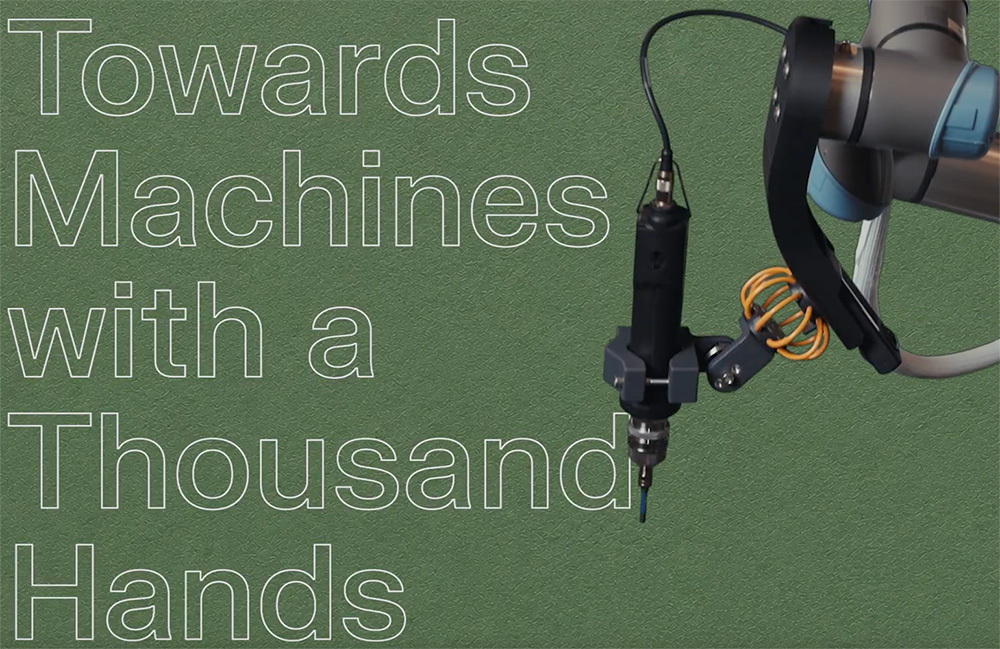
Generalist has extended its GEN-1 foundation model to support multiple robot end effectors by training it to work with different hands. This means a single base model can now learn sensorimotor policies—the motor control skills that translate perception into action—across various robot designs, rather than requiring separate models for each robot type.
Summaries like this, in your inbox every morning.
Sign up free →What happened
Generalist trained its GEN-1 foundation model to work with multiple robot end effectors (hands), allowing a single base model to learn sensorimotor policies across different robot types.
Why it matters
Foundation models that can adapt to various robot hardware reduce the need to build separate models for each robot design, potentially lowering development costs and accelerating deployment of new robotic systems.
What to watch
The ability to generalize across different robot morphologies may shape how roboticists approach hardware-software integration in future systems.
Generalist announced that its GEN-1 foundation model has been extended to support a range of robot end effectors—the hands and gripping mechanisms at the end of robot arms. The company achieved this by training GEN-1 to work with new hands, demonstrating that a single base model can learn sensorimotor policies on different robots. Sensorimotor policies are the learned mappings between what a robot perceives (via cameras and sensors) and the motor commands it sends to its actuators. By extending GEN-1 in this way, Generalist shows that foundation models can abstract over hardware variations, allowing developers to leverage the same pre-trained model across robots with different physical designs rather than building separate, robot-specific models. This flexibility could streamline robotics development and deployment, enabling faster iteration and broader applicability of a single foundation model across a heterogeneous fleet of robots.
Generalist's advancement addresses a long-standing challenge in robotics: the brittleness of models trained on a single robot design. By training GEN-1 to handle multiple end effectors, the company demonstrates that foundation models—large neural networks trained on diverse data—can abstract away hardware-specific details and learn generalizable sensorimotor skills. This follows the broader industry trend of applying foundation-model architectures (proven in language and vision) to robotics, where the same base model can theoretically adapt to different morphologies without retraining from scratch. The implication is that roboticists may be able to deploy and customize robots more flexibly, reducing the engineering overhead that currently ties software tightly to specific hardware.
AI-summarized, only the topics you pick — one digest a day via Email, Slack, or Discord.
Free · takes 30 seconds · unsubscribe anytime
No comments yet. Be the first to share your thoughts!
Log in to join the discussion


Get curated AI news from 200+ sources delivered daily to your inbox. Free to use.
Get Started FreeFree · takes 30 seconds · unsubscribe anytime