What happened
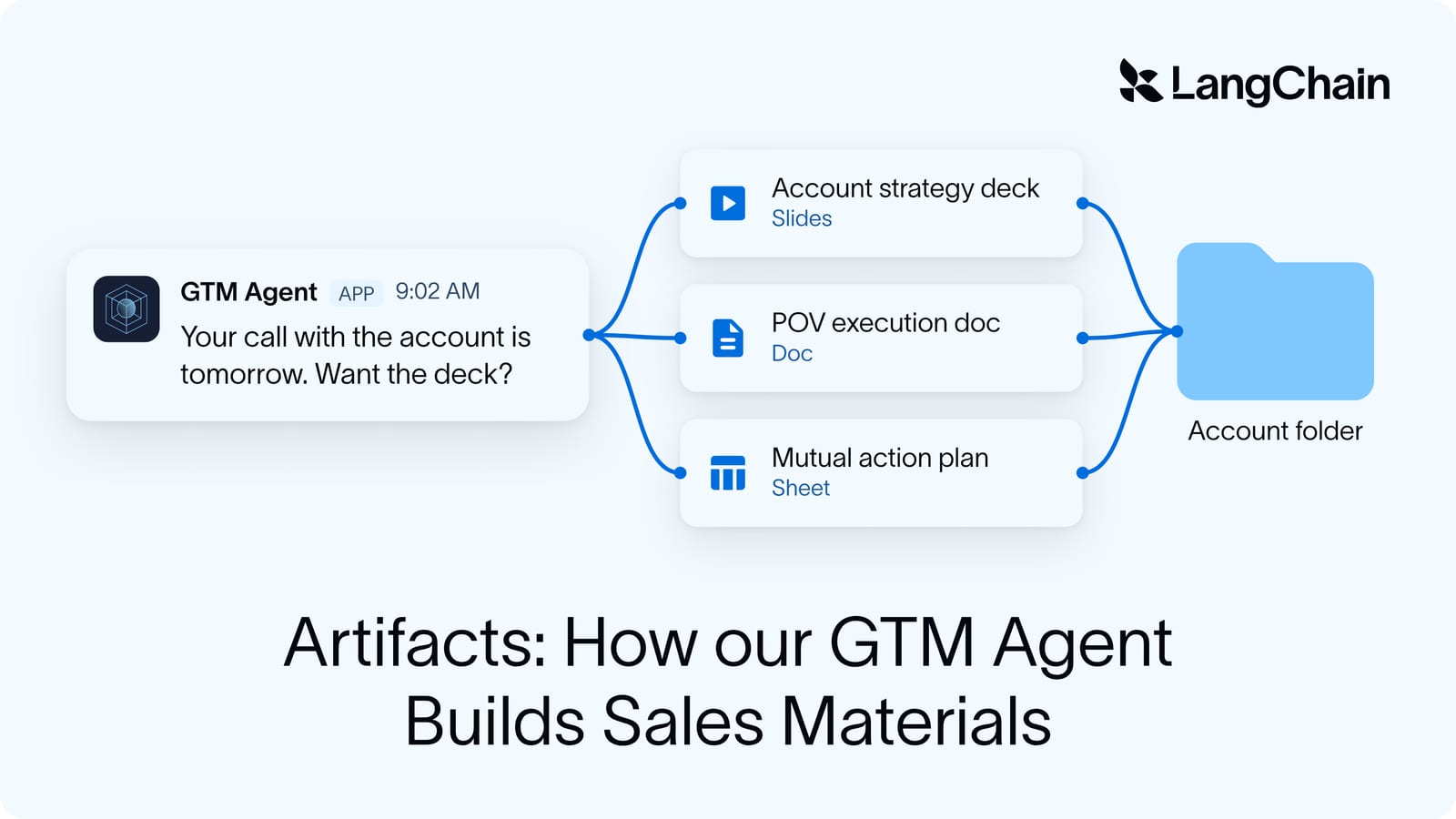
LangChain's GTM Agent generated 1,540 sales artifacts in 12 weeks; 47% of deals with a sent artifact moved to a later stage versus 16% of matched deals without one.
Why it matters
The gap suggests the artifacts are associated with deals advancing, though LangChain notes most gains come from business context built around the model, not the model alone.
Summaries like this, every morning.
LangChain's post is a case study in how much of an agent's value comes from the context wrapped around the model rather than the model itself. The company says it spends very little time on prompts that compensate for the model and instead focuses on capturing how its business runs: process knowledge, customer context from Salesforce and call transcripts, and brand rules baked into the sandbox image. That emphasis shows up in the workflow details, such as leadership-owned templates copied into each account's shared Google Drive folder so every rep gets the latest version.
The hardest part, by LangChain's account, was enforcing a consistent process on every deal. Each stage has gates, like naming an economic buyer or agreeing on success criteria, and when the work was manual a skipped step often surfaced in a pipeline review weeks later. Filing artifacts through the GTM Agent lets it spot a missing one while the deal is still active, and proactive features like pre-meeting briefs and tasks give reps a nudge before a customer call.
LangChain is careful to frame human feedback as the truest signal of quality. It runs weekly meetings with artifact owners, weekly office hours for the sales org, and Slack channels for rep feedback, and it tracks volume, utilization, leverage, and outcomes to check whether generated artifacts actually reach deals. The company says a job can look busy on volume and still go mostly unused, and closing that loop is a focus for the next version of the GTM Agent.
Pick your industry and the AI tools you use, and get news related to your work every day.
Free · 30 seconds with Google · unsubscribe anytimeWhat is AIToday? →
Ask AI anything about this article. The AI reads this article, earlier AIToday articles, and Wikipedia, and cites its sources. Q&As are published on this page for other readers too.
In a Postman column, Akihiko Kusanagi says MCP's July 2026 revision made MCP servers stateless, ordinary HTTP…

Will Knight used GPT-6 Sol, plus Nous Research's Hermes harness and an Nvidia DGX Spark, to train a simulated…

A Reddit user (u/Proud_Prior_6406) shared a ROS 2 agent skill for Claude Code and Codex that bundles QoS check…

Citro Labs released ego lite, a free Chromium-based browser for macOS and Windows

Running ZhuLinsen's daily_stock_analysis locally with Ollama's qwen2.5:7b-instruct, the author found that --dr…

A developer released Worktabs, a personal app for Windows and macOS that starts a code-server per git worktree…