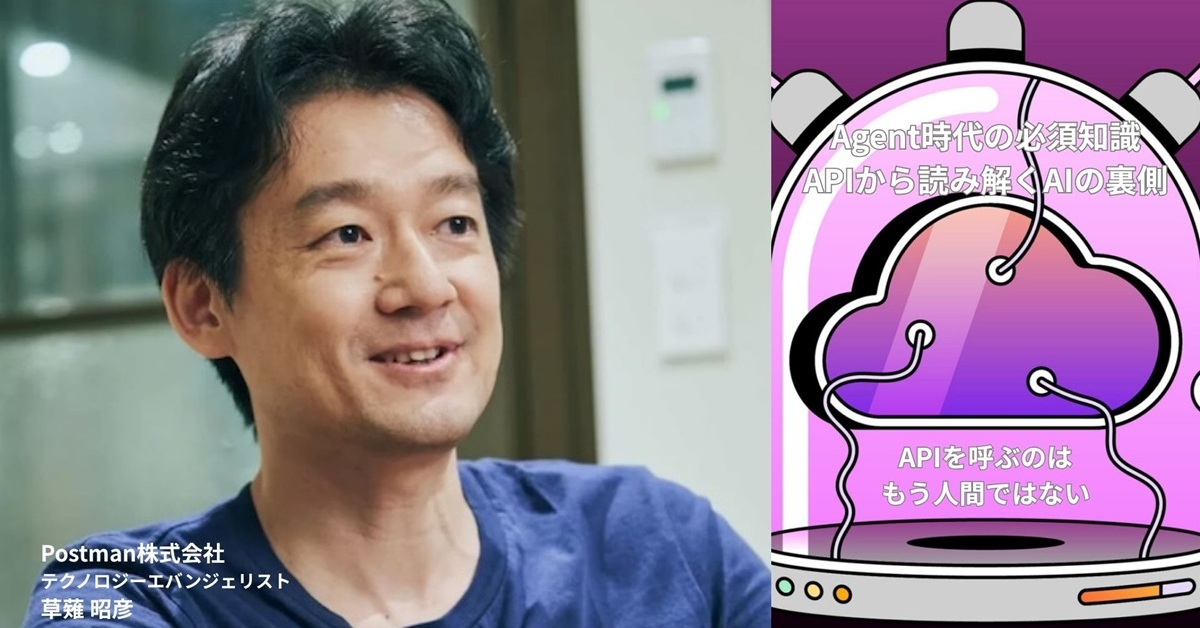
What happened
In a Postman column, Akihiko Kusanagi says MCP's July 2026 revision made MCP servers stateless, ordinary HTTP parts, so tools like Speakeasy, FastMCP and openapi-mcp-generator can generate MCP servers from existing OpenAPI specs without rewriting backend APIs.
Why it matters
That shifts API design from machine-readable specs toward machine-interpretable ones, where agents decide which operation to call, so descriptions must explain what each tool does and when to use it.
Summaries like this, every morning.
The column builds on an earlier installment's point that MCP's July 2026 revision made MCP servers stateless, which the author reframes as MCP ceasing to be a special construct and becoming an ordinary HTTP component that joins the API world. From there, the practical path for enterprises is to start from an existing OpenAPI specification: tools such as Speakeasy, FastMCP and openapi-mcp-generator read that spec and convert endpoints into agent-facing tool definitions, so the backend API does not need to be rewritten.
The author draws a contrast between conventional machine processing and AI. SDK generation follows fixed rules, but an agent interprets the meaning of descriptions and decides which operation to use based on its goal and situation. Kevin Swiber's description of MCP as the "ultimate API consumer" captures this relationship. As a result, a specification that is merely machine-readable is not enough; the descriptions must be refined so an AI can judge what a tool can do and when it should be used.
The column also notes that automatic generation is a convenient starting point but, especially for large APIs, not necessarily production-ready. Authorization and error handling, consolidating multiple endpoints into tools, and crafting descriptions are left for people to handle after generation. Around MCP, the author mentions that MCP Apps was published on January 26, 2026 as the first official MCP extension, and that the July 28, 2026 revision positioned a formal framework for extensions within the specification; related approaches such as Google's A2UI and AG-UI are still being sorted out. The next installment is set to address agentic commerce, where agents call APIs, choose products and complete payments.
Pick your industry and the AI tools you use, and get news related to your work every day.
Free · 30 seconds with Google · unsubscribe anytimeWhat is AIToday? →
Ask AI anything about this article. The AI reads this article, earlier AIToday articles, and Wikipedia, and cites its sources. Q&As are published on this page for other readers too.
Salesforce AI Research released SFR-AutoR&D, agents that form hypotheses, run controlled experiments and keep…

Interactive Brokers launched IBKR Autonomous Trading, which lets eligible clients connect AI platforms to a ri…
KWCH published guidance advising users to keep certain personal information out of AI chatbots to protect thei…

Honeywell Technologies unveiled AI-powered building intelligence, fire and life safety and security upgrades t…

J.P. Morgan Private Bank said it does not currently allow third-party AI agents to access client accounts or a…

Kora Systems, founded by Cyanogen co-founder Kirt McMaster, unveiled a Linux-based AI desktop operating system…