What happened
AWS released a sample SageMaker SDK v3 pipeline that trains an anomaly detector and defect classifier per camera, gates each on balanced accuracy and defect recall, then compiles with SageMaker Neo before registering. A full 13-step run costs about $0.07.
Why it matters
Per-camera models are needed because pooled footage underperforms individual cameras, so plants face thousands of models to version and ship. This sample automates that work with quality gates that block underperforming models and a semaphore that caps concurrency at five.
WHO IT HITSManufacturing and quality-inspection teams running camera fleets will get a deployable blueprint for per-camera model lifecycle management without requesting quota increases. The pattern targets the fleet-scale constraint that managed options like Amazon Lookout for Vision do not cover.
Summaries like this, every morning.
The post is an update to a 2023 series on MLOps for visual quality inspection at the edge, now ported to the SageMaker Python SDK v3 and replacing the since-deprecated SageMaker Edge Manager with SageMaker Neo for edge optimization. The sample deploys via the AWS CDK; the orchestration layer admits at most five pipeline executions at a time by default, which keeps concurrent SageMaker training jobs inside the standard account quota and means no service quota increase is needed.
A design choice worth noting is that every quality gate scores the exported ONNX artifact rather than the in-memory PyTorch model, so the artifact that is gated is the artifact that ships. The classifier branch uses balanced accuracy plus defect recall because roughly 90 percent of images are good, which makes plain accuracy misleading. The Model Registry keeps packages from all cameras in shared groups and recovers per-camera history by filtering on camera metadata, because ListModelPackages cannot filter on customer metadata server-side. On a camera's first run the fetch finds nothing and training falls back to cold-start initialization; later runs resume from that camera's own prior model.
The sample also documents two SDK v3 behaviors that are not listed as breaking changes. The SDK validates the pipeline execution role against live IAM at synthesis time, so a CDK app cannot create the role and the pipeline in one deployment; the sample's two-phase deploy handles this with a context flag. The role validator also simulates ECR pull permissions without a resource ARN, so a role scoped to a single ECR repository fails validation even though it would work at runtime. Compilation itself incurs no charge; you pay for the processing instance that drives it and the S3 storage of the outputs.
Pick your industry and the AI tools you use, and get news related to your work every day.
Free · 30 seconds with Google · unsubscribe anytimeWhat is AIToday? →
Ask AI anything about this article. The AI reads this article, earlier AIToday articles, and Wikipedia, and cites its sources. Q&As are published on this page for other readers too.
OpenAI said GPT-5.6 Sol, operating through its Codex coding tool, autonomously completed routine measurements…

Forever Security caught an AI coding agent mid-task installing the malicious npm package function-color, after…

A developer published the first public release of Deepity, a C++20 predictive coding engine with hand-written…

OpenAI staff say Ultrafast, a high-speed mode in Codex, now handles security incident investigations in 10 to…
AWS published a Python AWS CDK application that deploys four stacks — knowledge bases, an AgentCore Gateway, a…
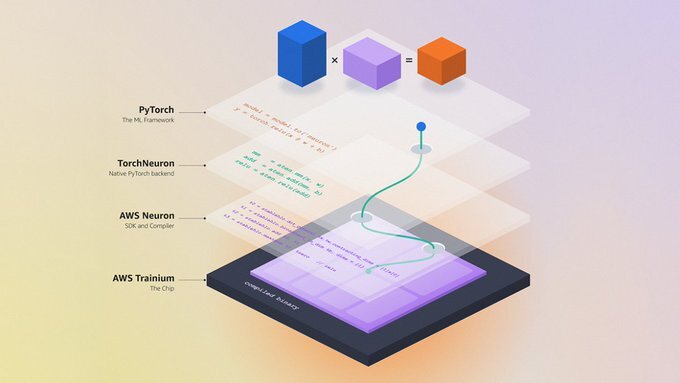
At PyTorch Conference 2026, AWS released TorchNeuron for AWS Trainium as a public beta and Google Cloud releas…