What happened
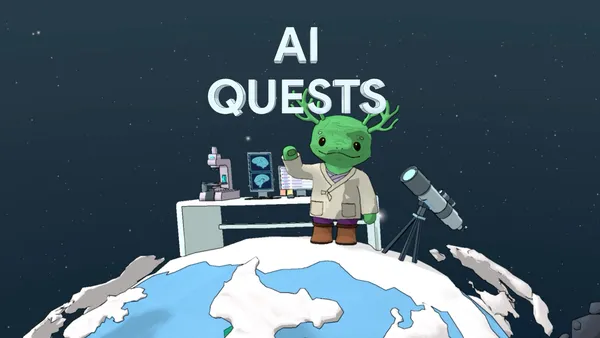
Google Research and the Stanford Accelerator for Learning launched "Polar Peaks," the third AI Quests lesson, where students ages 11 to 14 map neurons and learn that AI requires human oversight.
Why it matters
The quest introduces students to connectomics (mapping neural networks) and is inspired by Google's real-world brain mapping, including the complete fruit fly brain.
What to watch
Teacher training modules for Quest #3 launch next month within the Google AI Educator Series.
WHO IT HITSK-12 educators and students ages 11 to 14 gain a new classroom tool for AI literacy, with teacher training modules rolling out to help fit the quest into existing curricula.
Summaries like this, every morning.
AI Quests is a series created by Google Research and the Stanford Accelerator for Learning to teach students how AI works and how to use it responsibly. The first two quests focused on flood forecasting and eye disease detection, drawing on Google's Flood Forecasting initiative and its AI model for diabetic retinopathy screening. "Polar Peaks" shifts to neuroscience, having students scan and map neurons to understand a game character's memory loss while completing tasks like data cleaning and model testing. The quest draws on more than a decade of Google's connectomics research, and upon completion students hear from two researchers behind real-world breakthroughs, including the recent mapping of the complete fruit fly brain. More than 400,000 quests have been completed to date, localized to 10 languages. Alongside the new lesson, Google is rolling out dedicated teacher training modules within the Google AI Educator Series, with the module for Quest #3 to follow next month. Earlier this year, AI Quests won a 2026 Webby Award for AI Education, Learning & Training, and Best Global K–12 Learning Solution at the ETIH Innovation Awards.
Pick your industry and the AI tools you use, and get news related to your work every day.
Free · 30 seconds with Google · unsubscribe anytimeWhat is AIToday? →
Ask AI anything about this article. The AI reads this article, earlier AIToday articles, and Wikipedia, and cites its sources. Q&As are published on this page for other readers too.
Anthropic's long-awaited IPO document, released Monday, shows more than $400 billion in future obligations for…
Anthropic's S-1 shows more than half of customers spending at least $100,000 a year use both the Claude platfo…
An Apollo Global Management-managed entity will buy Nvidia's next-generation Vera Rubin chips and server hardw…
The RealReal is updating its bot defense system so AI agents like Meta's Muse can no longer log in, add items…

AWS published a guide showing prompt caching for OpenAI models on Amazon Bedrock, with a six-turn GPT-6 Astra…
OpenAI released OpenAI Signals data connecting ChatGPT work messages to 165 work activity categories called In…