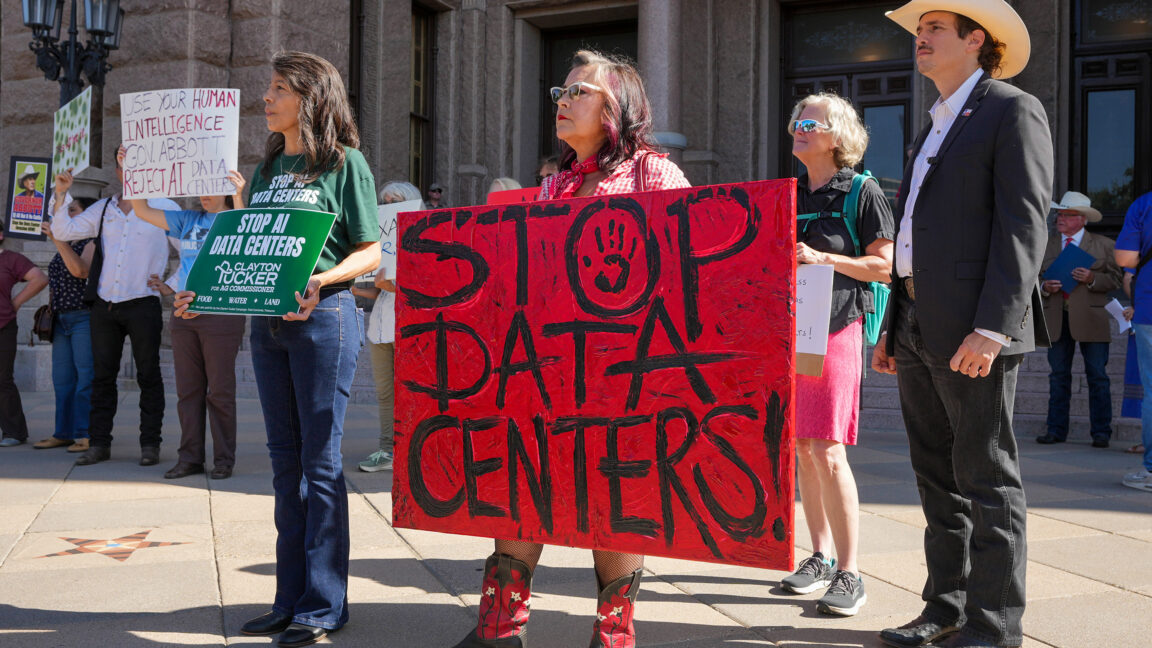
What happened
Texas Governor Greg Abbott issued a directive pausing new data center connections to the state's electrical grid. The pause does not apply to data centers building their own on-site power generation. ERCOT (the grid operator) has postponed its planned "Batch Zero" process—notifications for the first group of data center projects approved to connect—while it works with state regulators to carry out Abbott's directive.
Why it matters
Data centers powering AI systems are straining Texas's electricity supply at a time when the state is already managing peak demand. Abbott's directive requires increased scrutiny of noise, light, traffic, and community protection measures, but notably omits oversight of air pollution and greenhouse gas emissions—a gap AI companies have exploited by installing gas-powered turbines and diesel generators via local permit loopholes without full environmental review.
What to watch
Texas leads all US states with 40 gigawatts of announced behind-the-meter (on-site) power capacity for data centers. Major tech and AI companies—Meta, Microsoft, Amazon, Oracle, OpenAI, and Anthropic—are increasingly relying on alternative power sources like mobile gas generators and aeroderivative turbines, rather than waiting for grid connections, to avoid the moratorium.
Summaries like this, in your inbox every morning.
Texas's data center boom has collided with grid capacity constraints, forcing state regulators to take action. Governor Abbott's pause on new grid connections reflects mounting pressure on ERCOT, which had been planning to onboard data center projects in batches—a strategy now on hold. The timing is significant: ERCOT had planned to notify the first approved group ("Batch Zero") by the end of the week, but Abbott's directive requires the grid operator to pause that process and align with state oversight measures.
Crucially, the moratorium includes a major loophole: data centers that generate their own power on-site bypass the pause entirely. This exception has created a perverse incentive. Rather than wait for grid capacity, major AI and cloud companies—including Meta, Microsoft, Amazon, Oracle, OpenAI, and Anthropic—are racing to build on-site power infrastructure. CleanView's research shows this trend is widespread. Texas's dominance in announced behind-the-meter capacity (40 gigawatts nationally) reflects both the state's abundant natural gas supply and its historically light regulatory touch.
The regulatory gap is stark. Abbott's directive mandates scrutiny of community impacts—noise, light, traffic, emergency response—but explicitly omits air quality and greenhouse gas emissions. Nonprofit newsroom Floodlight has documented how AI companies have exploited local permit loopholes to install gas-powered turbines and diesel backup generators without triggering more rigorous environmental review or community outreach. This oversight creates a situation where the fastest path to power bypasses the cleanest environmental accountability.
Pick your industry and the AI tools you use, and get news related to your work every day.
Free · 30 seconds with Google · unsubscribe anytimeWhat is AIToday? →
Ask AI anything about this article. The AI reads this article, earlier AIToday articles, and Wikipedia, and cites its sources. Q&As are published on this page for other readers too.
Hewlett Packard Enterprise stock is down 5% at $55.87

The Motley Fool argues Amazon is the AI company of the two, since AWS was just 21% of first-half 2026 revenue…

Vercel data published Thursday shows TypeSafe AI's Jev, a lightweight decision model for choosing among predet…

Chunghwa Telecom president Rong-shy Lin said the shift from conversational AI to autonomous AI agents is resha…
CoreWeave fell 5% in premarket trading Friday and was on track to finish the week down 15%, after rebounding f…
Apple and Meta said they would jointly release a new open-weight AI model designed to run on high-end Macs, ai…