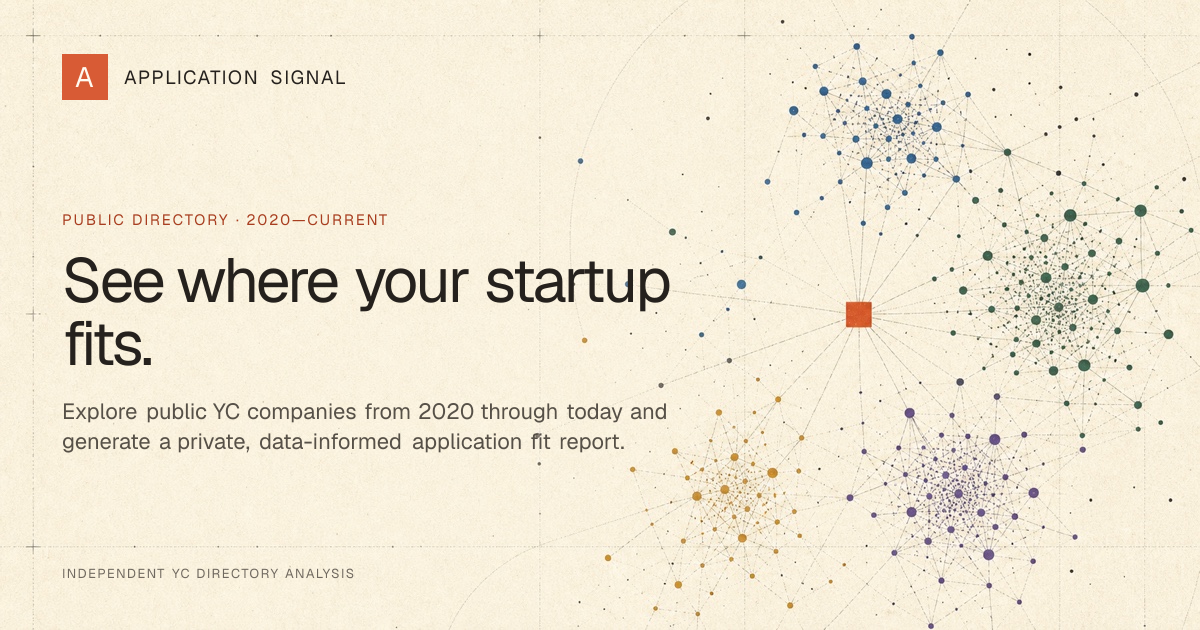
Application Signal is an AI analysis tool that compares your startup business plan against Y Combinator companies dating from 2020 to the present. You upload a PDF of your plan, and the tool maps your idea on a visual grid showing similar companies and their profiles, based on publicly available YC directory data and transparent algorithmic analysis. The report is private and evidence-led, offering practical feedback rather than a pass/fail verdict.
Summaries like this, in your inbox every morning.
Sign up free →What happened
A tool called Application Signal has launched that analyzes startup business plans and compares them to Y Combinator companies from 2020 onward using AI-driven pattern analysis. Users upload a PDF plan, approve the analysis, and receive a private visual report showing how their idea fits relative to existing YC companies on a mapped grid.
Why it matters
The tool makes YC's historical company data transparent and searchable for entrepreneurs. Rather than a binary accept/reject prediction, it surfaces similar companies and their characteristics, helping founders understand market positioning and business model patterns that have worked in YC's portfolio—without claiming to predict funding success.
What to watch
The tool is independently maintained and versioned separately from YC itself, meaning search updates do not silently change existing scores. Industry, batch, location, target market, and AI linkage are all derived from public YC directory records and transparent rule-based inference, so users can see how their plan was evaluated.
Application Signal is a web-based research tool that uses AI pattern analysis to evaluate startup business plans against a dataset of Y Combinator companies. The dataset spans from 2020 to the present day and includes publicly available information from the YC directory.
Here is how it works: users sign in, upload a selectable-text PDF containing their business plan, and approve the analysis. The tool then maps the plan onto a visual grid called the "map," where each dot represents a public YC company. The layout is determined by learned normalized coordinates on the X and Y axes—not individual business metrics or scores. Proximity on the map indicates similarity: companies near each other have similar business model profiles. The tool derives industry, batch, location, and company descriptions from the public YC directory, and uses transparent rule-based inference to infer target market and AI linkage to make the map easier to explore.
Users receive a private visual report showing their startup's position on the map relative to similar companies, along with practical improvements suggested by the analysis. The creators emphasize that the tool does not offer a verdict or predict acceptance probability. Instead, every score is framed as a comparison—helping founders see which existing YC companies share similar characteristics and what that reveals about their market positioning.
Application Signal is an independent research project, not an official Y Combinator product. The active fit model is separately versioned, ensuring that search updates or algorithm changes do not silently alter scores for analyses already completed. This separation allows the tool to evolve while preserving the integrity of past reports. Founders can contact the creators to report issues or ask questions about the analysis methodology.
Application Signal fills a gap between raw YC portfolio data and actionable founder intelligence. The tool takes the company directory that YC has published—covering all batches from 2020 onward—and uses AI to extract business model patterns, industry clusters, and target market signals. Rather than offering a black-box prediction of funding likelihood, it grounds each founder's idea in concrete comparison: you see which existing companies share similar characteristics, where they sit on the map (proximity = similarity), and what that positioning reveals about market saturation, model viability, or untapped niches.
The design emphasizes transparency. The creators explicitly note that scores are comparisons, not verdicts; that industry, batch, location, and AI linkage are rule-based and inspectable; and that the tool is separately versioned so old analyses do not silently shift as the underlying model updates. This contrasts sharply with opaque ML scoring systems and reflects a deliberate choice to help founders understand the logic rather than trust a number. The report itself is private, avoiding the awkwardness of public ranking while still surfacing peer benchmarks.
AI-summarized, only the topics you pick — one digest a day via Email, Slack, or Discord.
Free · takes 30 seconds · unsubscribe anytime
No comments yet. Be the first to share your thoughts!
Log in to join the discussion





Get curated AI news from 200+ sources delivered daily to your inbox. Free to use.
Get Started FreeFree · takes 30 seconds · unsubscribe anytime
1 minute a day. The AI essentials.
200+ sources · Email / LINE / Slack
