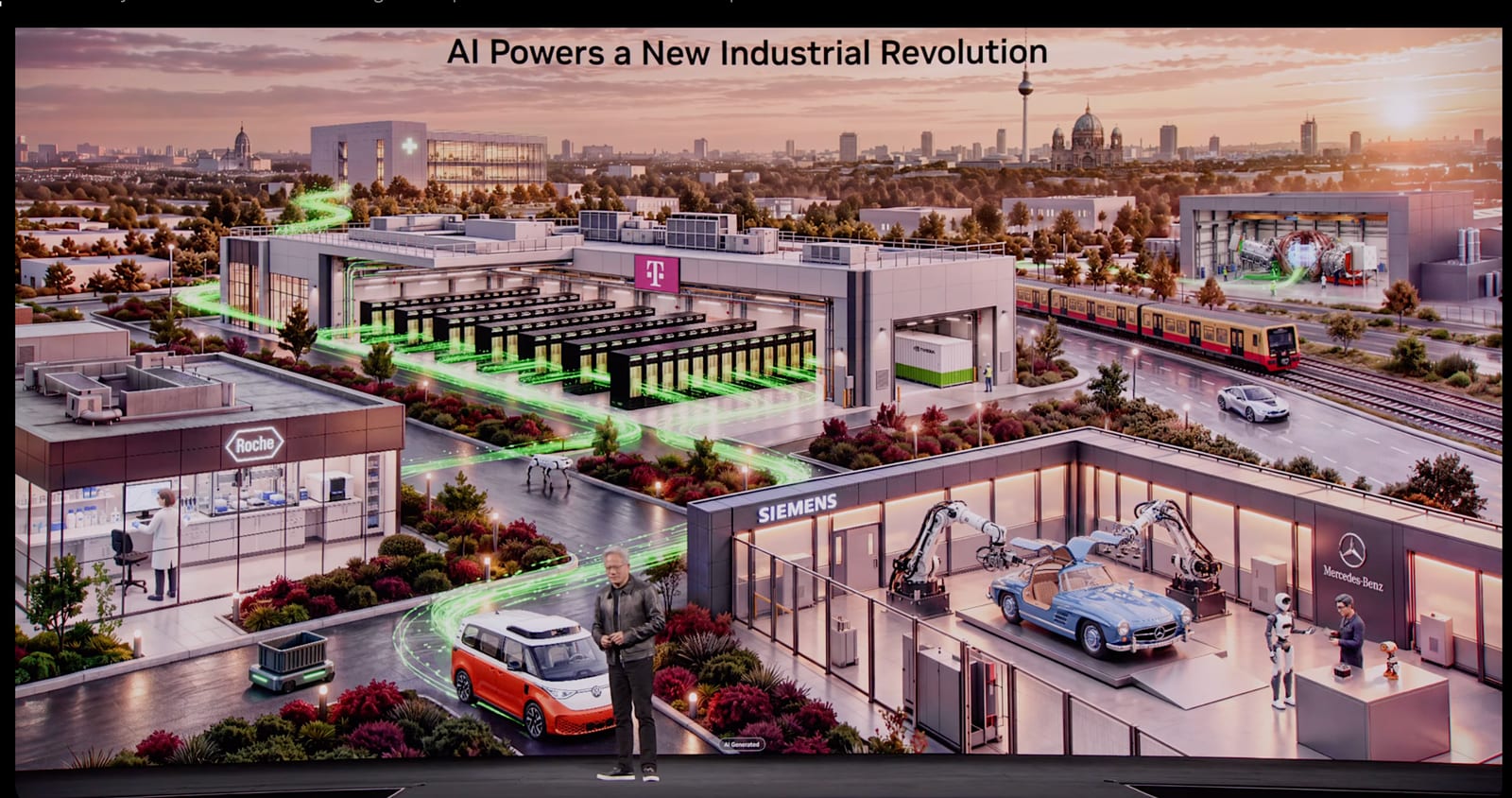
What happened
At GTC Berlin, Jensen Huang introduced DSX POD — seven Vera Rubin NVL72 racks per container — and said deployment at a prepared site drops from six months to as little as 14 days. He also launched the OpenShell Reference Architecture and Kumo structured-data models.
Why it matters
By shipping pre-cabled, pre-tested AI factories, Nvidia is selling the operating model for AI, not just the chip — targeting hundreds-of-megawatts sites where operators have power but lack time for full builds, though grid interconnect queues remain.
WHO IT HITSEuropean neoclouds, sovereign AI projects and telcos — operators with a site and power but no time for a full land-and-shell build — are the clearest near-term buyers of DSX POD, with delivery set for early 2027.
Summaries like this, in your inbox every morning.
For most of the past half-decade, Nvidia's story has been about the GPU itself — who gets allocation and how much faster the next generation runs. At GTC Berlin, Jensen Huang spent surprisingly little of his keynote on silicon, arguing instead that AI constraints have moved to deployment speed, power, security and putting enterprise data to work. That framing ties together the Berlin announcements from containerized factories to agent security tools, showing Nvidia moving from selling the most important component in AI to selling the operating model for AI.
The DSX POD packaging reflects a specific economic concern Huang laid out on stage: a gigawatt AI factory costs about $50 billion and should generate roughly $40 billion in annual revenue, so a quarter's delay costs about $10 billion. The cost that keeps builders up at night is no longer hardware price but hardware sitting idle while crews pull cable. DSX POD shifts that long pole by pre-cabling and testing racks before shipment, though it does not remove grid interconnect queues. The sweet spot is the hundreds-of-megawatts tier, where operators have a site and power but lack the permitting runway for a full build — exactly where Europe's neoclouds, sovereign AI projects and telcos operate.
Beneath the pod, Nvidia's DSX platform adds warm-water cooling, power direction and DSX Flex, which automates the interaction between grid operators and data centers. On the agent side, Huang described agents as five-part systems needing minimal privileges and constant monitoring, and argued no model can be trained to understand every business's policy requirements — hence deterministic controls enforced outside the model. Nvidia also said physical AI revenue reached nearly $11 billion in the first half of 2026, about 30% higher than all of last year, a figure that supports its case that the technology is now good enough for companies without in-house robotics teams.
Pick your industry and the AI tools you use, and get news related to your work every day.
Free · 30 seconds with Google · unsubscribe anytimeWhat is AIToday? →
Ask AI anything about this article. The AI reads this article, earlier AIToday articles, and Wikipedia, and cites its sources. Q&As are published on this page for other readers too.
AI and high-performance computing are pushing PCBs toward higher layer counts and denser, higher-performance m…

Vice President Hsiao Bi-khim opened the 27th TPCA Show 2026 in Nangang on October 20 and urged the PCB industr…

Opposable launched an AI agent that operates Android phones via accessibility services and iPhones through a c…

Vertiv and NVIDIA launched an AI factory framework at NVIDIA GTC Berlin, targeting up to 30% higher cumulative…
On Meta's third quarter earnings call, CEO Mark Zuckerberg said the company has a goal of serving billions of…

Meta plans new non-voting stock, people familiar said, possibly announced as soon as Wednesday when it reports…