What happened
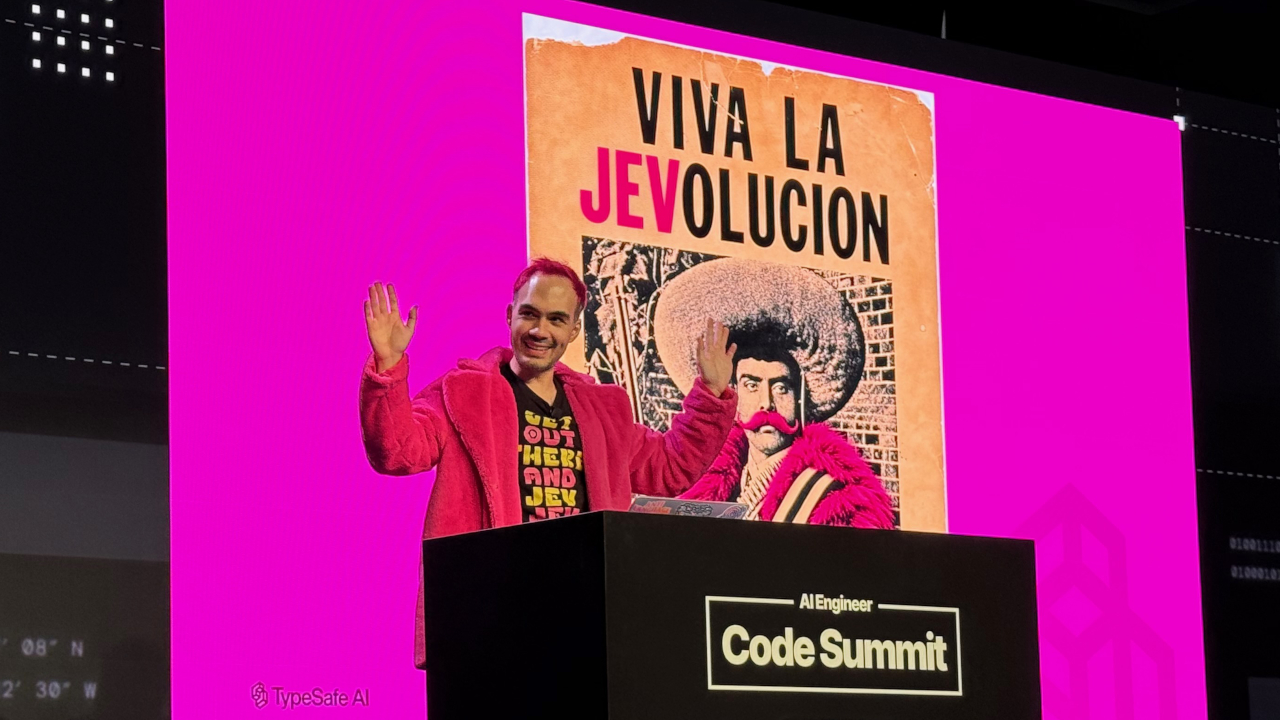
At the AI Engineer Code Summit, TypeSafe AI CEO Diogo Almeida called Jev "reliable intelligence" and urged engineers to integrate system one models directly into application code.
Why it matters
Almeida argues that code is the language of automation, so making software smarter means calling these fast, non-generative models from inside application code rather than building ever more convoluted LLM pipelines, which he says are not always reliable.
Summaries like this, every morning.
Jev was released in September and quickly became a popular topic among AI engineers, with a Latent Space podcast episode about its launch becoming the show's most popular of the year. Almeida's keynote built on the reliability problem he discussed then: making LLMs the heart of software can produce inconsistent results, and he argues system one models offer a more dependable foundation for automation.
The summit presentations showed that message being put into practice. Glean's Chinmay Goyal said Jev is used alongside LLMs and other classifiers and is especially suited for zero-shot flexibility, so teams avoid constant fine-tuning as decision spaces change. UiPath's Chibi Vikram and Kevin Bernstein described Jev as a building block they can adjust, and their document-chunk ranking tournament completed in under a second even with thousands of Jev calls. Workday's Scott Roberts showed a prototype that fills in a time-off card while the user is still typing, which he described as going from predicting what you want to say to predicting what you want to do.
Almeida closed by comparing the moment to the early internet, predicting an explosion of what software can do as engineers explore new boundaries, not necessarily because it is valuable but because they can.
Pick your industry and the AI tools you use, and get news related to your work every day.
Free · 30 seconds with Google · unsubscribe anytimeWhat is AIToday? →
Ask AI anything about this article. The AI reads this article, earlier AIToday articles, and Wikipedia, and cites its sources. Q&As are published on this page for other readers too.
millionways launched Thorsten-4, an AI model built from a German research project in which dozens of psycholog…

Databricks released the Genie app for Slack to General Availability, so users can @mention Genie or DM it and…
Google, Samsung, Gentle Monster, and Warby Parker opened preorders for AI smartglasses with no screen, startin…

Naver said on November 12 it signed a KRW2 trillion (approx

In a Stratechery interview, CEO David Baszucki said AI is transforming Roblox into a platform where 'literally…

Since 2021, Apollo has provided and arranged more than $15 billion of debt for SoftBank across multiple deals…