What happened
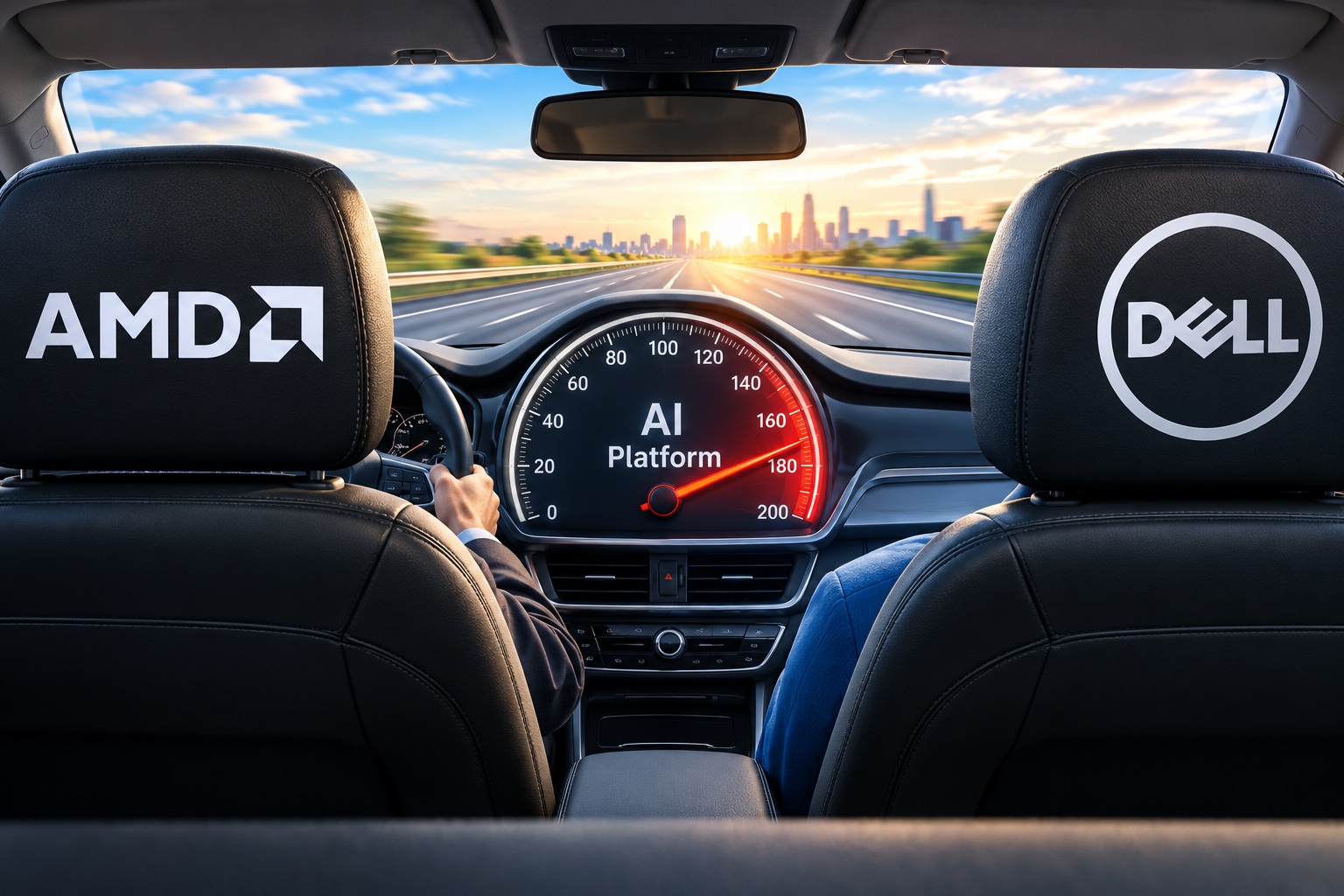
Dell integrated AMD's ROCm software stack into the Dell AI Platform with AMD, combining Instinct accelerators, EPYC processors, PowerEdge servers, PowerSwitch networking and PowerScale storage for on-premises model training and inference.
Why it matters
Customers can start with small composable units and expand on the same validated infrastructure, which Dell says avoids rearchitecting as AI workloads grow.
What to watch
Dell will support AMD Instinct MI350P PCIe GPUs in PowerEdge XE7745 and R7725 servers beginning in July.
WHO IT HITSEnterprise IT teams running on-premises AI infrastructure gain a pre-validated, modular option that lets them scale compute and GPU density without redesigning their data centers.
Summaries like this, every morning.
Dell and AMD have been deepening their collaboration since the Dell Technologies World event in May, positioning themselves to compete across CPUs, GPUs, rack-scale systems, memory capacity, network bandwidth and tokens per dollar. A central piece of that effort is server consolidation: as agentic AI drives demand for general-purpose compute, Dell says AMD-powered systems can fold 13 servers from its 14th PowerEdge generation into one, delivering 70% gen-over-gen performance gains. Dell's three-rack-unit server also requires less power for cooling than a two-unit equivalent, allowing more computing power per rack.
The integration of AMD's ROCm software stack into the Dell AI Platform with AMD extends this modular approach to software, letting customers begin with smaller deployments and expand on the same infrastructure. Dell has also announced support for AMD Instinct MI350P PCIe GPUs in PowerEdge XE7745 and R7725 servers beginning in July; the MI350P offers 144 gigabytes of HBM3E memory, which AMD's Mike Darby says can be a key differentiator for inference performance. AMD's PCIe-based GPU supports air-cooled deployments, providing a path to deploy AI within existing data center infrastructure as some enterprises remain unprepared to adopt liquid cooling.
Beyond joint product announcements, Dell and AMD in June announced a partnership with the University of Cambridge to establish a Sovereign AI Innovation Lab in the United Kingdom, building on Cambridge's Zenith AI supercomputer powered by fifth-generation AMD EPYC processors and AMD Instinct MI355X GPU accelerators integrated into Dell infrastructure. They have also collaborated on a telecom initiative with AT&T, whose OTel 2.0 training infrastructure uses Dell's PowerEdge XE9785 server configured with eight MI355X GPUs.
Pick your industry and the AI tools you use, and get news related to your work every day.
Free · 30 seconds with Google · unsubscribe anytimeWhat is AIToday? →
Ask AI anything about this article. The AI reads this article, earlier AIToday articles, and Wikipedia, and cites its sources. Q&As are published on this page for other readers too.
Anthropic raised about $81.3 billion in its Nov

Taiwan's Financial Regulatory Commission announced five measures to stabilize the securities market, including…

Machina Labs unveiled Machina Rebellis at its Chatsworth, California facility, using robotics, AI and digital…
Vectigo launched the Vectigo Platform, solar-powered POD sensor units installed flush with the road surface, w…

Altimeter's Brad Gerstner said applying a 10x multiple to 2028 numbers gets Anthropic to about $3 trillion in…

Following Jensen Huang's ouster as Nvidia CEO, investor Bill Birmingham of REX Financial said the successor in…